Australia Sydney + Great Barrier Reef
11DFrom ₹2,85,000
A 5-day premium trip to Nuku'alofa, Tonga, taking in Ha'amonga 'a Maui trilithon, Royal Palace, Mapu 'a Vaea blowholes and Pangaimotu Island.
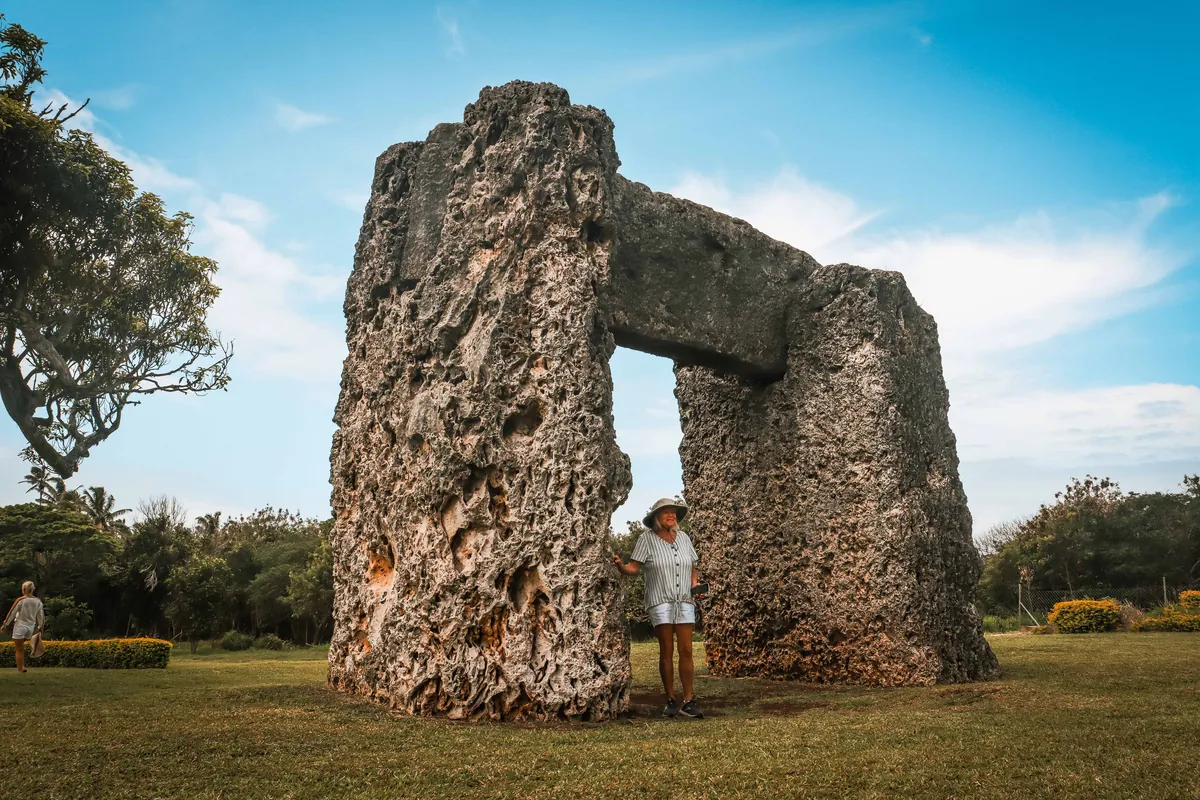
Tongatapu & Nuku'alofa Heritage opens at Haʻamonga ʻa Maui, a coral limestone trilithon on the eastern side of Tongatapu in the village of Niutōua, sometimes called the "Stonehenge of the Pacific." Built from three slabs — two uprights each weighing an estimated 30 to 40 tons and standing 5.2 metres high, joined by a 5.8-metre lintel set into deep mortises — historical analysis dates its construction to around 1200 AD under Tuʻitātui, the eleventh Tuʻi Tonga, who is thought to have raised it as a gateway to the royal compound at Heketā in honour of his two sons, represented by the paired uprights and their bond by the lintel above. Tradition instead credits the demigod Maui with carrying the stones from ʻUvea Island by canoe, and in 1967 King Tāufaʻāhau Tupou IV proposed that a V-shaped mark on the lintel aligns with sunrise at the solstices and equinoxes, a claim later disputed by astronomer C. F. Velt as too short a mark to reliably indicate direction. Nearby stands the ʻEsi maka faakinanga, a stone throne against which a seated king could guard his back from surprise attack; the monument and its surroundings became a protected national park in 1972.
The route continues to the Royal Palace in Nuku'alofa, a wooden building completed in 1867 that remains the official residence of the King of Tonga, standing close to the Pacific shoreline in the northwest of the capital. Not open to the public but visible from the waterfront, the palace is treated with such deference that Tongan poets traditionally avoid naming it directly, instead using allegorical references such as Fanga-tapu, "sacred beach," for the shoreline in front of it. Its original metre-high stone perimeter fence was once considered too sacred to sit on or cross; King Tāufaʻāhau Tupou IV replaced it with a three-metre grid fence after 1990, and iron bars were added to the gates after intruders broke through them by truck sometime after 2000.
From the capital the trip reaches Mapu a Vaea, a five-kilometre chain of natural blowholes near the village of Houma on Tongatapu's coast, formed from hundreds of channels carved through a mix of former volcanic tubes, limestone and coral rock by thousands of years of wave pressure. Struck by incoming swells, the channels compress and force seawater upward — sprays from some reach 18 metres into the air, and from others as high as 30 metres, sometimes catching enough light to form rainbows. The name, meaning "Whistle of the Noble," refers to the nearby Vaea family of chiefs and to the sound the blowholes are said to resemble: the whistle of a high-ranking Tongan chief.
The route closes on Pangaimotu, a small island reached by a ten-minute boat trip from Nuku'alofa, its reef declared a national marine reserve in 1989. Beyond its beaches, the island's best-known feature is the upturned hull of a shipwreck about 50 metres offshore, used today for wreck jumping, alongside the Big Mama Yacht Club, the Pangaimotu Island Resort and a vanilla plantation; the island also holds a place in Tongan religious history as the site where the first Catholic mass in the kingdom was celebrated under a tree on 2 July 1842 by Jean Baptiste Pompallier and Father Chevron — a fitting close to a five-day route spanning Tongatapu's ancient stone monument, royal capital and coastal landmarks.
Text adapted from the linked articles under CC BY-SA 4.0; edited for length.
Every dimension the Taro team tags this pack with — filter by any of these on the packs page.
Share your travel month, group size, budget comfort, and must-do experiences. The Taro team will shape the right route before any payment conversation.