heritage
Rome
Colosseum, Vatican City, Sistine Chapel, Trevi Fountain, Pantheon, and pasta carbonara where it was invented.
Italy, officially the Italian Republic, is a country in Southern and Western Europe consisting of a peninsula extending into the Mediterranean Sea, with the Alps along its northern land border and nearly 800 islands, most notably Sicily and Sardinia. It shares land borders with France to the west, Switzerland and Austria to the north, Slovenia to the east, and the enclaves of Vatican City and San Marino, and is the tenth-largest country in Europe by area, covering 301,340 square kilometres, with nearly 59 million inhabitants. Rome is the capital, with other major cities including Milan, Naples, Turin, Palermo, Bologna, Florence, Genoa, Bari, and Venice.
Italy's history traces back to numerous Italic peoples, notably the ancient Romans, who conquered the Mediterranean world under the Roman Republic and ruled it for centuries as the Roman Empire. Rome itself, a settlement on the River Tiber founded in 753 BC, was governed under a monarchical system for 244 years until the Romans expelled the monarchy in 509 BC and established an oligarchic republic under the Senate and the People, SPQR. The Italian Peninsula, named Italia, was consolidated during Roman expansion at the expense of Etruscans, Celts, Greeks, and other Italic tribes, and Rome went on to conquer Western Europe, North Africa, and the Middle East; after Julius Caesar's assassination in 44 BC, Rome grew into an empire stretching from Britain to the borders of Persia. Italy's architectural history runs through the ancient Roman construction of arches and domes, the Christian basilica style invented in Rome that came to dominate the Middle Ages, and the Romanesque architecture that flourished from roughly 800 to 1100 AD, before Italy went on to found the Renaissance architectural movement in the late 14th to 16th centuries and to develop Palladianism, a style that later influenced country house design across the UK and US into the early 20th century.
Italy sits in Southern Europe between latitudes 35° and 47° N, bordered to the north, from west to east, by France, Switzerland, Austria, and Slovenia, roughly delimited by the Alpine watershed that encloses the Po Valley and the Venetian Plain. Its territory comprises the entire Italian Peninsula along with Sicily and Sardinia, the two largest islands in the Mediterranean, plus many smaller islands, covering 301,230 square kilometres, of which 294,020 is land and 7,210 water. Including its islands, Italy has a coastline of 7,600 kilometres along the Mediterranean, Ligurian, Tyrrhenian, Ionian, and Adriatic seas.
Italian cuisine draws on Etruscan, ancient Greek, ancient Roman, Byzantine, Arabic, and Jewish culinary traditions, reshaped significantly from the 18th century onward as New World foods such as potatoes, tomatoes, and maize became staple ingredients. Built on the Mediterranean diet, it centres on pasta, fish, fruit, and vegetables, and is known for simplicity and regional variety, with many dishes built from only four to eight ingredients. Italian cooking relies heavily on traditional products, and the country has a large number of specialities protected under EU law, alongside 395 Michelin-starred restaurants.
Cheese, cold cuts, and wine sit at the centre of Italian cuisine, with regional variations and products protected under designation-of-origin schemes across the country. That regional pattern echoes the country's wider geography, where the Alpine north, the Po Valley, the long peninsula running down through Tuscany and Rome, and island territories such as Sicily and Sardinia each carry distinct culinary and architectural traditions bound together within a single, comparatively narrow national territory.
Text adapted from the linked articles under CC BY-SA 4.0; edited for length.
Book Vatican & Uffizi tickets online weeks ahead to skip lines
A quick visual sense of the landscapes, stays, and atmosphere your itinerary can be built around.
Colosseum, Vatican City, Sistine Chapel, Trevi Fountain, Pantheon, and pasta carbonara where it was invented.
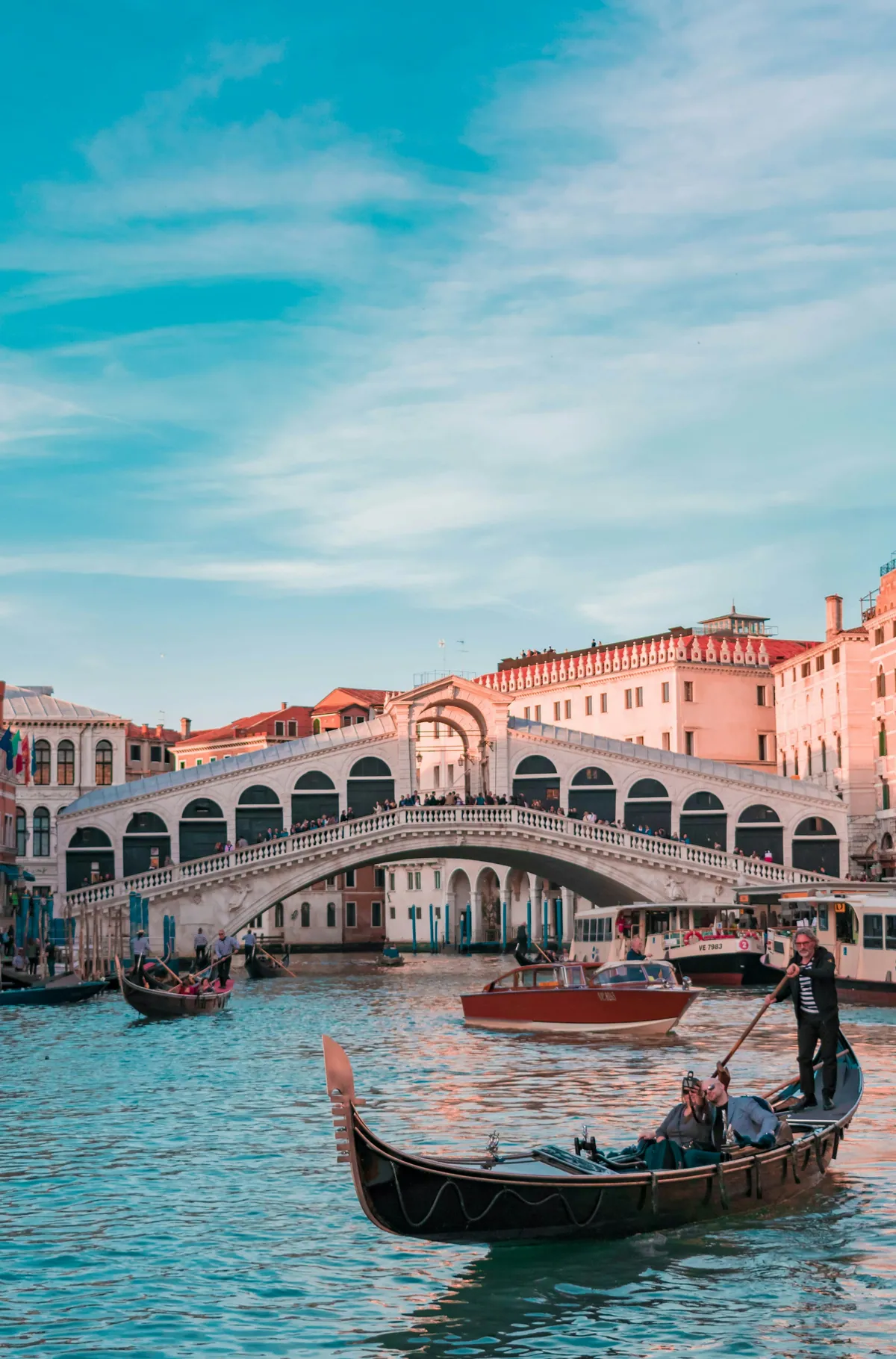
Gondola rides through 150+ canals, St. Mark's Basilica, Murano glass, and Burano's rainbow houses.
Renaissance capital — Uffizi Gallery, Duomo cathedral, Ponte Vecchio, and the birthplace of the Italian Renaissance.
Dramatic cliffside villages — Positano, Amalfi, Ravello — with the Mediterranean sparkling far below.
Rolling vineyards, cypress-lined roads, medieval hill towns like San Gimignano, and Chianti wine trails.
Five colorful fishing villages clinging to the Ligurian coast, connected by hiking trails and a train line.
April to June, September to October
Schengen Visa required. Visa rules change without notice — confirm current requirements with the destination's embassy or consulate before you book.
Euro (EUR)
Italian, English in tourist areas
Share your travel month, group size, budget comfort, and must-do experiences. The Taro team will shape the right route before any payment conversation.