Day 1
Arrival & Resort Transfer
Arrive at Velana International Airport. Speedboat or seaplane transfer to your resort island. Welcome drink and resort orientation. Evening sunset cruise.
The Maldives, officially the Republic of Maldives, is an archipelagic country in South Asia, lying in the Indian Ocean southwest of India and Sri Lanka, about 750 kilometres from the Asian mainland. Its chain of 26 atolls stretches across the equator from Ihavandhippolhu Atoll in the north to Addu Atoll in the south, and while the country's land area totals only 298 square kilometres, this is spread across roughly 90,000 square kilometres of sea, making the Maldives one of the world's most dispersed sovereign states as well as its smallest country in Asia. With an average ground-level elevation of about 1.5 metres and a highest natural point of just 2.4 metres, it is also the world's lowest-lying country. Malé, traditionally known as the "King's Island," is the capital and most populous city.
The Maldives has been inhabited for more than 2,500 years, and archaeological evidence points to a Buddhist kingdom that shaped the islands' language, early scripts, architecture and customs for some 1,400 years after Buddhism likely arrived around the third century BCE. The last Buddhist king, Dhovemi, converted to Islam in 1153, adopting the title Sultan Muhammad al-Adil and beginning a line of Islamic dynasties that lasted until 1932. Portuguese and later Dutch influence gave way to British protectorate status in 1887, formalised in an agreement with Sultan Muhammad Mueenuddeen II, until independence was achieved on 26 July 1965; a 1968 referendum, in which 93.34 percent of voters backed the change, ended 853 years of monarchy and established the Republic of Maldives under President Ibrahim Nasir.
Tourism began transforming the Maldivian economy in the early 1970s, with the country's first resorts, Bandos Island Resort and Kurumba Village, opening in 1972; the industry grew from a standing start to become the country's largest source of foreign exchange, today accounting for around 28 percent of GDP and more than 60 percent of foreign exchange receipts. Of the roughly 200 inhabited islands in the Maldives, many others are set aside for tourism and agriculture, and by 2019 more than 1.7 million visitors were arriving each year, most of them through Velana International Airport on Hulhulé Island next to Malé, which is served by flights from India, Sri Lanka, the Gulf, Singapore and, via Gan Airport in the south, Milan.
The Maldives has a tropical monsoon climate shaped by the seasonal rush of moisture-laden air off the Indian Ocean, with a drier season tied to the northeast monsoon and a rainy season from June to November brought by the southwest monsoon; annual rainfall averages around 254 centimetres in the north and 381 centimetres in the south. Average high temperatures sit around 31.5 degrees Celsius year-round, with lows near 26.4 degrees, keeping the islands warm regardless of season. The archipelago's atolls themselves are built from live coral reefs and sand bars sitting atop a submarine ridge some 960 kilometres long that rises abruptly from the floor of the Indian Ocean.
Fishing remains central to Maldivian life even as tourism has overtaken it economically, contributing over 15 percent of GDP and engaging around 30 percent of the workforce as of 2010; the mechanisation of the traditional dhoni fishing boat in 1974 marked a turning point for the industry. Historically, the islands were known to Arab traders as the "Money Isles" from around the second century CE, after the enormous quantities of cowrie shells gathered here that circulated as currency as far afield as Africa — a history still commemorated in the cowry symbol used by the Maldives Monetary Authority today.
Text adapted from the linked articles under CC BY-SA 4.0; edited for length.
Book seaplane transfers in advance — they don't fly after sunset
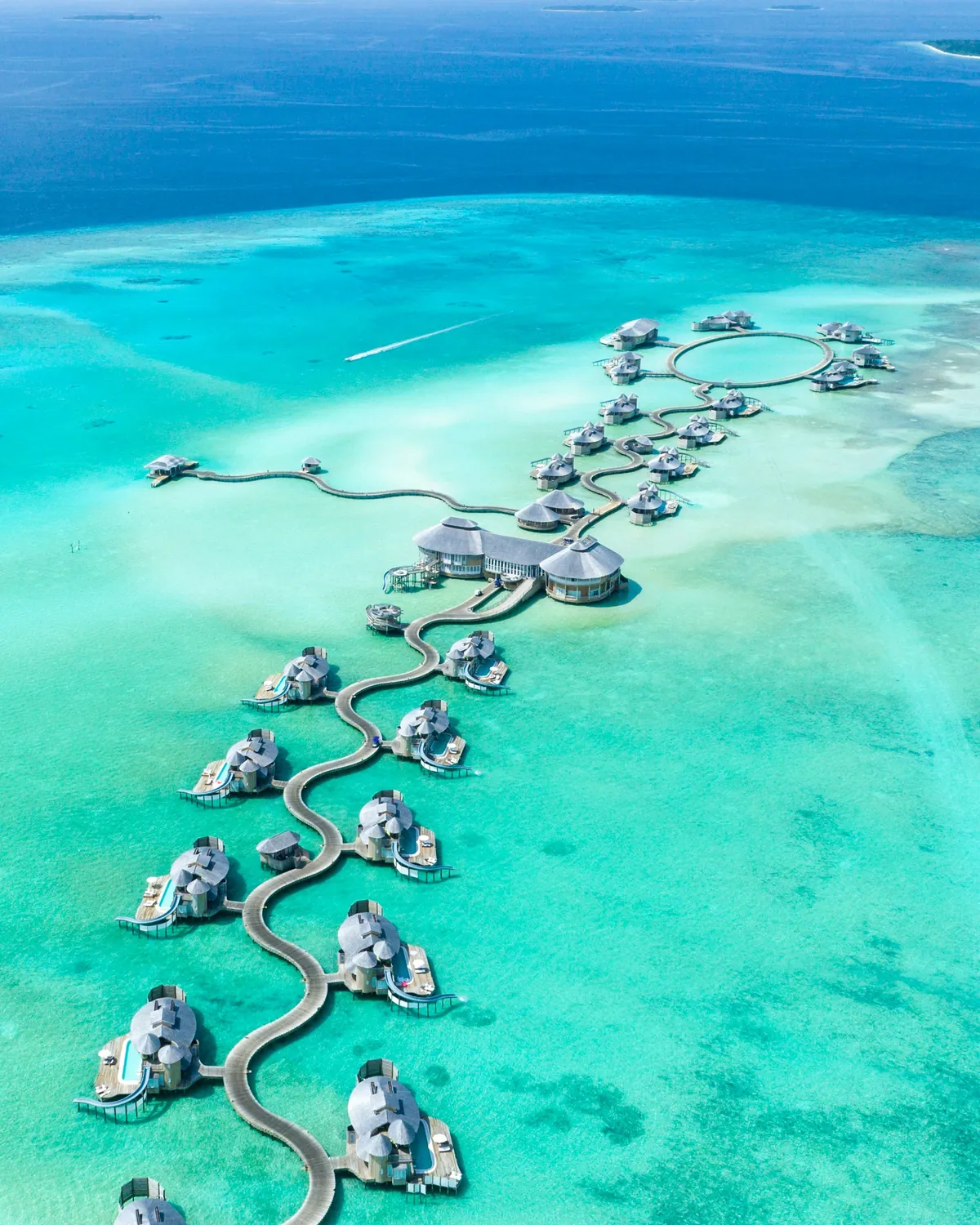
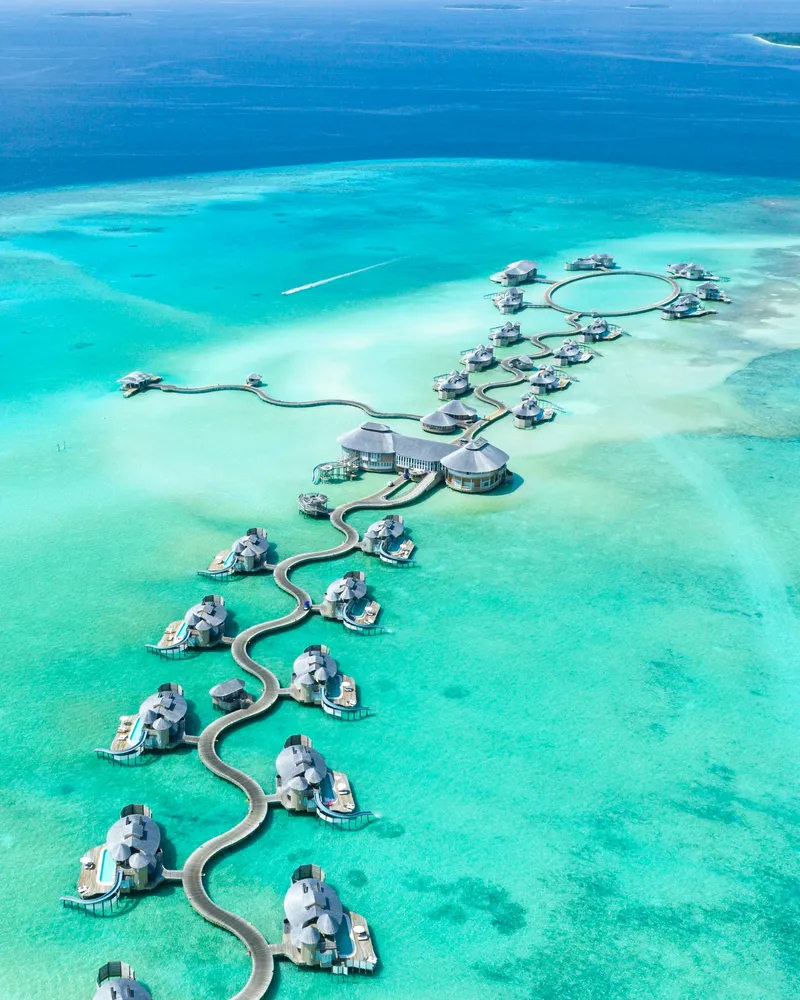
A quick visual sense of the landscapes, stays, and atmosphere your itinerary can be built around.
Every trip is adjusted around your dates, pace, hotel style, and traveler profile.
Arrive at Velana International Airport. Speedboat or seaplane transfer to your resort island. Welcome drink and resort orientation. Evening sunset cruise.
Morning snorkeling at the house reef. Afternoon at leisure — spa, beach, or pool. Evening: beach dinner under the stars.
Half-day diving excursion to see manta rays and reef sharks. Afternoon: jet ski, parasailing, or kayaking. Romantic private sandbank dinner.
Morning visit to a local island to experience Maldivian culture. Afternoon dolphin-watching cruise at sunset. Night fishing experience.
Morning couples spa treatment. Leisurely brunch. Airport transfer and departure with unforgettable memories.
The vibrant capital with colorful markets, the Grand Friday Mosque, and bustling fish market on the waterfront.
The most popular local island with budget-friendly guesthouses, bikini beaches, and water sports galore.
UNESCO Biosphere Reserve famous for manta ray gatherings — one of the best snorkeling spots on earth.
Whale shark central. Swim alongside the gentle giants in the deep blue waters of South Ari Atoll.
The famous Sea of Stars — bioluminescent plankton makes the shoreline glow electric blue at night.
The modern reclaimed island with a long sandy beach, street food scene, and vibrant local culture.
November to April
Tropical, 27-30°C year-round
Visa on arrival for Indian nationals (30 days). Visa rules change without notice — confirm current requirements with the destination's embassy or consulate before you book.
Maldivian Rufiyaa (MVR)
Dhivehi, English widely spoken
Share your travel month, group size, budget comfort, and must-do experiences. The Taro team will shape the right route before any payment conversation.