adventure
Jungfraujoch (Top of Europe)
3,454m altitude station with ice palace, snow playground, Sphinx observation deck, and panoramic Alpine views.
Switzerland, officially the Swiss Confederation, is a landlocked country at the intersection of Central, Western, and Southern Europe, bordered by Germany to the north, France to the west, Austria and Liechtenstein to the east, and Italy to the south. Its 41,291 square kilometres divide into three basic topographical areas: the Swiss Alps to the south, which cover about 60 percent of the country, the Swiss Plateau in the centre, where most of the country's nine million people live, and the Jura Mountains to the west. Switzerland is a federal republic of 26 cantons, with Bern as the federal city, and it recognises four national languages and cultures — German, French, Italian, and Romansh — reflecting a long tradition of multilingualism that the country has come to describe as a "Willensnation," a nation formed by shared will rather than shared ethnicity or language.
The confederation traces its origins to the Old Swiss Confederacy, a defensive and commercial alliance formed in the Late Middle Ages, with the Federal Charter of 1291 regarded as the country's founding document. It expanded gradually over the following centuries, surviving as one of the few republics of the early modern period, and its independence from the Holy Roman Empire was formally recognised in the Peace of Westphalia of 1648. Revolutionary France invaded in 1798 and imposed a centralist Helvetic Republic, which Napoleon abolished in 1803 in favour of a restored confederation; growing division between liberal and conservative cantons later led to a brief civil war, the Sonderbundskrieg, in 1847, and the following year Switzerland adopted a new federal constitution, modelled partly on that of the United States, that established the current system of two legislative chambers and mandatory referendums for constitutional change. Switzerland has maintained a policy of armed neutrality since the sixteenth century and has fought no international war since 1815, a stance that later made it the birthplace of the Red Cross and host to the headquarters of institutions including the WTO, the WHO, and the UN.
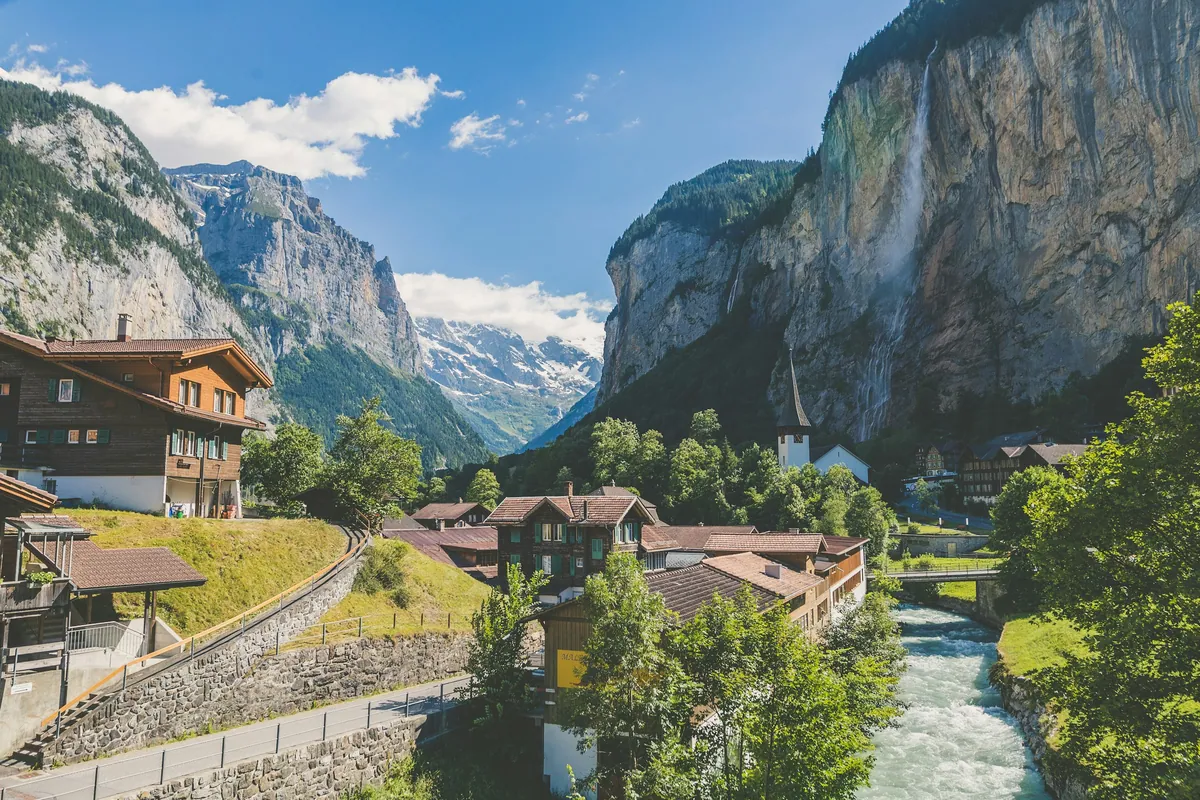
The country's Alpine geography produces its best-known scenery: forty-eight peaks rise above 4,000 metres, led by Monte Rosa at 4,634 metres, though the Matterhorn, at 4,478 metres in the Pennine Alps, remains the most widely recognised summit. The Bernese Alps rise above the glacial Lauterbrunnen valley, home to 72 waterfalls and the peaks of the Jungfrau, Eiger, and Mönch, while the Engadin Valley in the southeast, centred on St. Moritz, sits beneath the Bernina Alps and their highest point, Piz Bernina. Switzerland holds more than 1,500 lakes and six percent of Europe's freshwater reserves, including Lake Geneva, shared with France, and Lake Constance, bordered by Germany and Austria; the headwaters of the Rhine, Rhône, Inn, and Ticino rivers all rise within the Swiss Alps and flow outward across the continent in four different directions, with the springs of the Rhône and the Rhine only about 22 kilometres apart despite emptying into seas a thousand kilometres from each other.
Switzerland's climate is generally temperate but varies sharply with altitude and region, running from glacial conditions on the highest peaks to a near-Mediterranean climate at the country's southern tip in Ticino, where cold-hardy palms grow in some valleys. Summers tend to be warm and humid with periodic rainfall well suited to Alpine pastures, while winters in the mountains bring longer stretches of stable weather, occasionally interrupted by the föhn, a warm, dry wind that can raise temperatures rapidly on either side of the Alps. Precipitation is spread fairly evenly through the year with a summer peak, and drier inner-Alpine valleys such as Valais and Graubünden receive less rain than the pre-Alpine regions, conditions dry enough that Valais supports established vineyards.
Swiss cultural life reflects the same regional diversity as its languages: fondue, raclette, and rösti are found nationwide, but each linguistic region has developed its own gastronomy, including Zürcher Geschnetzeltes, sliced veal in cream sauce, associated with Zurich, alongside cheeses such as Gruyère and Emmental named for the valleys where they are produced. Switzerland has made chocolate since the eighteenth century, and its reputation grew after the invention of conching and tempering in the late nineteenth century and Daniel Peter's development of solid milk chocolate in 1875; the country remains, per capita, the world's largest chocolate-consuming nation. Alpine symbolism runs through Swiss cultural identity more broadly, from the alphorn, yodelling, and folk embroidery to the ski resorts and hiking trails that draw visitors through both winter and summer, sitting alongside an older, pastoral tradition of small farms and mountain villages.
Text adapted from the linked articles under CC BY-SA 4.0; edited for length.
Swiss Travel Pass covers trains, buses, boats & museum entries
A quick visual sense of the landscapes, stays, and atmosphere your itinerary can be built around.
3,454m altitude station with ice palace, snow playground, Sphinx observation deck, and panoramic Alpine views.
Chapel Bridge, Lion Monument, Lake Lucerne boat cruises, Mount Pilatus cogwheel train, and charming old town.
The iconic pyramid peak, car-free village, Gornergrat railway, glacier paradise, and world-class skiing.
Adventure capital between two lakes — paragliding, skydiving, canyoning, and stunning Jungfrau views.
UNESCO old town capital with medieval arcades, the Zytglogge clock tower, bear park, and Einstein's house.
Château de Chillon, Montreux Jazz Festival, Lavaux vineyard terraces (UNESCO), and Chaplin's World.
June to September (summer), December to March (skiing)
Alpine, varies by altitude
Schengen Visa required. Visa rules change without notice — confirm current requirements with the destination's embassy or consulate before you book.
Swiss Franc (CHF)
German, French, Italian, English widely spoken
Share your travel month, group size, budget comfort, and must-do experiences. The Taro team will shape the right route before any payment conversation.