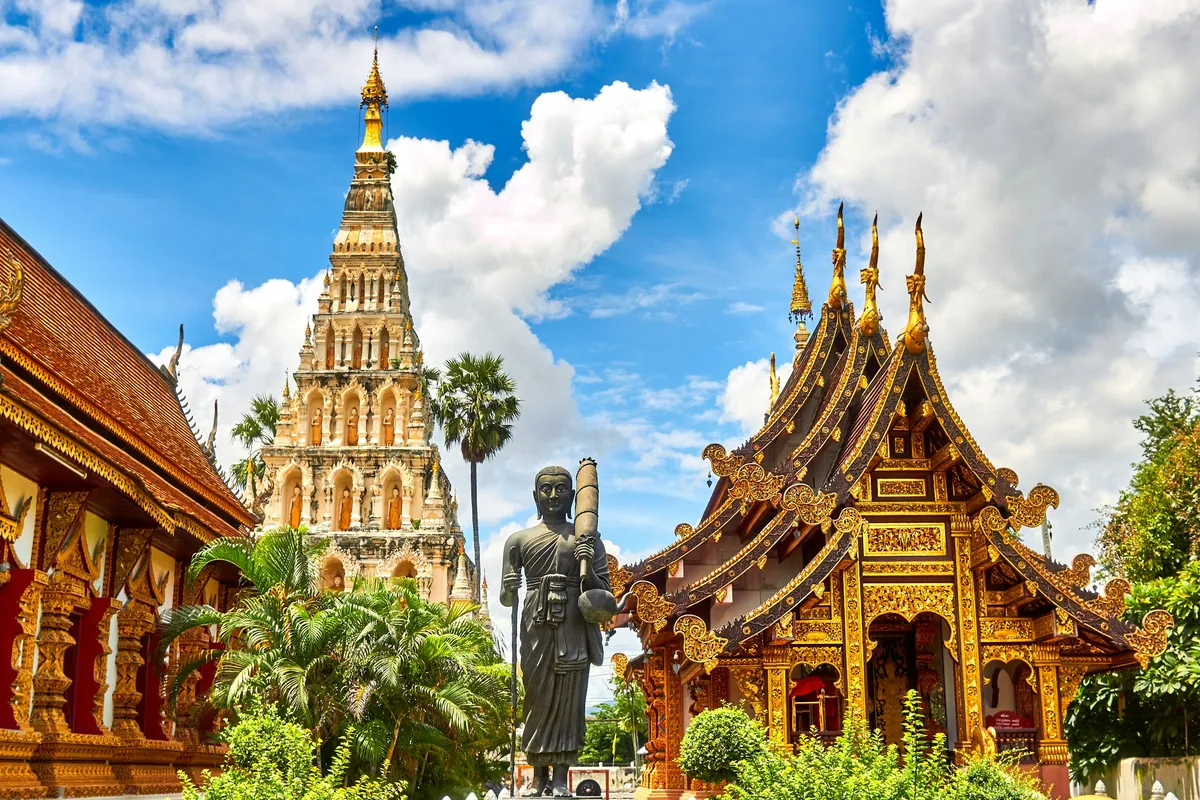
Day 1-2
Bangkok Highlights
Grand Palace, Wat Pho, Wat Arun. Chinatown food walk. Chatuchak Weekend Market. Rooftop bar sunset views.
Thailand, officially the Kingdom of Thailand and formerly known as Siam, lies in mainland Southeast Asia, bordered by Myanmar to the west and northwest, Laos to the east and northeast, Cambodia to the southeast, and Malaysia to the south, with coastlines on the Gulf of Thailand and the Andaman Sea. Covering roughly 513,000 square kilometres and home to nearly 66 million people, its capital and largest city is Bangkok. Archaeological evidence shows the region has been inhabited for at least 40,000 years, and the Tai peoples who gave the country its name are believed to have migrated south from the Điện Biên Phủ region between the eighth and tenth centuries, settling among the existing Mon and Khmer populations of the Chao Phraya basin.
Thai history is usually traced to the Sukhothai Kingdom, founded around 1238 when Pho Khun Bang Klang Hao led a rebellion against Khmer rule; under King Ram Khamhaeng, credited with inventing the Thai script, Sukhothai adopted Theravada Buddhism and functioned as a loose network of local lords. The Ayutthaya Kingdom, founded in 1351, later eclipsed both Sukhothai and the Khmer Empire, sacking Angkor before the end of the fifteenth century and prospering under King Narai in the mid-seventeenth century into a power ranked alongside China and India, with Portuguese traders arriving as early as 1511 and the French, Dutch, and English following. Ayutthaya fell to Burmese forces in 1767 after a fourteen-month siege, but King Taksin reunified the kingdom soon after, and King Rama I, founder of the Chakri dynasty that still reigns, moved the capital to Bangkok in 1782, founding the Rattanakosin Kingdom; alone among Southeast Asian states, Siam avoided formal European colonisation, though it ceded territory and legal privileges under a series of unequal treaties before adopting a constitutional monarchy after the 1932 revolution and taking its present name.
Thailand's geography divides into four distinct regions: the mountainous northern highlands, rising to Doi Inthanon at 2,565 metres; the Khorat Plateau of the northeastern Isan region, bordered by the Mekong River; the flat, fertile Chao Phraya River valley at the centre of the country, which drains into the Gulf of Thailand; and the narrow Kra Isthmus in the south, widening into the Malay Peninsula. The Gulf of Thailand's clear, shallow coastal waters support much of the country's beach tourism, while the Andaman Sea coast, including Phuket, Krabi, Phang Nga, and their surrounding islands, hosts its own string of coastal resorts. A tropical monsoon climate shapes the calendar into three seasons: a rainy southwest monsoon from mid-May to mid-October, a cooler, drier northeast monsoon from mid-October to mid-February, and a hot pre-monsoon season from mid-February to mid-May, with temperatures inland reaching as high as 40 degrees Celsius in the hottest months while the south stays milder and wetter year-round.
Theravada Buddhism sits at the centre of Thai identity, an inheritance that traces back through the Mon kingdom of Dvaravati and has absorbed elements of Hinduism, animism, and ancestor worship along the way; the wai greeting, offered first by whoever is younger or of lower social standing, and a deep respect for elders and monks both reflect this cultural framework in daily life. Thai cuisine varies by region — green curry associated with the centre, som tam green papaya salad with the northeast, khao soi with the north, and massaman curry with the south — built from shared ingredients like lemongrass, galangal, and coconut milk, with jasmine rice as the staple eaten at nearly every meal. Thailand is one of the world's leading rice exporters, and Bangkok's street-food culture is prominent enough that the city is sometimes called the world's street-food capital, a reputation reinforced when seven Thai dishes, including tom yum goong and pad thai, appeared on a 2017 CNN Travel readers' poll of favourite dishes worldwide, more entries than any other country received.
Tourism plays a substantial role in the modern Thai economy: before the COVID-19 pandemic, Thailand ranked among the ten most-visited countries globally according to the UN World Tourism Organisation, and it was the most-visited country in Southeast Asia as of 2013. Visitor patterns differ by origin and region — travellers from elsewhere in Asia gravitate toward Bangkok and its surrounding historical and cultural sites, while visitors from farther afield often combine the capital with the southern beaches and islands, and the northern hill country draws trekkers interested in its forested mountains and ethnic minority communities. Isan, in the northeast, receives the fewest visitors of Thailand's regions, leaving its Khorat Plateau landscapes and Mekong River towns comparatively undisturbed by the tourism concentrated elsewhere in the country.
Text adapted from the linked articles under CC BY-SA 4.0; edited for length.
Always remove shoes before entering temples and homes
A quick visual sense of the landscapes, stays, and atmosphere your itinerary can be built around.
Every trip is adjusted around your dates, pace, hotel style, and traveler profile.
Grand Palace, Wat Pho, Wat Arun. Chinatown food walk. Chatuchak Weekend Market. Rooftop bar sunset views.
Fly to Chiang Mai. Visit Doi Suthep temple. Night Bazaar shopping. Elephant Nature Park ethical visit. Thai cooking class.
Fly to Phuket. Phi Phi Islands day trip. James Bond Island. Patong Beach. Old Phuket Town exploration.
Morning Thai massage. Beach time. Airport transfer and departure.
The electrifying capital — Grand Palace, Wat Pho, Chatuchak market, rooftop bars, and legendary street food.
Northern cultural heart with 300+ temples, night bazaar, elephant sanctuaries, and a booming café culture.
Thailand's largest island with stunning beaches, Old Town Portuguese architecture, and Big Buddha viewpoint.
Maya Bay's turquoise lagoon (from The Beach), dramatic limestone cliffs, and world-class snorkeling.
Towering karst cliffs, emerald pools, tiger cave temple, and Railay — accessible only by boat.
The ethereal White Temple, Blue Temple, Black House museum, and gateway to the Golden Triangle.
November to February
Tropical, 25-35°C
Visa on arrival for Indians (15 days) or e-Visa. Visa rules change without notice — confirm current requirements with the destination's embassy or consulate before you book.
Thai Baht (THB)
Thai, English in tourist areas
Share your travel month, group size, budget comfort, and must-do experiences. The Taro team will shape the right route before any payment conversation.