Botswana Okavango Delta
8DFrom ₹3,65,000
A 7-day luxury migration safari through the Serengeti.
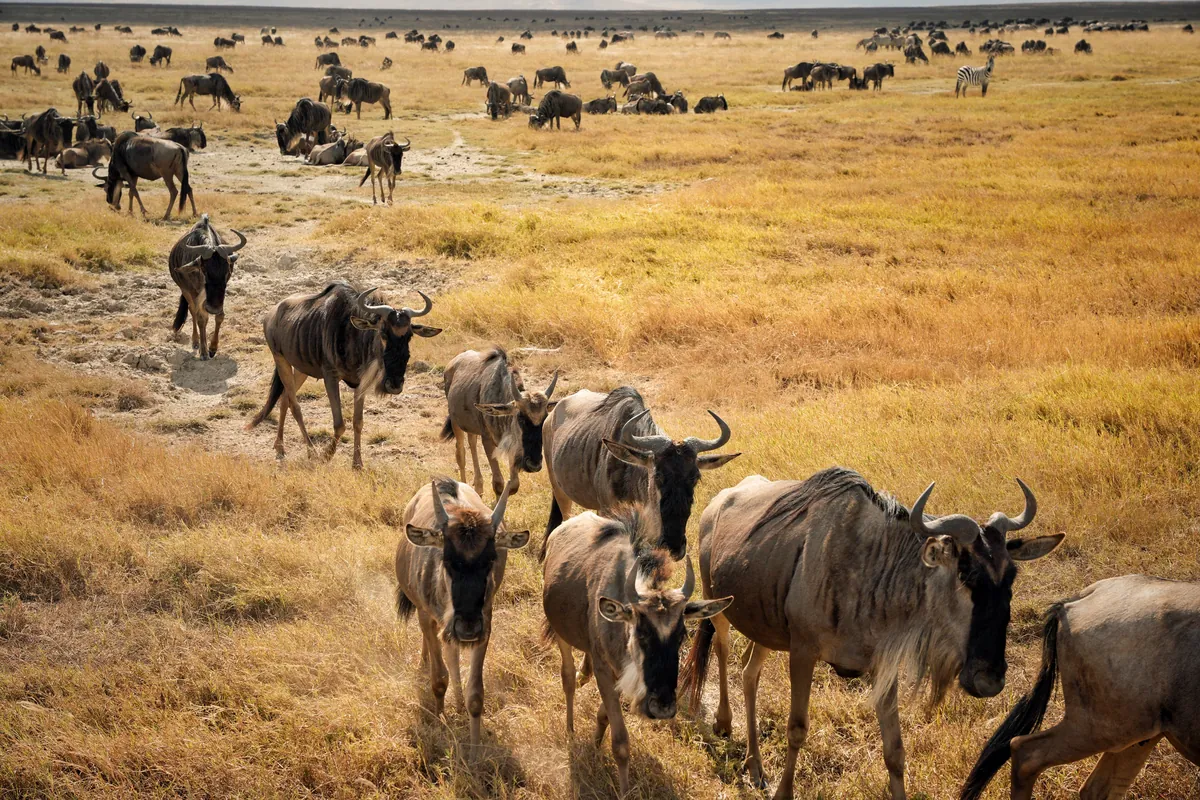
The safari is centred on Serengeti National Park, 14,763 square kilometres of savanna and grassland plains in northern Tanzania, established in 1940 and granted strict protection in 1948. Its name is often traced to the Maasai word siringet, "the place where the land runs on forever," though the word does not appear in dictionaries of the language. The park hosts the world's largest annual animal migration, in which more than 1.5 million western white-bearded wildebeest and around 250,000 zebra move in a roughly 800-kilometre loop each year, calving on the plains that now form the adjoining Ngorongoro Conservation Area between January and March before heading north from March onward. The park also holds Africa's largest lion population, along with recovering elephant and buffalo numbers after decades of poaching pressure, and gained international attention through Bernhard Grzimek's 1959 book and documentary Serengeti Shall Not Die. Central to the migration is the Grumeti River, flowing west through the park's Western Corridor to Lake Victoria's Speke Gulf. Between May and August, thousands of migrating wildebeest and other animals cross its waters at established points, sharing the crossing's notoriety with the Mara River farther north for the crocodiles that lie in wait; the crossing counts among the migration's most closely watched moments, drawing safari vehicles to the riverbanks each season the herds pass through. The route continues into the Ngorongoro Conservation Area, a UNESCO World Heritage Site 180 kilometres west of Arusha centred on the Ngorongoro Crater, the world's largest inactive, intact and unfilled volcanic caldera. Formed by the collapse of a volcano estimated to have once stood between 4,500 and 5,800 metres tall, the crater floor sits 1,800 metres above sea level and covers 260 square kilometres, sheltering around 25,000 large animals including one of Tanzania's remaining black rhinoceros populations, recovered from as few as 13 individuals in 1993 to around 55 by 2018. Named by Maasai pastoralists for the sound of cattle bells, ngoro ngoro, the area was separated from the national park in 1959 specifically to accommodate Maasai grazing and settlement, and the crater rim and surrounding highlands remain home to Maasai communities alongside the conservation area's wildlife. The route's final stop is Olduvai Gorge, a 48-kilometre ravine within the conservation area that ranks among the most significant paleoanthropological sites in the world. Excavations begun by Louis and Mary Leakey in the 1930s and continued by their family uncovered the remains of Paranthropus boisei in 1959 and, the following year, the jawbone that defined Homo habilis, alongside layers of Oldowan stone tools dating back some 1.9 million years. The gorge takes its name from the Maasai word for the wild sisal plant that grows throughout it, and a 2019 monument at its turnoff, topped with two large fossil-skull sculptures, now marks the site for safari travellers passing between Ngorongoro and the Serengeti; the adjacent Olduvai Gorge Museum, built into the gorge's rim, ranks among the largest onsite museums in Africa. Across seven days the safari moves through a single connected ecosystem and a single connected story: the wildebeest migration crossing the Grumeti in the Serengeti's Western Corridor, the volcanic caldera at Ngorongoro that shelters wildlife and Maasai grazing together, and the gorge below it where the earliest evidence of the human genus was found — a landscape that has sustained both the largest animal migration on Earth and the oldest known record of the species now watching it.
Text adapted from the linked articles under CC BY-SA 4.0; edited for length.
Every dimension the Taro team tags this pack with — filter by any of these on the packs page.
Share your travel month, group size, budget comfort, and must-do experiences. The Taro team will shape the right route before any payment conversation.