Botswana Okavango Delta
8DFrom ₹3,65,000
A 6-day luxury island stay near La Digue with its granite-boulder beaches.
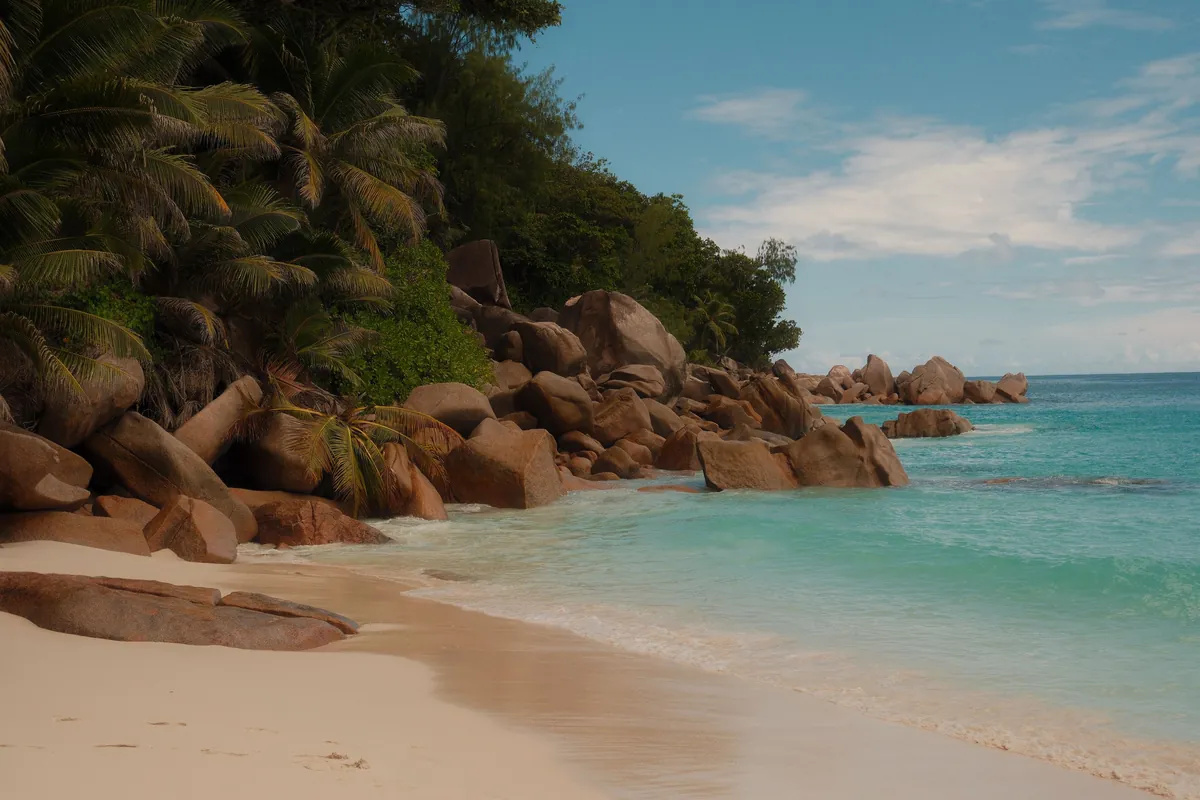
The cycle begins at Anse Source d'Argent, a beach on the southwest coast of La Digue set within L'Union Estate, a former coconut plantation and vanilla farm now run as a nature reserve, reached through the estate on payment of a small entrance fee. The beach is shaped by massive granite boulders, weathered into rounded forms that observers have compared to a prehistoric landscape, and its combination of pink-tinged sand, shallow turquoise water and boulder-framed coves has repeatedly drawn international attention: Lonely Planet named it among the world's standout beaches in 2024, and it has appeared on similar lists from Forbes India, CNN and Newsweek in preceding years, often cited as one of the most photographed beaches anywhere. From La Digue the route crosses to Praslin, the second-largest island in the Inner Seychelles at 38.5 square kilometres, lying 44 kilometres northeast of Mahé. Explorer Lazare Picault named it Isle de Palmes in 1744, when it served as a hideaway for pirates and Arab traders, before it was renamed in 1768 in honour of the French diplomat César Gabriel de Choiseul, duc de Praslin. The island's tropical forest shelters the endemic Seychelles bulbul and Seychelles black parrot, and its southern reaches form Praslin National Park, while resort development has grown up around beaches such as Anse Lazio and Anse Georgette on an island still centred on the districts of Baie Sainte Anne and Grand'Anse. At Praslin's heart lies the Vallée de Mai, a UNESCO World Heritage Site since 1983 protecting one of the last stands of a palm forest dating back to when the Seychelles broke away from the supercontinent Gondwana between present-day Madagascar and India. Its flagship species, the coco de mer, produces the largest seed of any plant on Earth, with palms reaching 25 to 34 metres and fan-shaped leaves up to ten metres long; five other endemic palm species grow alongside it, found nowhere else in the Indian Ocean. In 1881 the British general Charles George Gordon, visiting on a military mission, proposed that the valley was the biblical Garden of Eden, reading the coco de mer's shape as the forbidden fruit — a theory contested at the time and never substantiated, though the reserve remains habitat for the rare Seychelles black parrot, which nests almost exclusively in the dead trunks of the coco de mer palm. The route's final stop is Curieuse Island, a small granitic island of 2.9 square kilometres off Praslin's north coast, originally named Ile Rouge for its bare red soil before the French renamed it in 1768 after the schooner La Curieuse. Between 1829 and 1965 the island served as a leprosarium, whose ruins and the former physician's residence at Anse St Joseph survive today as an educational centre, a period of isolation that inadvertently shielded much of the island's ecosystem from wider human disturbance. A 1967 fire destroyed more than 150 coco de mer palms before the government took ownership and, from 1978 to 1982, relocated Aldabra giant tortoises from Aldabra Atoll to the island; more than 300 now live around Curieuse, alongside a mangrove swamp, a hawksbill turtle nesting ground and the marine park declared around the island's waters in 1979. Across six days the cycle links four pieces of the same granitic archipelago: the boulder-strewn beach of Anse Source d'Argent on La Digue, the palm-forested slopes of Praslin, the ancient coco de mer stands of Vallée de Mai at its centre, and the tortoise-repopulated, once-quarantined shores of Curieuse Island just offshore — each shaped by the same granite geology and each holding species found nowhere else on Earth.
Text adapted from the linked articles under CC BY-SA 4.0; edited for length.
Every dimension the Taro team tags this pack with — filter by any of these on the packs page.
Share your travel month, group size, budget comfort, and must-do experiences. The Taro team will shape the right route before any payment conversation.