Botswana Okavango Delta
8DFrom ₹3,65,000
A 6-day premium trip to Saint-Louis, Senegal, taking in Faidherbe Bridge, Langue de Barbarie National Park, Djoudj National Bird Sanctuary and Richard Toll sugar town.
Saint-Louis Colonial Island Town opens on Faidherbe Bridge, the metal road bridge linking Saint-Louis island to the Senegalese mainland across the Senegal River. Before any bridge existed, access to the island depended on boats, and even after Governor Louis Faidherbe introduced the 150-passenger Bouteville ferry in 1858, running ten crossings a day, the crossing quickly proved insufficient; a floating bridge of 40 metal pontoons opened in 1865 and served for 32 years before the current structure replaced it. Financed by a five-million-gold-franc loan approved by French president Sadi Carnot in 1892 and built by the firm Nouguier, Kessler et Cie, the new bridge — 507.35 metres long, 10.5 metres wide and weighing 1,500 tonnes across eight riveted spans, one of which turns to let ships pass — opened on Bastille Day 1897 with 21 cannon shots, horse races and a ceremonial crossing by the warship L'Ardent. A long-running myth attributes its ironwork to Gustave Eiffel and claims the parts were originally built for a Danube bridge in Romania or Austria-Hungary, but research on both sides has shown the story to be fiction; the bridge underwent a $27 million rehabilitation between 2008 and 2011, jointly financed by the French Development Agency and the Senegalese government.
From the bridge the route follows the Langue de Barbarie, the thin sand peninsula that separates the Senegal River's final stretch from the Atlantic and gives its name to the national park covering the peninsula's southern tip. Spanning 2,000 hectares and designated a Ramsar wetland site in 2021, the park shelters a wide range of bird species and three species of turtle, including the critically endangered hawksbill. A channel deliberately cut through the peninsula in October 2003 to relieve flooding widened far beyond its planned four metres, permanently separating the peninsula's southern end from the mainland and, by 2020, growing to six kilometres wide — swallowing villages and tourist resorts and reshaping the area's plant and animal life along the way.
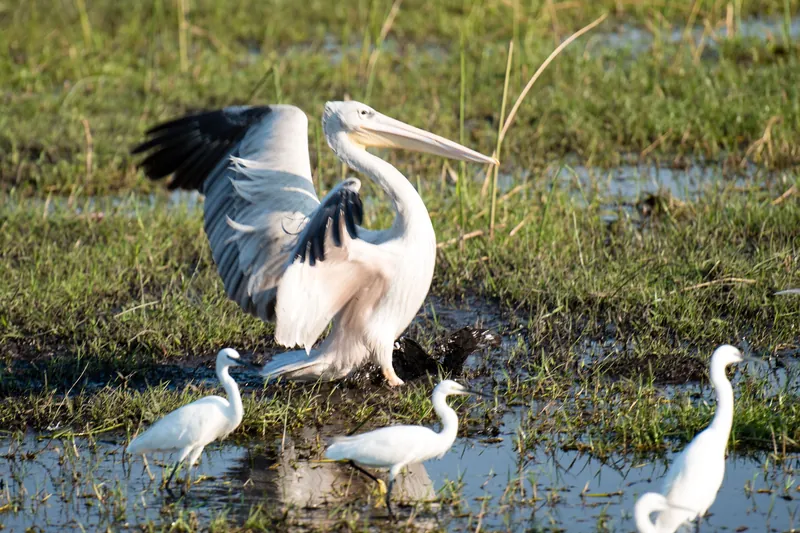
The trip continues to the Djoudj National Bird Sanctuary, a UNESCO World Heritage Site on the southeast bank of the Senegal River northeast of Saint-Louis, where wetland habitats draw birds that have often just crossed the Sahara. Nearly 400 recorded species, most visibly pelicans and flamingos, use the park's 16,000 hectares, making it, by some counts, the world's third-largest ornithological reserve with close to three million birds recorded; it is also the single most important known wintering site for Europe's migrating aquatic warblers, and its waters support large populations of crocodiles and manatees. The site briefly appeared on UNESCO's List of World Heritage in Danger between 1984 and 2006 due to the invasive giant salvinia plant, and the Diama Dam, operating on the Senegal River since 1988, has since brought measurable changes to the park's water levels and vegetation, tracked in NASA satellite comparisons of the area before and after the dam's construction.
The route closes upriver in Richard Toll, a sugar-industry town on the Senegal River's south bank named for the botanist Jean Michel Claude Richard, who was sent in 1822 to develop the site then known as L'Escale — "Toll" itself derived from the local Pulaar word for farm. A rice-growing scheme launched by France's colonial development agency in 1949 covered an initial 6,000 hectares, and the arrival of the Compagnie Sucrière Sénégalaise sugar company in 1970 drew around 15,000 new residents, merging surrounding villages into a town of some dozen neighbourhoods that had grown to a recorded population of 73,147 by 2023. Its French-owned sugar refinery, which exports across Senegal, remains the town's defining industry alongside agriculture and fishing — a fitting inland conclusion to a six-day route that runs from a colonial iron bridge through river-delta wetlands to Senegal's sugarcane heartland.
Text adapted from the linked articles under CC BY-SA 4.0; edited for length.
Every dimension the Taro team tags this pack with — filter by any of these on the packs page.
Share your travel month, group size, budget comfort, and must-do experiences. The Taro team will shape the right route before any payment conversation.