Botswana Okavango Delta
8DFrom ₹3,65,000
Red dunes, Etosha pan, Skeleton Coast shipwrecks.
This trip opens in Windhoek, Namibia's capital and largest city, sitting around 1,700 metres above sea level on the Khomas Highland plateau at the geographical centre of the country, with a 2023 population of 486,186. The site grew up around a hot spring known to local pastoral tribes, and Jonker Afrikaner, captain of the Orlam, settled there in 1840, building a stone church that could hold 500 people; wars between the Nama and Herero later destroyed the settlement, and it was founded a second time in 1890 by the German Imperial Army major Curt von François after Germany declared a protectorate over the territory.
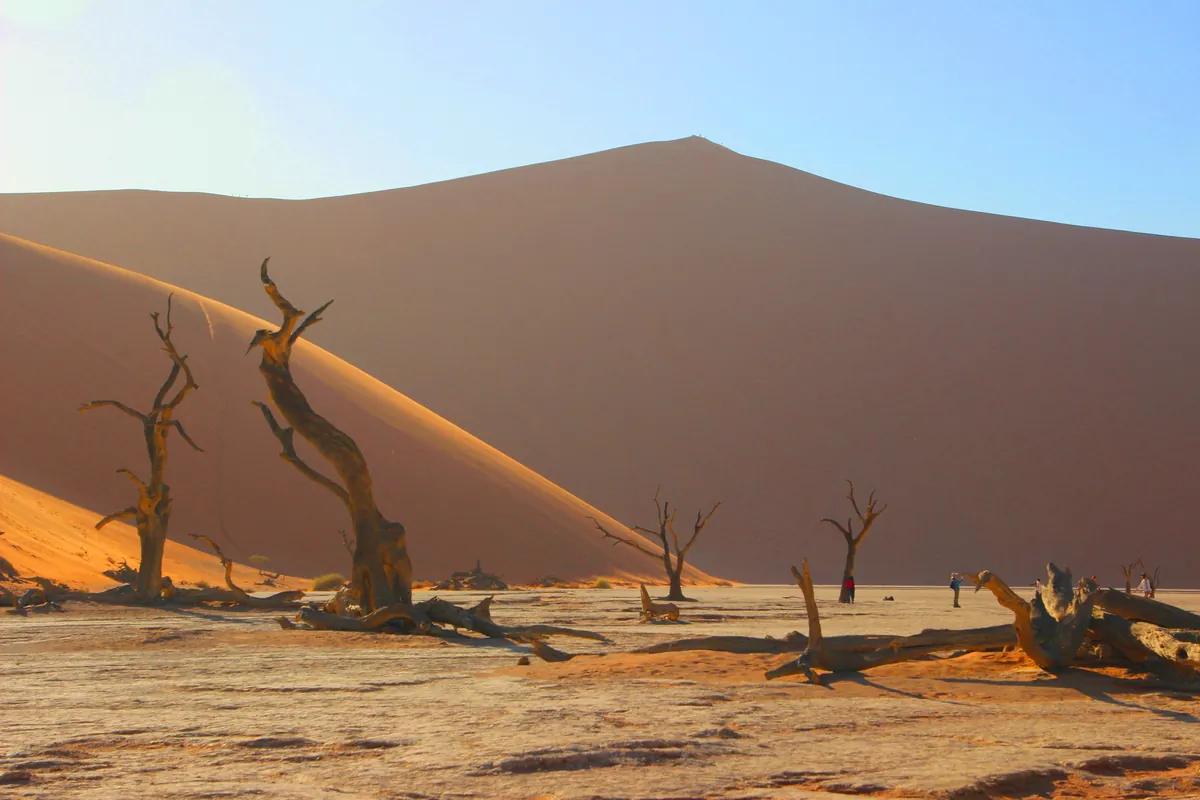
South of the capital, the trip reaches Sossusvlei, a salt-and-clay pan ringed by towering red dunes in the Namib-Naukluft National Park, part of the southern Namib Desert. Its name mixes the Afrikaans vlei, "marsh," with the Nama sossus, "no return," a reference to the fact that it forms an endorheic basin with no outflow for the ephemeral Tsauchab River. The surrounding dunes owe their reddish colour to iron oxidised over long periods — the older the dune, the more intense the colour — and rank among the highest in the world, with the tallest, nicknamed Big Daddy, reaching about 325 metres.
North of Windhoek, Etosha National Park spans 22,270 square kilometres around the Etosha pan, which alone covers 4,760 square kilometres, or 23 percent of the park's total area. Proclaimed a game reserve in March 1907 under the German colonial governor Friedrich von Lindequist and awarded national park status in 1967, Etosha takes its name from an Oshindonga word meaning "Great White Place," first recorded by the European explorers Charles John Andersson and Francis Galton in 1851 though long known to the Ovambo and Hai//om peoples who lived in and around it. The park remains one of the largest in Africa and home to hundreds of mammal, bird, and reptile species, including the black rhinoceros, though poaching claimed 46 rhinos here in 2022 alone.
West along the coast lies the Skeleton Coast, the northern stretch of Namibia's Atlantic shoreline running from the Kunene River to the Swakop River, a region the indigenous San once called "The Land God Made in Anger" and Portuguese sailors called "The Gates of Hell." Cold Benguela current upwelling produces dense fog for much of the year, and the coast's name comes from the whale and seal bones once scattered along it, joined more recently by the skeletal remains of shipwrecks including the Eduard Bohlen and the Dunedin Star, whose 1942 grounding — and the rescue of all 106 people aboard — was chronicled in the 1944 book that gave the coast its now-standard name.
The trip closes at Twyfelfontein, officially ǀUi-ǁAis, a valley of ancient rock engravings in the Kunene Region fed by a spring flanked by a sandstone table mountain. Inhabited for some 6,000 years, first by Stone Age hunter-gatherers of the Wilton culture and later by Khoikhoi herders, the site holds at least 2,500 rock carvings made as part of shamanist ritual, among the largest concentrations of rock petroglyphs in Africa, and UNESCO named it Namibia's first World Heritage Site in 2007.
Text adapted from the linked articles under CC BY-SA 4.0; edited for length.
On documentation, this trip is in the lowest visa-complexity band for this trip — treat that as a planning signal only, and verify exact, current requirements with the relevant embassy or consulate before booking. It runs 9 days, from ₹2,15,000 per person.
Every dimension the Taro team tags this pack with — filter by any of these on the packs page.
9 days across Namibia, starting from ₹2,15,000 per person.
Suited to Couples, Friends, and Luxury Travellers, with a suitable option for families and a moderate activity level.
This trip falls into the free/no-visa complexity band for this trip. Always confirm exact, current requirements with the relevant embassy or consulate before booking — this is a planning signal, not a legal statement.
Share your travel month, group size, budget comfort, and must-do experiences. The Taro team will shape the right route before any payment conversation.