Botswana Okavango Delta
8DFrom ₹3,65,000
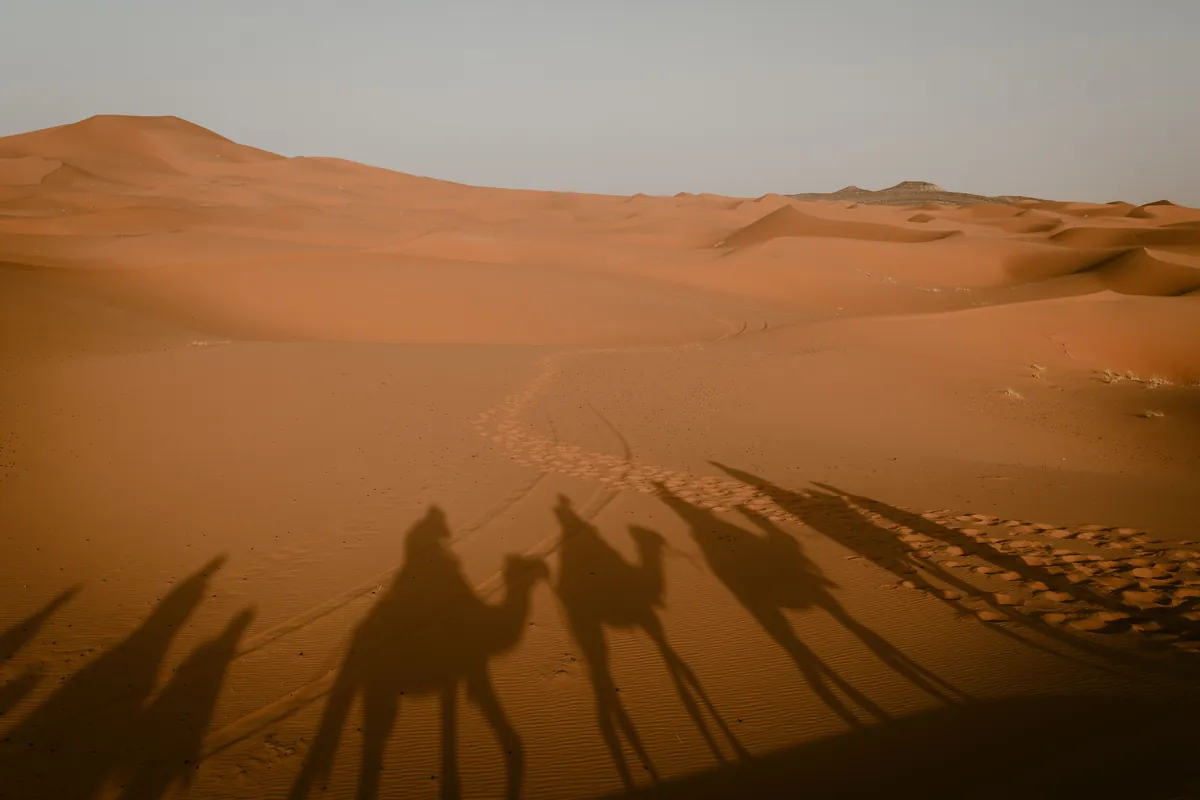
Jemaa el-Fnaa, Atlas Mountains, Sahara camel night under stars.
This trip opens in Marrakesh, Morocco's fourth-largest city and one of its four imperial cities, founded around 1070 by Abu Bakr ibn Umar as capital of the Almoravid dynasty. The red walls Ali ibn Yusuf built around the city in 1122-1123, and the red sandstone used in later buildings, earned it the nickname the "Red City"; it regained its status as an imperial capital in the early sixteenth century under the Saadian dynasty, when sultans Abdallah al-Ghalib and Ahmad al-Mansur added an array of monuments, and from the seventeenth century it became popular among Sufi pilgrims for the seven patron saints buried there.
At the heart of the old city, the trip visits Jemaa el-Fnaa, the medina's main square, used by locals and tourists alike. Historians trace the space back to the Almoravid founding of Marrakesh, when the axis linking the fortress Ksar el-Hajjar to the city's first Friday mosque created an open market area then known as Rahbat al-Ksar; one historical account holds that the Saadian sultan Ahmad al-Mansur later began building a monumental Friday mosque in the square itself, only to abandon it partway through, likely due to a plague outbreak, leaving ruins that were reportedly still visible into the nineteenth century.
From Marrakesh, the trip climbs into the Atlas Mountains, a range stretching roughly 2,500 kilometres through Morocco, Algeria, and Tunisia that separates the Sahara from the Mediterranean Sea and the Atlantic Ocean. Its highest peak, Toubkal, rises 4,167 metres in central Morocco, and the range — primarily home to Berber populations — holds deposits of iron ore, lead ore, copper, silver, mercury, and phosphate among other resources, formed across three distinct geological phases beginning with the Anti-Atlas some 300 million years ago.
Beyond the mountains lies the Sahara itself, the largest hot desert in the world at 9,200,000 square kilometres, third-largest overall behind only the deserts of Antarctica and the northern Arctic. It runs from the Red Sea and Mediterranean in the east and north to the Atlantic in the west, bounded to the south by the Sahel, and is made up of hamada rocky plateaus, ergs of sand dunes rising over 180 metres, gravel plains, dry valleys, and salt flats — a landscape so vast and reflective that, in theory, it could be picked out from other stars as a surface feature of Earth with near-current technology.
The trip closes in Chefchaouen, a city in northwest Morocco known as the "Blue City" for its buildings painted in shades of blue, set about 600 metres above sea level in the foothills of the Kaʻala mountain in the Rif range. It was founded in 1471 by Ali ibn Rashid al-Alami as a small kasbah built to defend against Portuguese incursions into northern Morocco, and in the years that followed, Andalusi Muslims, Moriscos, and Spanish and Portuguese Jews settled there as the Reconquista pushed them out of Iberia; the city's name combines the Arabic "chef," to look, with the Berber "echaouen," horns, a reference to the two mountain peaks that overlook the town.
Text adapted from the linked articles under CC BY-SA 4.0; edited for length.
On documentation, this trip is in the lowest visa-complexity band for this trip — treat that as a planning signal only, and verify exact, current requirements with the relevant embassy or consulate before booking. It runs 8 days, from ₹1,15,000 per person.
Every dimension the Taro team tags this pack with — filter by any of these on the packs page.
8 days across Morocco, starting from ₹1,15,000 per person.
Suited to Couples and Friends, with a suitable option for families and a moderate activity level.
This trip sits in the simplest visa-complexity band for this trip. Always confirm exact, current requirements with the relevant embassy or consulate before booking — this is a planning signal, not a legal statement.
Share your travel month, group size, budget comfort, and must-do experiences. The Taro team will shape the right route before any payment conversation.