Botswana Okavango Delta
8DFrom ₹3,65,000
A 10-day premium trip to Cape Coast, Ghana, taking in Cape Coast Castle, Elmina Castle, Kakum canopy walk and Kwame Nkrumah Mausoleum.
Ghana Castles & Rainforest Trail opens at Cape Coast Castle, one of roughly forty fortified trading posts, sometimes called "slave castles," built along West Africa's Gold Coast by European traders. Founded in 1555 as a Portuguese trading post and rebuilt in timber by the Swedish Africa Company in 1653 under the name Carolusborg, the fort changed hands repeatedly between Swedish, Danish, Dutch and English interests before England captured it in 1664 and reinforced it into what Dutch naval commander Michiel de Ruyter reportedly judged too strong to take; the castle then served as the English headquarters on the Gold Coast. Large underground dungeons, cut into the rock beneath the castle's parade ground and capable of holding as many as a thousand people at a time, were used through the 18th century to hold captives awaiting transport across the Atlantic, a role that has made the castle, together with Ghana's other coastal forts, a UNESCO World Heritage Site recognised for its testimony to the Atlantic slave and gold trades; restored in the 1990s with support from the Ghanaian government, USAID and the Smithsonian Institution, the castle is now open for guided tours of its dungeons, governor's quarters and museum.
A short distance west lies Elmina Castle, built by the Portuguese in 1482 as Castelo de São Jorge da Mina — the oldest surviving European building anywhere in Sub-Saharan Africa and the first European trading post established on the Gulf of Guinea. Constructed from prefabricated stone and roof tiles shipped from Portugal aboard ten caravels under the command of Diogo de Azambuja, the fort was raised despite initial resistance from the local Fante chief, Kwamin Ansah, and functioned first as a hub of the Portuguese gold trade before the Dutch West India Company seized it in 1637 and made it the capital of the Dutch Gold Coast; the slave trade continued here under Dutch control until its abolition in 1814, and the fort passed to British administration in 1872 following an Anglo-Dutch treaty. Also a UNESCO World Heritage Site since 1979, Elmina today functions as a Ghanaian national museum and a site of pilgrimage for members of the African diaspora tracing their heritage.
The route continues inland to Kakum National Park, a 375-square-kilometre tropical forest reserve first protected in 1931 and gazetted as a national park in 1992, notable for having been created largely at the initiative of local communities. Home to endangered forest elephants, Diana monkeys, giant bongo antelope and more than 260 recorded bird species — eight of them of global conservation concern — the park holds one of only three canopy walkways found anywhere in Africa, a series of hanging bridges strung between seven treetops that rise up to 40 metres above the forest floor along a run of roughly 330 metres, giving visitors a view into the rainforest canopy usually reserved for the park's resident wildlife.
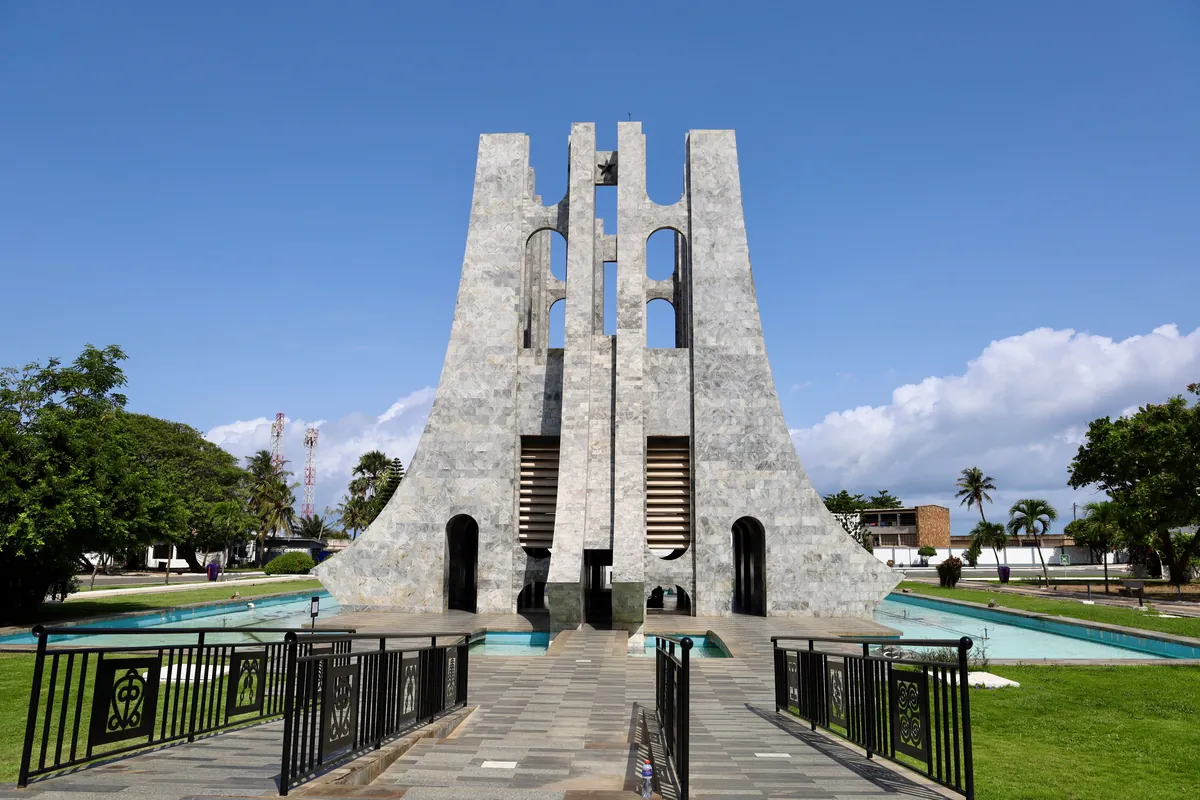
The route closes back in Accra at the Kwame Nkrumah Memorial Park and Mausoleum, dedicated in 1992 on the site of Accra's former colonial polo grounds and marking the spot where Kwame Nkrumah declared Ghana's independence in 1957. Designed to resemble an inverted sword — a symbol of peace in Akan culture — the mausoleum is clad in Italian marble with a black star at its apex symbolising unity, and holds the remains of Nkrumah and his wife Fathia alongside a museum tracing his political career from his studies abroad through the 1957 independence he led Ghana to achieve — a ten-day route spanning two of the Gold Coast's oldest European forts, a rainforest canopy, and the memorial to the leader of Ghana's independence movement.
Text adapted from the linked articles under CC BY-SA 4.0; edited for length.
Every dimension the Taro team tags this pack with — filter by any of these on the packs page.
Share your travel month, group size, budget comfort, and must-do experiences. The Taro team will shape the right route before any payment conversation.