Botswana Okavango Delta
8DFrom ₹3,65,000
A 7-day luxury route through Okaukuejo, featuring Etosha National Park, Tsumeb, Namutoni and Etosha salt pan.
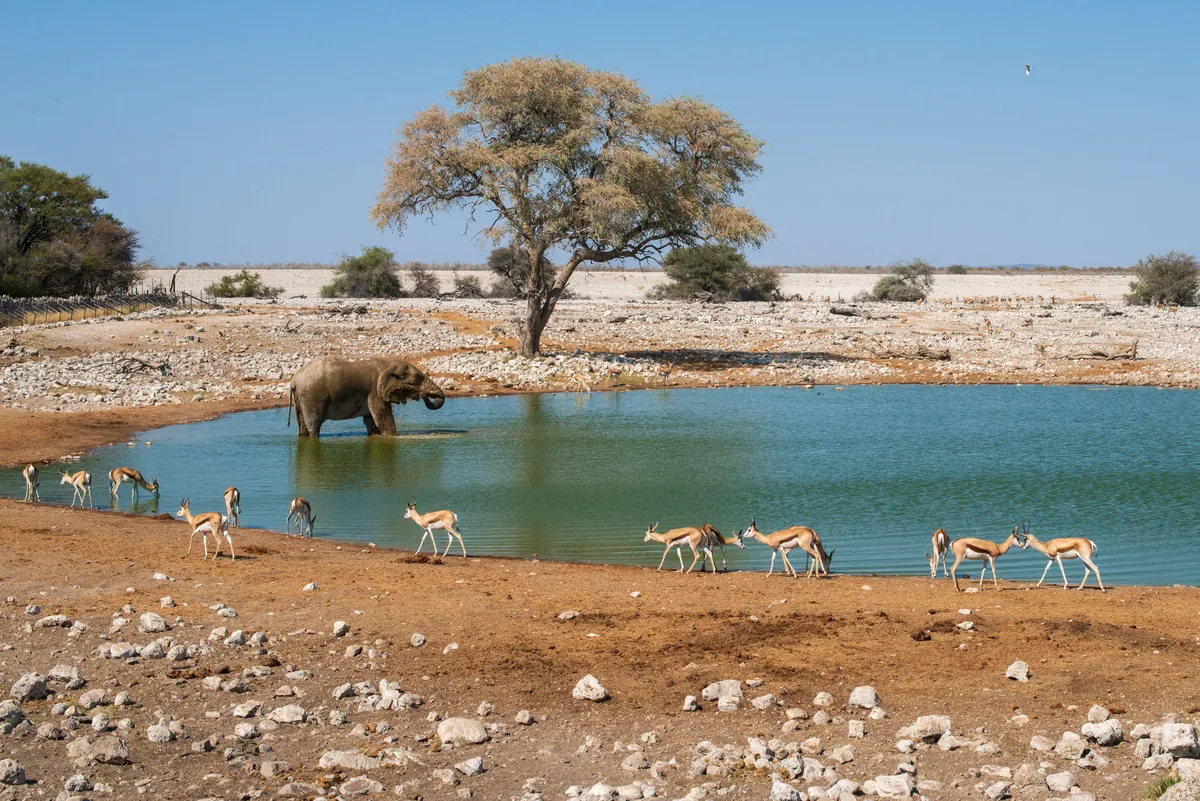
Etosha National Park Safari opens inside Etosha National Park, one of the largest national parks in Africa at 22,270 square kilometres, first proclaimed a game reserve in March 1907 under German colonial governor Friedrich von Lindequist and granted national park status in 1967. The park takes its name from the Etosha pan, whose Oshindonga name means "Great White Place" — the Hai||om people who lived alongside it before their removal in 1954 called it Khubus, "totally bare, white place with lots of dust" — and it shelters hundreds of species of mammal, bird and reptile, including the black rhinoceros, a species under sustained poaching pressure across the region.
The route enters through Tsumeb, a town of around 35,000 people founded in 1905 as a mining settlement and still known as the "gateway to the north" for its position closest to Etosha. Its name, from Otjiherero and Khoekhoe words referring to frogs and to digging in loose ground, points to the huge mineralised ore pipe that made the town's fortune — worked from prehistoric times and then intensively through the 20th century for copper, lead, zinc, silver, gold and germanium, and recognised by the International Union of Geological Sciences as one of the world's 100 geological heritage sites for the rarity of its minerals. Nearby, the sinkhole lakes of Otjikoto and Guinas, both of unknown depth where they disappear into lateral cave systems, are where retreating German forces dumped weaponry and supplies in 1914 rather than let it fall to advancing South African troops, and the Hoba meteorite, the largest known on Earth at about 60 tonnes, lies in a field a short drive southeast of town.
Inside the park, Namutoni is a rest camp on the eastern edge of the Etosha pan, its most prominent structure Fort Namutoni, built in 1896 as a German police post and veterinary control station. On 28 January 1904, 500 men led by Nehale Mpingana attacked and destroyed the fort, driving out its colonial garrison, before it was rebuilt and later used to hold prisoners of war and, still later, as a South African army base; declared a national monument in 1947 and restored to its present form in 1957, it served for decades as a lodge and viewpoint for park visitors before newer rest-camp facilities were built alongside it, and its King Nehale waterhole remains a fixture of the modern camp.
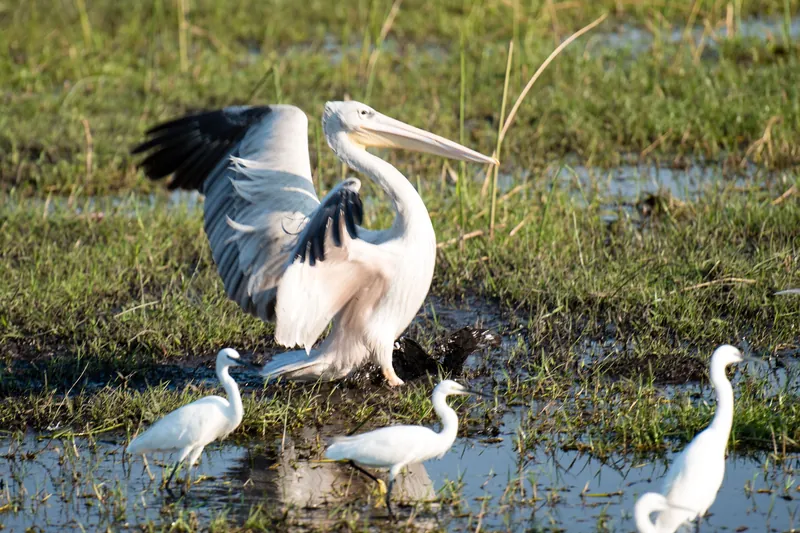
The safari's final stop is the Etosha Pan itself, a 120-kilometre-long endorheic salt pan covering roughly 4,800 square kilometres, believed to have formed over about ten million years of tectonic activity after the Kunene River changed course and stopped feeding the ancient lake that once filled the basin. Mostly a cracked, dry expanse of white and greenish clay for most of the year, the pan floods to a shallow depth of around 10 centimetres in exceptional rainy seasons, drawing thousands of flamingos and great white pelicans to breed, while the surrounding grassland and mopane woodland support zebra, wildebeest, gemsbok, springbok, eland, elephant, lion and leopard drawn to its fringing waterholes — the same waterholes this seven-day safari has followed from Tsumeb's mine shafts to the pan's white horizon.
Text adapted from the linked articles under CC BY-SA 4.0; edited for length.
Every dimension the Taro team tags this pack with — filter by any of these on the packs page.
Share your travel month, group size, budget comfort, and must-do experiences. The Taro team will shape the right route before any payment conversation.