Botswana Okavango Delta
8DFrom ₹3,65,000
A 6-day premium route through Luxor's temples and the Valley of the Kings.
The route begins in the Valley of the Kings, a wadi on the Nile's west bank opposite Luxor where, for nearly 500 years across the Eighteenth to Twentieth Dynasties, rock-cut tombs were carved for pharaohs and powerful nobles of the New Kingdom. The valley sits over more than 1,000 feet of limestone and other sedimentary rock deposited between 35 and 56 million years ago, later carved into its present shape by Pleistocene rains; occasional flash floods still wash debris into open tombs today. Tomb layouts evolved over the centuries, from the tightly turning 'bent axis' corridors of early tombs such as that of Thutmose IV to the straighter passages of later dynasties, decorated with texts including the Amduat and the Book of Gates describing the sun god's nightly journey through the underworld. By the Twenty-first Dynasty, as royal authority declined, priests of Amun moved plundered royal mummies into hidden caches to protect them from ongoing tomb robbery, a practice documented in surviving papyri recording the trials of the robbers themselves.
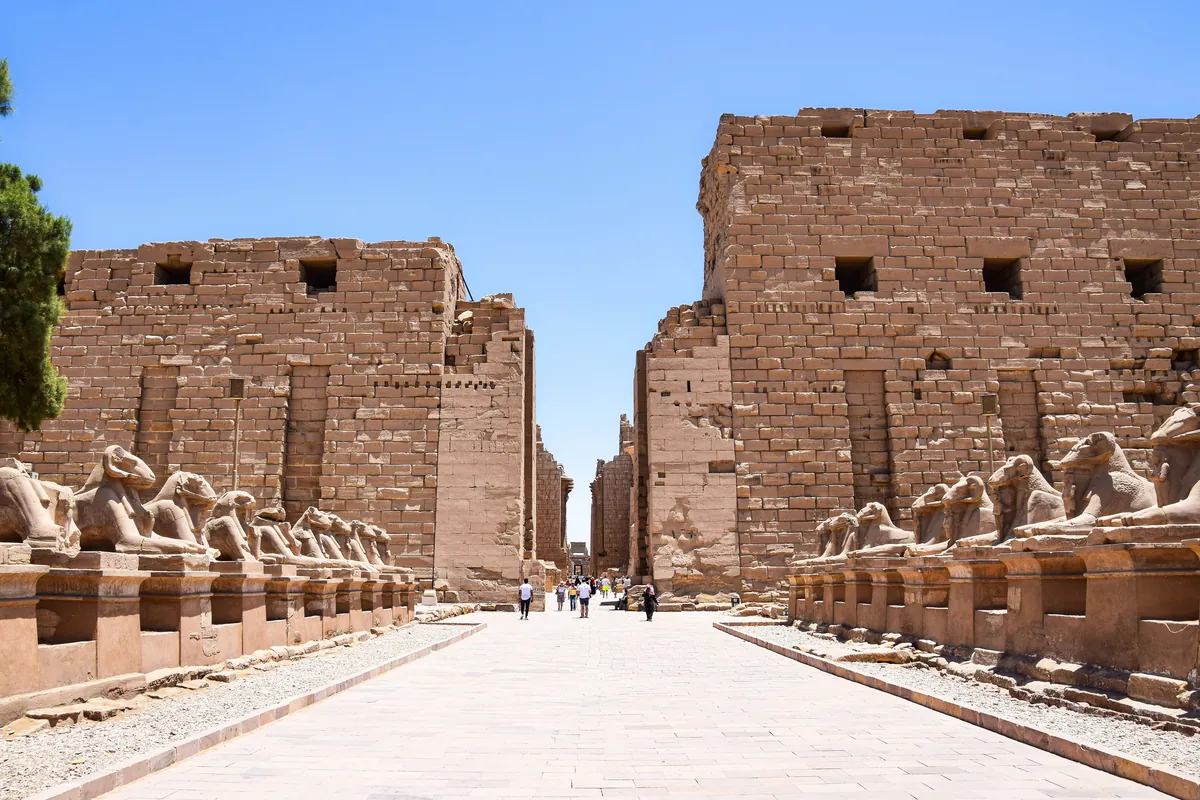
The Karnak temple complex, whose original name Ipet-isut meant 'the most select of places', was begun under Senusret I around 1971–1926 BC and expanded for centuries into the New Kingdom, becoming the main place of worship of the Theban Triad headed by the god Amun. Its Great Hypostyle Hall alone covers 5,000 square metres and holds 134 massive columns arranged in 16 rows, the tallest reaching 21 metres, topped with architraves estimated to weigh 70 tons apiece; nearby stands one of the site's largest obelisks, at 29 metres and 328 tons, its sandstone quarried 100 miles south at Gebel Silsila and floated down the Nile. Karnak was added to the UNESCO World Heritage List in 1979 as part of the wider monumental city of Thebes and today ranks as the second most-visited historical site in Egypt after the Giza pyramid complex.
Luxor Temple, on the Nile's east bank, was built around 1400 BCE and known in ancient Egyptian as Ipet-resyt, 'the southern sanctuary'; unlike most Theban temples it was dedicated not to a single deity but to the renewal of kingship itself, and may have hosted the coronation, in reality or in ritual concept, of numerous pharaohs. A 2.7-kilometre avenue lined with human-headed sphinxes once connected it directly to Karnak, used during the annual Opet Festival when a statue of Amun was carried by boat between the two temples. Centuries of accumulated village rubble had buried three-quarters of the temple by the time excavation began under Gaston Maspero after 1884; today the site is lit at night, and the active Abu Haggag Mosque, built atop its ancient columns after the temple was earlier converted into a church around 395 AD, represents more than 3,400 years of continuous religious use on the same ground.
Hatshepsut, the sixth pharaoh of the Eighteenth Dynasty and only the second confirmed woman to rule Egypt in her own right, began as regent for her young stepson Thutmose III before assuming the throne herself around 1472 BC. Among the most prolific builders in ancient Egyptian history, she commissioned her mortuary temple at Deir el-Bahari, where reliefs commemorate a trading expedition she sponsored to the Land of Punt that returned with 31 live myrrh trees and stores of frankincense — the first recorded use of the resin, which Hatshepsut had ground into kohl eyeliner. After her death, an effort during the later reign of Thutmose III sought to erase her from the historical record, chiselling her name and image from monument walls or replacing them with those of earlier kings, though enough survived at Deir el-Bahari and elsewhere for modern Egyptologists to reconstruct her reign.
Across the route, Luxor's monuments trace the full arc of New Kingdom power: the hidden royal tombs of the Valley of the Kings, the vast state temple of Karnak built up over centuries of pharaohs, the temple of kingship at Luxor still in religious use today, and the mortuary temple of the woman who ruled as pharaoh and was nearly erased from memory for it. Each stop belongs to the same Theban landscape that anchored ancient Egyptian religion and kingship for half a millennium.
Text adapted from the linked articles under CC BY-SA 4.0; edited for length.
Every dimension the Taro team tags this pack with — filter by any of these on the packs page.
Share your travel month, group size, budget comfort, and must-do experiences. The Taro team will shape the right route before any payment conversation.