Botswana Okavango Delta
8DFrom ₹3,65,000
A 6-day premium trip to Dakar, Senegal, taking in Gorée Island, House of Slaves, African Renaissance Monument and Lake Retba.
Dakar & Goree Island opens on Gorée Island itself, an 18.2-hectare island two kilometres off Dakar's main harbour and, since 1444, one of the first places in Africa visited by European traders, when Portuguese merchants established themselves there. Almost devoid of drinking water and largely unsettled before their arrival, the island passed between Portuguese, Dutch and eventually French control after the French invasion of 1677, with brief periods of British occupation during the wars fought between France and Britain in the 18th century, including a spell from 1758 to 1763 during the Seven Years' War. Today Gorée is the smallest and least populated of Dakar's nineteen communes, its population of under 2,000 living among the streets and buildings that carry this long colonial history.
On the island stands the House of Slaves, built around 1776 by the merchant Nicolas Pépin and associated in particular with his daughter, Anna Colas Pépin, a signare, or wealthy colonial trader, whose family owned ships engaged in the slave trade and used the house as a holding centre for enslaved Africans awaiting export. Opened as a museum and memorial in 1962 and curated for decades by Boubacar Joseph Ndiaye until his death in 2009, the House of Slaves and its 'Door of No Return' are visited today by people from Africa, Europe and the Americas as a place to reckon with the human toll of the Atlantic slave trade, even as historians continue to debate exactly how many enslaved people passed through this particular building and how central Gorée itself was to the wider trade.
Back on the mainland, the route reaches the African Renaissance Monument, a 50-metre bronze statue atop the Collines des Mamelles hills in the Ouakam suburb, overlooking the Atlantic. Designed by the Senegalese architect Pierre Goudiaby Atepa at the instigation of President Abdoulaye Wade and built by the North Korean firm Mansudae Overseas Projects, the statue depicts a man carrying a child and holding his wife by the waist, rising from the earth — a vision Wade linked to the Pan-African ideals of Senegal's first president, Léopold Sédar Senghor. Unveiled on 3 April 2010 before nineteen African heads of state, the monument has also drawn public criticism over its roughly US$27 million price tag, paid in land rather than cash, and over its scale in a city facing more pressing economic needs.
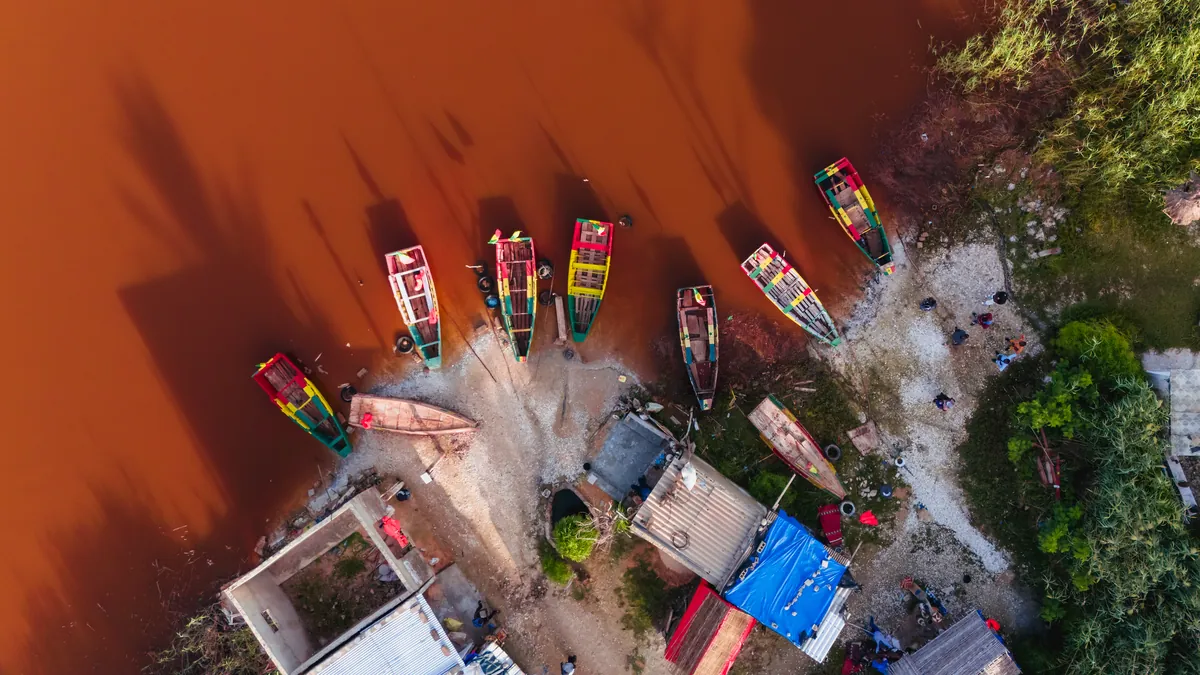
The final stop, Lake Retba, or Lac Rose, lies about 35 kilometres north-east of Dakar, separated from the Atlantic by a narrow band of dunes and coloured a distinctive pink by the alga Dunaliella salina, whose red pigment helps it absorb sunlight for energy. The lake's salt content can reach 40 percent, buoyant enough that swimmers float much as they would in the Dead Sea, and up to 3,000 collectors from across West Africa harvest salt from its waters for six or seven hours a day, protecting their skin with shea butter as they work; the colour is strongest in the dry season from November to May, and though flooding in 2022 temporarily turned the lake green, it has since partly regained its pink hue.
Across six days the pack runs from the colonial-era streets and slave-trade memorial of Gorée, back to the mainland monument above Dakar's Atlantic shore, and out to the salt-pink waters north of the city — a route through Senegal's most weighted history and one of its most visually distinct landscapes.
Text adapted from the linked articles under CC BY-SA 4.0; edited for length.
Every dimension the Taro team tags this pack with — filter by any of these on the packs page.
Share your travel month, group size, budget comfort, and must-do experiences. The Taro team will shape the right route before any payment conversation.