Abu Dhabi + Yas Island
5DFrom ₹1,05,000
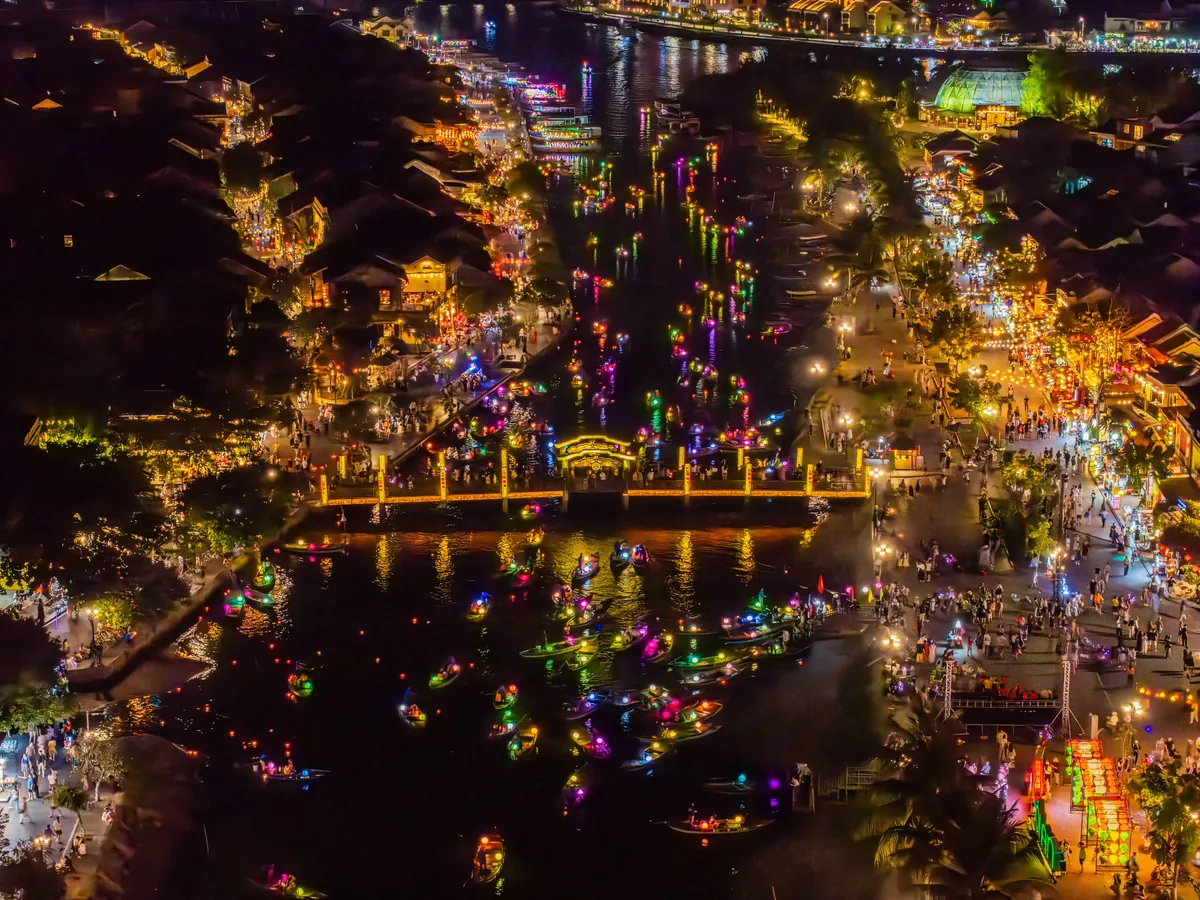
A 5-day mid-range route through Hoi An's lantern-lit old town.
The evenings unfold in Hoi An's lantern-lit old town, a trading post that served foreign merchants from the 15th to the 19th century and today preserves 1,360 heritage structures, including 1,068 old houses, across a site inscribed on the UNESCO World Heritage List since 1999. The settlement's location downstream of the Thu Bồn River first belonged to the Sa Huỳnh culture before the Kingdom of Champa claimed it in the early second century and built it into a key trading port on the maritime Silk Road; Vietnamese settlement followed from the late 15th century under the Nguyễn clan. Because the port fell into economic decline from the start of the 19th century, its old buildings were never replaced with newer construction, an accident of stagnation that left the town intact enough to be declared a National Cultural Heritage Site in 1985 and a Special National Cultural Heritage Site in 2009.
At its centre stands the Japanese Bridge, a covered footbridge with a small temple on its northern end, begun by Japanese merchants living in the port then known as Faifo in 1593 and completed in 1595 to improve access to the neighbouring Chinese quarter across the canal. In 1653, resident Japanese traders added the temple atop the bridge, according to legend to placate Namazu, the earthquake-causing catfish monster of Japanese folklore, decorating it with statues of the monkey and dog gods believed to hold Namazu in check. The bridge survived largely undisturbed after Japanese and Dutch traders withdrew from Hoi An in the 17th century, was granted status as a National Historic-Cultural Relic in 1990, and now appears on Vietnam's 20,000 đồng banknote.
Mỹ Sơn, a cluster of Hindu temples dedicated to Shiva, was built between the 4th and 13th centuries by the kings of Champa and served for centuries as the religious and cultural centre of the Cham civilisation. Its earliest structures, wooden buildings raised under King Bhadravarman I in the 4th century, burned in a great fire around 535 AD and were rebuilt in brick in the 7th century by his descendant Sambhuvarman; later kings continued adding and restoring temples for hundreds of years more, with most of the surviving structures dating to the 10th and 11th centuries. The site fell into obscurity after the Vietnamese conquest of Champa and was rediscovered by the French archaeologist Camille Michel Paris in 1898, after which French scholars began restoration work in 1937; extensive damage followed when the area, then a wartime base area, was bombed in August 1969, and the surrounding forest still carries unexploded ordnance from that period.
The Chàm Islands, a group of eight small granite islands reached from Cửa Đại beach and protected as a UNESCO Biosphere Reserve, were first settled by Cham people roughly 3,000 years ago, according to archaeologists, and later served the mainland as a transhipment point for goods including pepper, cinnamon bark and ivory traded through the port of Hội An. Their waters hold 165 hectares of coral reef and 500 hectares of seaweed beds, home to 135 coral species and four species of tiger shrimp, some of which appear in Vietnam's and the world's Red Book of endangered species, while inland, monuments including the 1753 Hải Tạng pagoda and 1843 Thần Yến Sào shrine remain from the islands' later Cham and Vietnamese settlement.
Across the evenings, Hoi An's old town and its surroundings trace a single Cham-and-trading-port history: a merchant town that outlasted its own economic decline, a bridge built by Japanese traders to placate a mythical monster, a Hindu temple complex built and rebuilt across nine centuries of Champa kings, and an island chain that once carried goods between them all. Each stop belongs to the same layered network of cultures that passed through this stretch of the central Vietnamese coast.
Text adapted from the linked articles under CC BY-SA 4.0; edited for length.
Every dimension the Taro team tags this pack with — filter by any of these on the packs page.
Share your travel month, group size, budget comfort, and must-do experiences. The Taro team will shape the right route before any payment conversation.