Abu Dhabi + Yas Island
5DFrom ₹1,05,000
Hanoi Old Quarter → Ha Long Bay → Hoi An lantern town → Ho Chi Minh.
Hanoi, Vietnam's capital, opens this ten-day heritage trail that runs south to the outskirts of Ho Chi Minh City and northeast to the coast. It is the country's second-most populous centrally governed city, covering 3,358.6 square kilometres and recording a population of 8,807,523 as of 2025, with a gross regional domestic product of US$48 billion in 2023, second only to Ho Chi Minh City among Vietnam's provinces and centrally governed cities. The city recorded 18.7 million domestic and international visitors in 2022 and hosts 78 foreign embassies alongside the headquarters of the Vietnam People's Army and the Vietnam National University system. Its urban core mixes pre-colonial Vietnamese architecture with French colonial buildings, brutalist apartment blocks, and the narrow tube houses that grew up along its older streets as the city expanded through the twentieth century.
Hanoi's site has carried several names across its history: Long Biên, then Tống Bình, and Long Đỗ, the last a reference to the curved course of the Red River around the city, before it was turned into a citadel named Đại La in 866. Arab manuscripts of the ninth to twelfth centuries referred to it as Luqin, a name Muslim traders derived from Longbian. In 1010, the Lý dynasty emperor Lý Thái Tổ established the capital of the kingdom of Đại Việt on this site and renamed it Thăng Long, a name still attached to the Imperial Citadel that stands in the modern city. The trail's opening days move through the Old Quarter that grew up around that citadel, part of an urban fabric the city itself describes as layering pre-colonial building traditions with the French colonial and later brutalist construction that followed.
From Hanoi, the trail heads out to Ha Long Bay, a bay in northeastern Vietnam administered by the city of Quảng Ninh whose name means "descending dragon." It holds thousands of limestone karsts and islets, a formation recognized as a UNESCO World Heritage Site, and covers around 1,553 square kilometres with 1,969 islets in total, including a denser core zone of 334 square kilometres holding 775 islets; the limestone itself took roughly 500 million years to form, and the karst landscape visible today is the product of about 20 million years of erosion under a tropical wet climate. Local legend, reinforced by nineteenth-century Nguyễn dynasty accounts, holds that the gods sent a family of dragons to help defend the country and that the jewels and jade they spat out became the islands scattered across the bay, with the dragons said to have stayed on afterward.
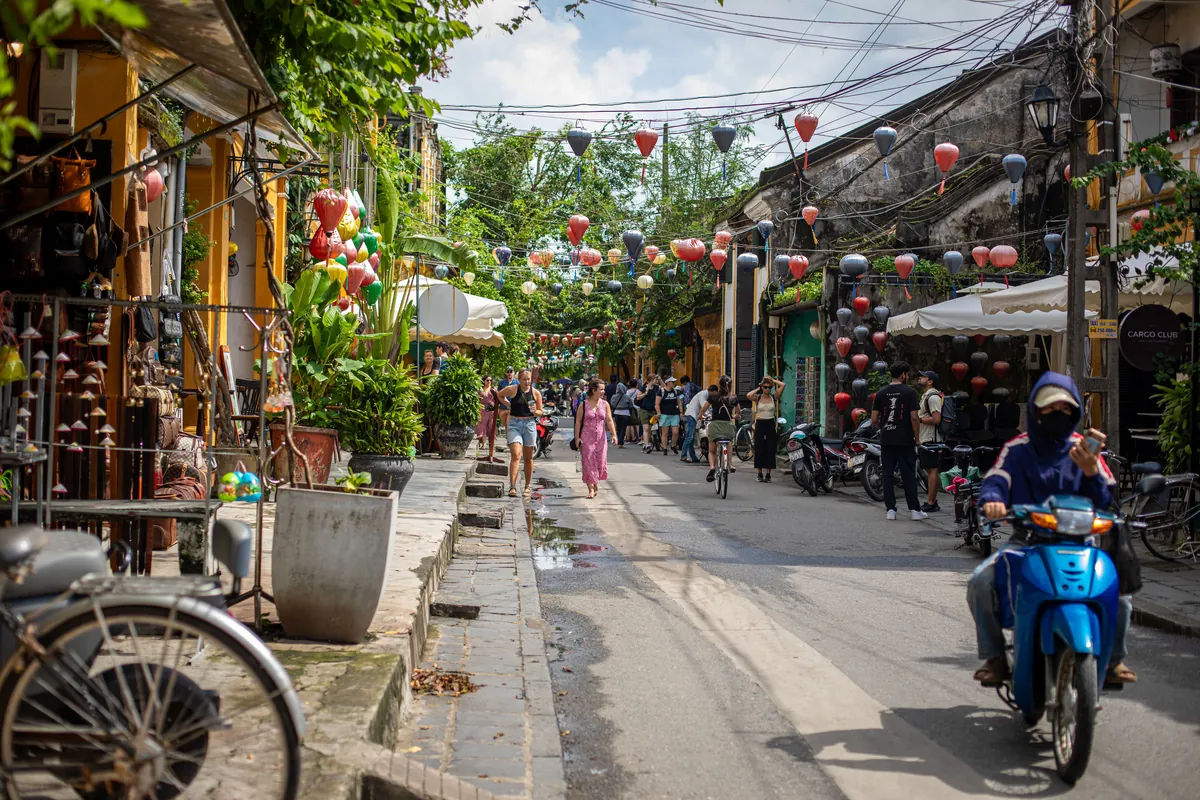
Further south, the trail reaches Hoi An Old Town, a heritage site and former trading post that operated from the fifteenth to the nineteenth century, a status the newer city around it still partly maintains. The site was first part of the Sa Huỳnh culture before it was claimed by the Kingdom of Champa from the early second century, when it became one of the kingdom's key foreign trading ports and a stop on the maritime Silk Road. From the end of the fifteenth century, an influx of Vietnamese residents brought the area under the control of the Nguyễn clan, and by the early seventeenth century a steady arrival of Chinese and Japanese traders had created the diverse neighbourhoods and streets that still make up the old town today. That history survives across some 1,360 monuments and heritage structures, including 1,068 houses and the Japanese Bridge, a record that has kept Hoi An Old Town on the UNESCO World Heritage list since 12 December 1999.
The trail's final stop is the Củ Chi tunnels, an extensive underground network in the Củ Chi District on the outskirts of Ho Chi Minh City, part of a still larger tunnel system running beneath much of the country. The tunnels served as a base for several Viet Cong military campaigns during the Vietnam War, including the 1968 Tết Offensive, and beyond combat they functioned as hiding spots, communication and supply routes, food and weapon caches, and living quarters for the fighters who used them to resist American and allied forces. Conditions inside were difficult: air, food, and water were scarce, the tunnels were shared with ants, centipedes, snakes, scorpions, and rodents, and soldiers often worked or rested underground by day, surfacing only at night to tend crops, gather supplies, or engage the enemy, sometimes staying below for days at a stretch during heavy bombing. American forces, aware of the advantage the tunnels gave their opponents, launched major operations against them, including Operation Crimp, which began on 7 January 1966 with B-52 strikes that turned the surrounding jungle into what has been described as a pockmarked moonscape.
Text adapted from the linked articles under CC BY-SA 4.0; edited for length.
On documentation, this trip is in the e-visa band, generally sorted online before travel — treat that as a planning signal only, and verify exact, current requirements with the relevant embassy or consulate before booking. It runs 10 days, from ₹78,000 per person.
Every dimension the Taro team tags this pack with — filter by any of these on the packs page.
10 days across Vietnam, starting from ₹78,000 per person.
Suited to Couples and Friends, with a suitable option for families and a moderate activity level.
This trip sits in the e-visa complexity band — usually arranged online ahead of travel. Always confirm exact, current requirements with the relevant embassy or consulate before booking — this is a planning signal, not a legal statement.
Share your travel month, group size, budget comfort, and must-do experiences. The Taro team will shape the right route before any payment conversation.