Abu Dhabi + Yas Island
5DFrom ₹1,05,000
Samarkand Registan, Bukhara madrasahs, Khiva walled city.
This trip opens in Tashkent, Uzbekistan's capital and largest city, and the most populous city in Central Asia at more than 3.1 million people. Its history stretches back centuries as part of the ancient Silk Road, the network of trade routes linking the eastern and western worlds, and the city has long served as a crossroads of cultures, goods, and ideas passing between them. Before Islam took hold in the mid-eighth century AD, Sogdian and Turkic culture predominated here, and after Genghis Khan destroyed the city in 1219, it was rebuilt and went on to profit anew from its position on the Silk Road. Its name is generally traced to the Turkic tash and Persian kent, together meaning "Stone City," a later gloss on the older name Chach.
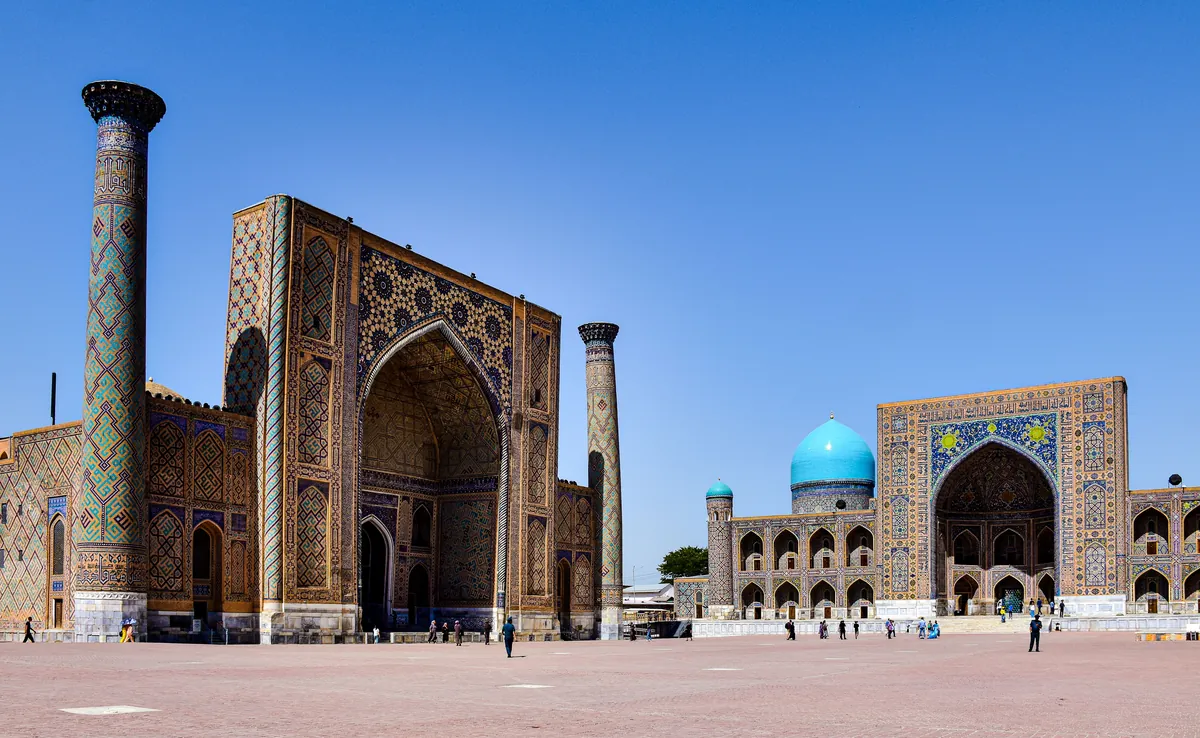
In Samarkand, the trip visits Registan Square, once the heart of the Timurid Empire and later the city's commercial, educational, and ceremonial centre. Its ensemble of three madrasas — the Ulugh Beg Madrasa from the Timurid period and the later Sherdar and Tilakari madrasas, built under the Janid dynasty — is renowned for soaring iwans, turquoise domes, and intricate mosaic tilework regarded as among the finest achievements of Islamic architecture in Central Asia.
Nearby, the trip walks Shah-i-Zinda, a necropolis in Samarkand's northeastern quarter whose name, "the Living King," refers to a legend that Qutham ibn Abbas, a cousin of the Prophet Muhammad who came to Samarkand in the seventh century to preach Islam, is buried there — said, in one telling, to have picked up his own severed head and walked to a deep well where he is believed to reside still. Formed over eight centuries, from the eleventh to the nineteenth, the complex today includes more than twenty mausoleums and ritual buildings arranged across three groups of structures.
In Bukhara, the trip enters the Ark of Bukhara, a massive earthen fortress first built and occupied around the fifth century AD, its current form developed from the sixteenth century under the Shaybanid Uzbek dynasty. Enclosing 3.96 hectares within external walls 789.6 metres around and up to 20 metres high, the Ark functioned as both a military stronghold and a self-contained town, home to the royal courts that ruled the region, until it fell to Russian forces in 1920; today it holds museums covering the fortress's history. Legend attributes its founding to Prince Siyâvash, said to be buried within it, and much of the citadel's design reflects astrological symbolism, including seven stone pillars said to represent the seven stars of Ursa Major.
The trip closes at Itchan Kala, the walled inner town of Khiva, protected as a UNESCO World Heritage Site since 1990 and home to more than 50 historic monuments and 250 old houses, most dating from the eighteenth or nineteenth centuries. Its Juma Mosque, established in the tenth century and rebuilt between 1788 and 1789, still stands on a hypostyle hall of 112 columns taken from older structures, and the town's inner defensive walls, 8 to 10 metres high and 5 to 6 metres thick, run 6,250 metres in total, punctuated every 30 metres by projecting watchtowers.
Text adapted from the linked articles under CC BY-SA 4.0; edited for length.
On documentation, this trip sits in the simplest visa-complexity band for this trip — treat that as a planning signal only, and verify exact, current requirements with the relevant embassy or consulate before booking. It runs 9 days, from ₹1,15,000 per person.
Every dimension the Taro team tags this pack with — filter by any of these on the packs page.
9 days across Uzbekistan, starting from ₹1,15,000 per person.
Suited to Couples and Friends, with a suitable option for families and a moderate activity level.
This trip sits in the simplest visa-complexity band for this trip. Always confirm exact, current requirements with the relevant embassy or consulate before booking — this is a planning signal, not a legal statement.
Share your travel month, group size, budget comfort, and must-do experiences. The Taro team will shape the right route before any payment conversation.