Abu Dhabi + Yas Island
5DFrom ₹1,05,000
A 5-day premium route through Bukhara's old city on the Silk Road.
The walk through Bukhara's old city begins at the Ark, a massive earthen fortress in the northwestern part of the city, occupied since around the 5th century AD, when it was already the residence of local rulers. Its perimeter walls run nearly 790 metres around and stand 16 to 20 metres high, enclosing what was effectively a self-contained royal town of reception halls, a court mosque, storerooms and even prison cells reached through a winch-raised portal. According to the 10th-century historian Narshakhi, the fortress was destroyed and rebuilt many times until its final builder was advised to lay it out around seven points mirroring the constellation Ursa Major, after which, legend holds, it was never destroyed again; local tradition instead credits its founding to the epic hero Siyavash, of Ferdowsi's Shahnameh. The Ark served as the seat of Bukhara's rulers until it fell to Russian forces in 1920, and it now holds museums covering that long history, including its throne room and coronation court.
Nearby, Lab-i Hauz is the plaza surrounding one of the last surviving hauz, or ornamental pools, of the many that once supplied Bukhara's water before being filled in during the 1920s and 1930s for spreading disease. This pool, a rectangular basin edged in yellowish limestone, survived because it anchors an architectural ensemble built in the 16th and 17th centuries: the Kukeldash Madrasah of 1568, the largest in the city with 160 cells, on its north side, and two buildings commissioned by the vizier Nadir Divan-Beghi on the others, including a khanqah, or Sufi lodge, built after Divan-Beghi's plan to buy the site from a Jewish widow was blocked by a council of muftis who ruled her consent could not be legally compelled. A modern statue of Nasreddin, the trickster of Muslim folklore whom Bukharans claim as one of their own, now stands beside the water.
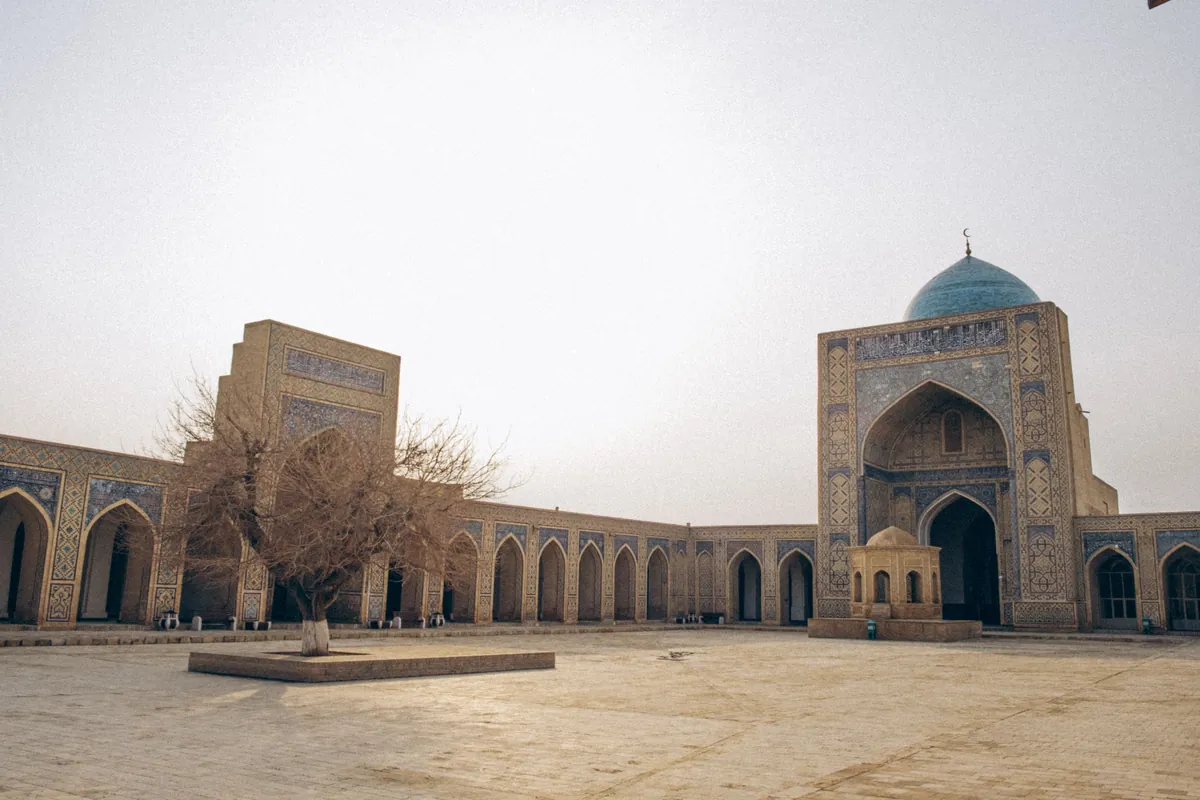
Rising above the old city is the Kalyan Minaret, part of the Po-i-Kalyan mosque complex and among the most prominent landmarks in Bukhara. Built in 1127 under the Qarakhanid ruler Muhammad Arslan Khan to summon worshippers to prayer, it stands 45.6 metres high, tapering from a 9-metre base to 6 metres near its lantern crown, and is linked to the adjoining Friday Mosque by an arched footbridge. Its architect, known as master Bako, was said to have asked to be buried at the spot 45 metres from the tower where he predicted it would fall if it ever collapsed; it never has, and only one other minaret in Central Asia, at Kunya-Urgench, has a wider base.
On the edge of the city, Sitorai Mokhi-Khosa, whose name translates as 'Palace like the Stars and the Moon', began as an 18th-century residence later rebuilt and expanded under Emir Said Abd al-Ahad Khan and completed under Bukhara's last emir, Sayyid Mir Muhammad Alim Khan, who ruled from 1912 to 1920. Built in a European style around a traditional division into male and female quarters with Eastern interior decoration, its construction brought together Uzbek master craftsmen alongside two Russian court engineers. The palace became a museum in 1927, and today its rooms display 19th- and 20th-century palace furniture, Bukharan gold-embroidered textiles and porcelain gathered from China, Japan and Russia.
The four stops trace Bukhara's history as a Silk Road capital in miniature: a fortress rebuilt and refounded across some 1,500 years at the city's political heart, a surviving pool plaza that was once one of many before Soviet sanitation filled the rest, a minaret old enough to have stood since the 12th century, and a late imperial summer palace built as the emirate came under Russian influence. Together they span the full arc of Bukhara's rule, from its earliest recorded citadel to the fall of its last emir.
Text adapted from the linked articles under CC BY-SA 4.0; edited for length.
Every dimension the Taro team tags this pack with — filter by any of these on the packs page.
Share your travel month, group size, budget comfort, and must-do experiences. The Taro team will shape the right route before any payment conversation.