Abu Dhabi + Yas Island
5DFrom ₹1,05,000
A 5-day premium route to Pamukkale's travertine terraces and Roman ruins.
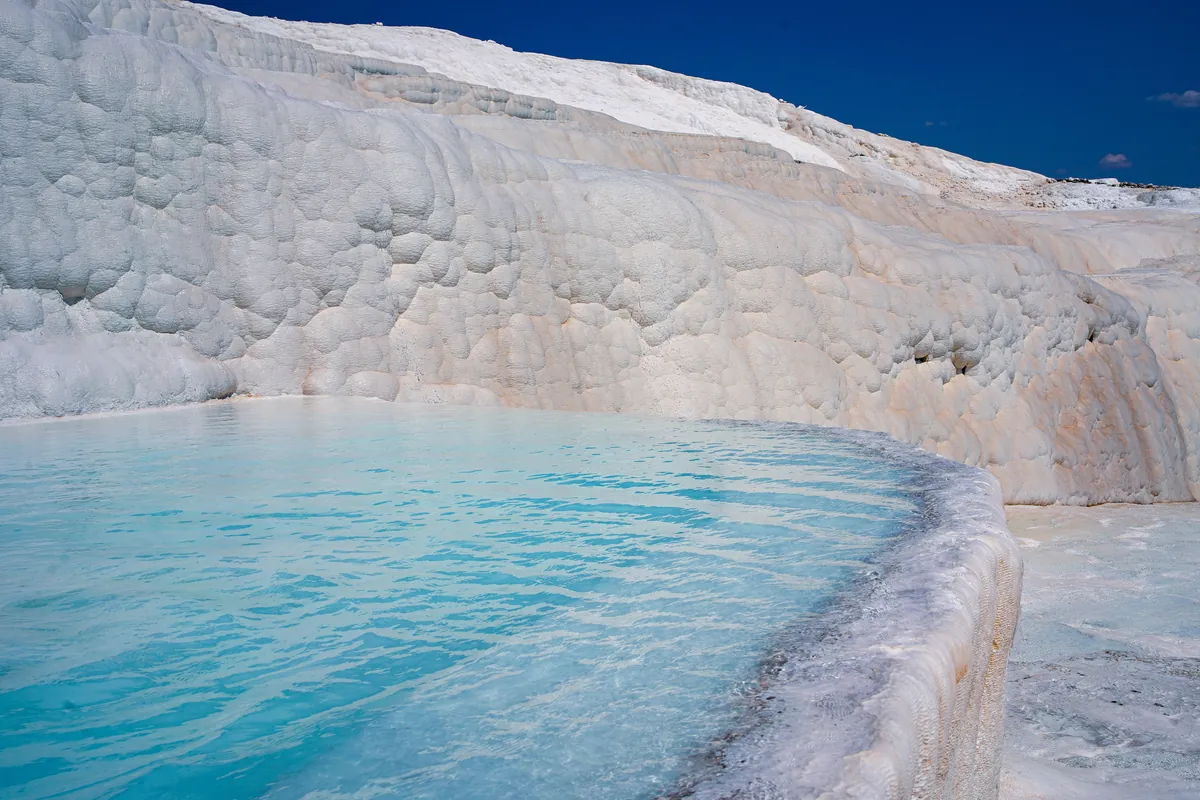
The route centres on Hierapolis, a Hellenistic Greek city founded in the 3rd century BC on the site of an earlier Phrygian sanctuary to the mother goddess Cybele, its ruins spread adjacent to the white travertine terraces of modern Pamukkale, whose name means "cotton castle" in Turkish. Renowned in antiquity for its hot springs, fine wool and dyes, and as the birthplace of the Stoic philosopher Epictetus, the city drew visitors seeking its thermal waters for centuries, growing under Roman rule into a city of some 100,000 people after Caracalla granted it special privileges in 215. Its necropolis, one of the best-preserved in Turkey, holds around 1,200 tombs spanning the Hellenistic, Roman and early Christian periods, and the site's Ploutonion, a small cave once believed to be a gateway to the underworld for the carbon-dioxide gas it releases, drew pilgrims who watched Cybele's priests apparently withstand the fumes. Hierapolis was inscribed as a UNESCO World Heritage Site in 1988, and Italian archaeologists have excavated there since 1957. The route descends into Denizli, the modern city that has grown beside Hierapolis and Laodicea, home to some 692,000 people and a textile industry that has driven its recent economic growth. Known in antiquity as Attouda, the settlement was later resettled by Seljuk Turks with people from nearby Laodicea, and the 14th-century traveller Ibn Battuta described it as a city of seven mosques and gushing springs, its markets largely staffed by Greek artisans under Seljuk rule. Today Denizli also serves as the gateway to the region's other thermal spa towns, including Karahayıt to the north, and to the marble and travertine quarries that still supply local building stone. The route continues to Laodicea on the Lycus, founded around 261–253 BC by the Seleucid king Antiochus II and named for his wife Laodice, on a hilltop between the Asopus and Caprus rivers a short distance from Hierapolis. Grown wealthy on trade in black wool and large-scale banking under Roman rule, the city built a stadium, gymnasium, two theatres and an aqueduct fed by an inverted siphon system that carried water across the valley under pressure, one of the more technically demanding solutions Roman engineers applied anywhere in Asia Minor. Laodicea's large Jewish community made it an early centre of Christianity, later named among the seven churches of Asia in the Book of Revelation, and ongoing excavations by Pamukkale University since 2002 have restored its 8,000-seat west theatre and uncovered a 2015 marble inscription recording ancient water-use regulations. The route's final stop is Aphrodisias, a Hellenistic city named for its unique cult image of Aphrodite, located near the modern village of Geyre and inscribed as a UNESCO World Heritage Site in 2017. Built up around abundant local marble quarries, the city became famous across the Roman world for its school of sculptors, and its surviving buildings include a tetrapylon gateway from around 200 AD, a stadium measuring 270 by 60 metres with seating for around 30,000 spectators, and a Sebasteion dedicated jointly to Aphrodite and the imperial Julian dynasty, which traced its own descent from the goddess. Excavations led by Kenan Erim from 1962 under New York University, and continued by teams from Oxford, have recorded more than 2,000 inscriptions at the site, among the largest such collections from the ancient world, before an early 7th-century earthquake left the city in permanent decline. Across five days the route traces a single river valley shaped by the same tectonic forces and ancient trade: the mineral terraces and thermal city of Hierapolis, the modern textile city of Denizli grown up beside it, the wool-and-banking metropolis of Laodicea across the valley, and the marble city of Aphrodisias further south — four settlements whose wealth, in every case, rested on the water, stone or wool of the land beneath them.
Text adapted from the linked articles under CC BY-SA 4.0; edited for length.
Every dimension the Taro team tags this pack with — filter by any of these on the packs page.
Share your travel month, group size, budget comfort, and must-do experiences. The Taro team will shape the right route before any payment conversation.