Arctic Svalbard Polar Bears
8DFrom ₹6,85,000
A 7-day luxury alpine week beneath the Matterhorn.
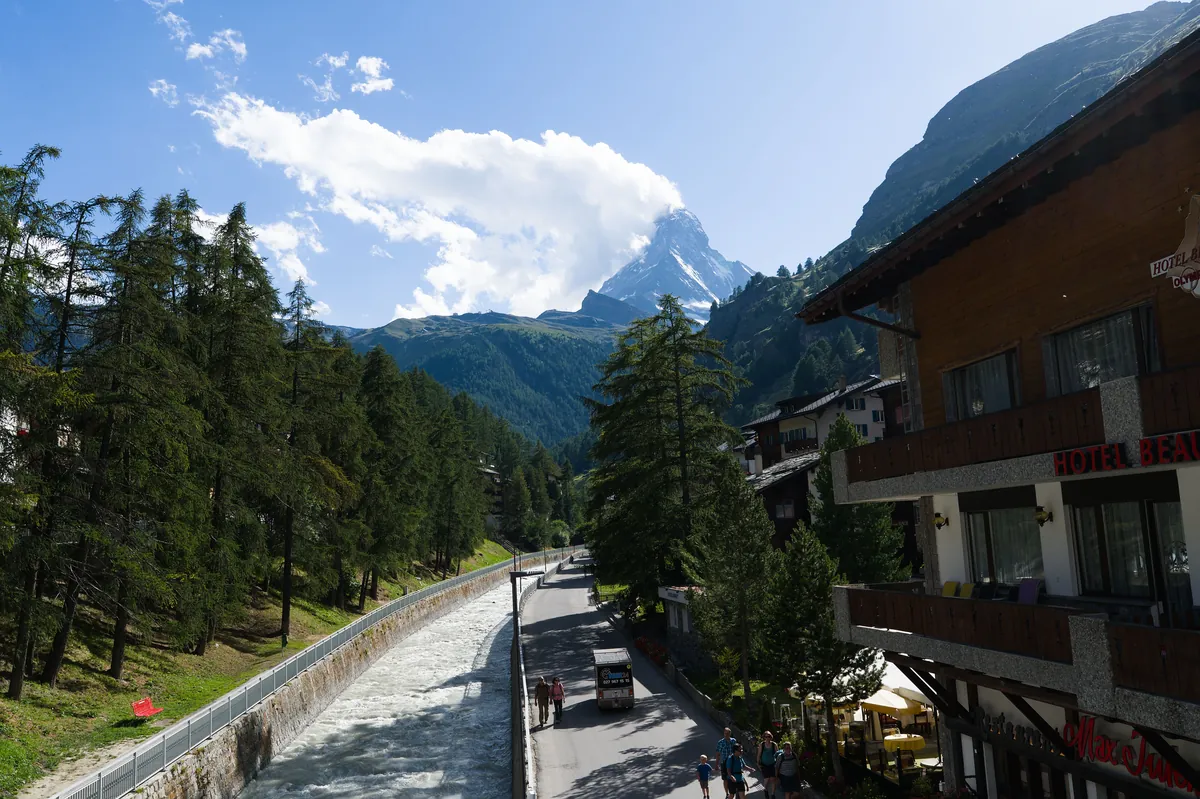
The week is built around the Matterhorn, a near-symmetric pyramidal peak straddling the Swiss–Italian border at 4,478 metres, its four steep faces roughly aligned to the compass points and separated by the Hörnli, Furggen, Zmutt and Lion ridges. Studied by the geologist Horace-Bénédict de Saussure in the late 18th century, the mountain resisted ascent longer than most other great Alpine peaks, becoming the focus of an international race that ended in 1865 when a party led by Edward Whymper reached the summit from Zermatt — only for a fall during the descent to claim four of the seven climbers' lives, a disaster later credited with closing the golden age of alpinism. Formed as gneiss from the Dent Blanche nappe, a fragment of the African plate carried north during the Alpine collision, the mountain's pyramidal shape is the product of glacial erosion carving cirques into what was once a rounded summit. The Hörnli ridge above Zermatt remains the standard climbing route today, while most visitors instead see the peak from the village or from the cable cars and railways built into the surrounding mountains since the late 19th century. The route climbs to the Gornergrat, a rocky ridge at 3,135 metres reached by the Gornergrat rack railway, the highest open-air railway in Europe, opened in 1898 and climbing nearly 1,500 metres from Zermatt through Riffelalp and Riffelberg. From the ridge, views open across 29 peaks above 4,000 metres, among them Dufourspitze in the Monte Rosa massif, Liskamm, the Matterhorn, the Dom and the Weisshorn; an observatory built atop the ridge's Kulmhotel in the late 1960s once housed the Gornergrat Infrared Telescope and, until 2010, the KOSMA radio telescope, and continues to host astronomical work today. South of the village lies the Theodul Glacier, descending from the Breithorn and splitting above Gandegg into upper and lower branches that feed the Rhone basin through the Gornera and Vispa rivers. Its upper section forms the Breithorn Plateau at around 3,800 metres, reached by cable car from Zermatt and, since a 2023 connection opened via Testa Grigia, from the Italian side as well; several small lakes formed here in the 1980s at the glacier's base, the largest, Theodulgletschersee, ranking as the highest lake over four hectares in Switzerland. Most of the glacier now lies within a year-round ski area marketed as Matterhorn Glacier Paradise, Europe's highest and, by area, the largest summer ski ground in the world, linking the resorts of Zermatt and Breuil-Cervinia across the glaciated Theodul Pass that Roman traders once crossed on foot. The week's final stop is the Riffelsee, a small alpine lake at 2,757 metres beneath the Riffelhorn, reachable from the Rotenboden station on the Gornergrat railway. Its still, shallow water is known chiefly for reflecting the Matterhorn on calm days, a view that has made it a frequent stopping point on the walk down from Gornergrat toward Zermatt through the same high-altitude terrain the railway otherwise crosses at speed. Across seven days the week keeps a single mountain in constant view from four different vantage points: the pyramidal peak itself, the panoramic ridge of the Gornergrat, the glacier and ski plateau at its base, and the small lake at Riffelsee where, weather permitting, the Matterhorn appears a second time in the still water below it.
Text adapted from the linked articles under CC BY-SA 4.0; edited for length.
Every dimension the Taro team tags this pack with — filter by any of these on the packs page.
Share your travel month, group size, budget comfort, and must-do experiences. The Taro team will shape the right route before any payment conversation.

