Arctic Svalbard Polar Bears
8DFrom ₹6,85,000
A 6-day luxury route through Lucerne's old town and a Mount Pilatus ascent.
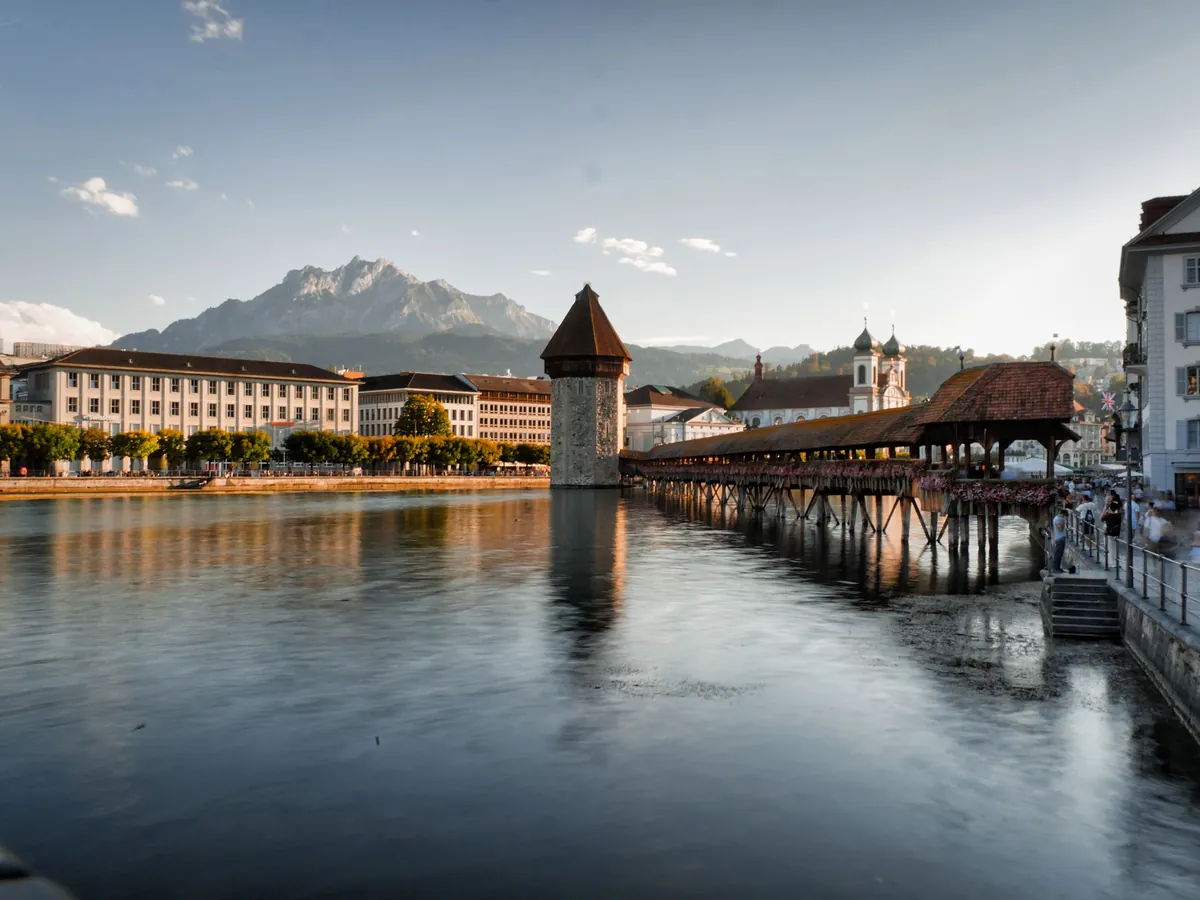
The visit centres on the Kapellbrücke, a covered wooden footbridge built around 1365 as part of Lucerne's fortifications, linking the old town to the new across the Reuss and today recognised as the oldest wooden covered bridge in Europe and the world's oldest surviving truss bridge. Its interior once carried 158 triangular painted panels by the local artist Hans Heinrich Wägmann, depicting scenes from Lucerne's history — a feature unique among Europe's wooden footbridges — though a 1993 fire destroyed much of the bridge and all but 47 of the paintings, of which only 30 could be fully restored after reconstruction. The adjoining octagonal Wasserturm, or water tower, predates the bridge by about thirty years and has served over the centuries as a prison, a torture chamber, a municipal archive and a treasury.
The bridge crosses toward Lake Lucerne, known in German as Vierwaldstättersee, or 'Lake of the four forest cantons', the fourth-largest lake in Switzerland, formed at the end of the last ice age from the meltwater of the retreating Reuss Glacier between roughly 20,000 and 15,000 BCE. Archaeologists surveying the lakebed during pipeline construction between 2019 and 2021 uncovered the remains of a Bronze Age village dated to around 1000 BCE, pushing back the known history of settlement in the area by some 2,000 years. The lake has served as a transport corridor since at least the opening of the Gotthard Pass route in 1230, and its scenery inspired the title of Beethoven's Moonlight Sonata, so named by the critic Ludwig Rellstab in 1832 after comparing its opening movement to moonlight on the water.
Overlooking the lake, Pilatus rises to 2,128.5 metres at its highest peak, Tomlishorn, its name traced by local legend either to a belief that Pontius Pilate was buried there or to the Latin pileatus, meaning 'cloud-topped'. The mountain has drawn notable visitors since at least the naturalist Conrad Gessner and later figures including Theodore Roosevelt and Queen Victoria, and since 1889 has been served by the steepest cog railway in the world, running from Alpnachstad to the summit.
In the city itself stands the Lion Monument, a rock relief designed by the Danish sculptor Bertel Thorvaldsen and carved into a former sandstone quarry in 1820–21 by the stonemason Lukas Ahorn. It commemorates the Swiss Guards killed in 1792 defending King Louis XVI when revolutionaries stormed the Tuileries Palace in Paris, a memorial financed by public subscription organised by a surviving officer, Karl Pfyffer von Altishofen, beginning in 1818. Mark Twain, visiting in 1880, called its wounded lion 'the most mournful and moving piece of stone in the world', and the monument, visited by around 1.4 million people annually, was placed under official Swiss protection in 2006.
Across the visit, Lucerne draws together water, mountain and memory into a single lakeside city: the medieval bridge that once defended the town, the glacially carved lake beneath it, the peak that has drawn travellers since the Renaissance, and the carved lion that mourns a distant revolution. Each stop belongs to the same central Swiss landscape shaped by ice, trade routes and centuries of visitors.
Text adapted from the linked articles under CC BY-SA 4.0; edited for length.
Every dimension the Taro team tags this pack with — filter by any of these on the packs page.
Share your travel month, group size, budget comfort, and must-do experiences. The Taro team will shape the right route before any payment conversation.