Arctic Svalbard Polar Bears
8DFrom ₹6,85,000
Glacier Express, Jungfraujoch top of Europe, Zermatt Matterhorn.
This train journey opens in Zurich, Switzerland's largest city, at the northwestern tip of Lake Zurich, with a municipal population of 436,551 and a metropolitan area of about 2.1 million. Evidence of settlement in the area reaches back more than 6,400 years, and the Romans, who built a customs post here called Turicum, gave the city its earliest recorded name; in the Middle Ages Zurich gained the privileged status of imperial immediacy, and in 1519 it became a leading centre of the Protestant Reformation under the reformer Huldrych Zwingli.
The journey's centrepiece is the Glacier Express, an eight-hour, 291-kilometre train that links the resorts of Zermatt and St Moritz via Andermatt through the central Swiss Alps, sometimes called the slowest express train in the world. Along the way it crosses 291 bridges and passes through 91 tunnels, including the 15.4-kilometre Furka Tunnel, and reaches its high point at the Oberalp Pass, 2,033 metres above sea level. First run on 25 June 1930 and named for the nearby Rhone Glacier, the train operated only in summer until 1982, when the opening of the Furka Base Tunnel allowed it to run year-round for the first time, even as it lost its direct view of the glacier that gave it its name.
From the rail line, the trip detours to the Jungfraujoch, a snow saddle at 3,463 metres between the Jungfrau and Mönch peaks of the Bernese Alps, overlooked by the rocky Sphinx outcrop. Reachable by rail since 1912 via a line that runs partly through a tunnel bored through the Eiger and Mönch, the Jungfraujoch railway station, at 3,454 metres, is the highest in Europe, and its Top of Europe building includes panoramic restaurants and an exhibition space above the upper snows of the Aletsch Glacier, the longest glacier in the Alps.
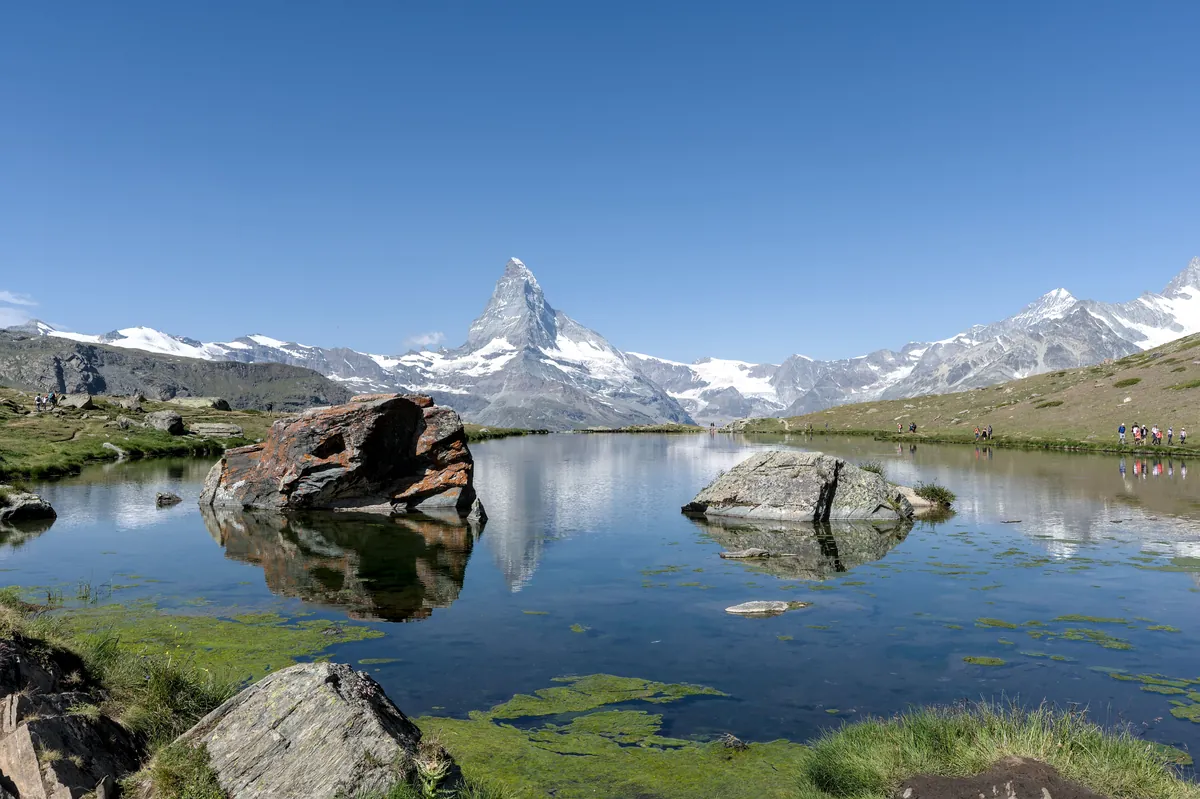
Views of the Matterhorn, straddling the Swiss-Italian border in the Pennine Alps at 4,478 metres, follow — a near-symmetric pyramidal peak that has been described as the most beautiful mountain in the world and claimed to be the most photographed. Its name comes from the German Matte, "meadow," and Horn, and the Genevan geologist Horace Bénédict de Saussure made the first measurement of its height in August 1792 using a sextant and a 50-foot chain laid across the Theodul glacier, calculating a figure of 4,501.7 metres, not far from the modern measurement.
The journey closes at Lake Lucerne, central Switzerland's fourth-largest lake, formed at the end of the last ice age from the meltwater of the retreating Reuss Glacier between roughly 20,000 and 15,000 BCE. Archaeological surveys of the lakebed carried out between 2019 and 2021 during pipeline construction uncovered a Bronze Age village dating to around 1000 BCE, pushing back the known settlement of the area by two millennia, and the lake has served as a transport route since at least 1230, when the opening of the Gotthard Pass made it the sole connection along that Alpine corridor until 1863. The lake's irregular, four-armed shape is divided into nine named sections, from the Urnersee at the mouth of the Reuss between Flüelen and Brunnen to the Küssnachtersee in the north, and the first steamer to cross it, the Stadt Luzern, began service in 1837, modernising the movement of goods and passengers across the water that the Glacier Express's cousins once served by rail alone.
Text adapted from the linked articles under CC BY-SA 4.0; edited for length.
On documentation, this trip typically involves an online e-visa arranged ahead of travel — treat that as a planning signal only, and verify exact, current requirements with the relevant embassy or consulate before booking. It runs 8 days, from ₹2,35,000 per person.
Every dimension the Taro team tags this pack with — filter by any of these on the packs page.
8 days across Switzerland, starting from ₹2,35,000 per person.
Suited to Couples, Friends, and Luxury Travellers, with a suitable option for families and a moderate activity level.
This trip typically involves an online e-visa arranged ahead of travel. Always confirm exact, current requirements with the relevant embassy or consulate before booking — this is a planning signal, not a legal statement.
Share your travel month, group size, budget comfort, and must-do experiences. The Taro team will shape the right route before any payment conversation.