Abu Dhabi + Yas Island
5DFrom ₹1,05,000
A 5-day mid-range route through Galle's colonial fort and southern coast.
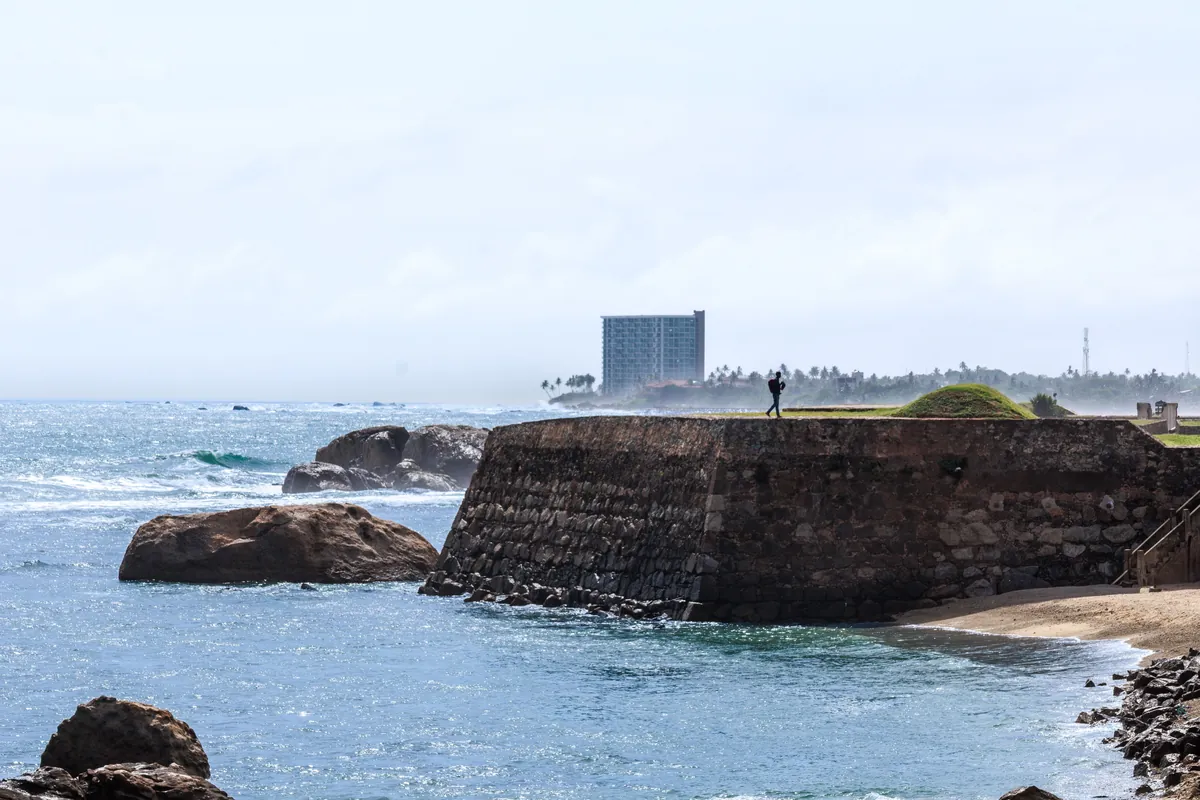
The coast walk begins along the Galle Fort ramparts, first built by the Portuguese in 1588 and then extensively refortified by the Dutch from 1649 onward, who considered the earlier earthen palisades inadequate and encircled the entire peninsula in coral and granite bastions. The harbour's history reaches back further still, appearing on Ptolemy's world map of 125–150 CE as a trading port linking Greece, Arabia and China, and it was here that the Portuguese under Lourenço de Almeida first landed in Sri Lanka in 1505. Today the fort, a UNESCO World Heritage Site covering 52 hectares, holds a mixed population — more than half of its residents are Moors, alongside Sinhalese, Dutch, English and Portuguese descendants — and streets still bearing Dutch names lead past the 1640 Groote Kerk, the old Dutch Hospital, and the great 1669 warehouse now housing Sri Lanka's National Maritime Archaeology Museum.
Anchoring the fort's eastern corner, Galle Lighthouse stands on the site of a far older marker: the 17th-century Dutch minister Philippus Baldaeus recorded an iron cannon and lantern already guiding sailors from atop the same rocky point in the 1650s. The first proper lighthouse was built by the British in 1848, an 80-foot cast-iron tower shipped from England and designed by the architect Alexander Gordon; after a fire destroyed it in 1936, the present 18-metre lighthouse was erected in 1938, making it Sri Lanka's oldest light station in continuous use.
Unawatuna, a beach town about five kilometres southeast of Galle, is linked in local tradition to the epic Ramayana and to a separate legend of a shipwrecked Indian prince saved by the goddess Manimekalai, whose shrine at the bay's western end has drawn worshippers for more than a thousand years. In 1640, Dutch forces landed here on their way to capture Galle from the Portuguese, fighting a battle at nearby Magalle in which, by local accounts, several hundred Dutch soldiers were killed before the surviving Portuguese retreated into a four-day siege at the fort. The 2004 Indian Ocean tsunami swept away many of the town's beachfront restaurants and reshaped its sandy coastline, though its waters still host coral reefs, nesting sea turtles, and the shy, endangered purple-faced langur in the surrounding forest.
Koggala Lagoon, roughly 110 kilometres south of Colombo, spans about 7.27 square kilometres and is fed mainly by the Warabokka-ela stream, its waters scattered with eight small mangrove-covered islands, including Madol Doova, the setting for Martin Wickramasinghe's well-known novel of the same name. The lagoon's ecology has been disrupted since the early 1990s, when coastal defence work destroyed the natural sand bar that once regulated seawater entering the lagoon, raising salinity and reducing shrimp, crab and freshwater fish populations; a 2013 modification of the resulting groyne system, developed with local universities and the NGO Practical Action, aimed to restore more natural water flushing.
Across the coast, Galle's shoreline traces four centuries of trade, colonisation and coastal change: the fortified port city built by the Portuguese and rebuilt by the Dutch, the lighthouse marking the same headland sailors have used for centuries, the mythic and colonial-era beach town of Unawatuna, and the lagoon whose ecology still bears the mark of twentieth-century coastal engineering. Each stop belongs to the same stretch of southwestern Sri Lankan coast shaped by trade winds and colonial rule alike.
Text adapted from the linked articles under CC BY-SA 4.0; edited for length.
Every dimension the Taro team tags this pack with — filter by any of these on the packs page.
Share your travel month, group size, budget comfort, and must-do experiences. The Taro team will shape the right route before any payment conversation.