Arctic Svalbard Polar Bears
8DFrom ₹6,85,000
A 5-day premium city break in Barcelona around Gaudí's landmark buildings.
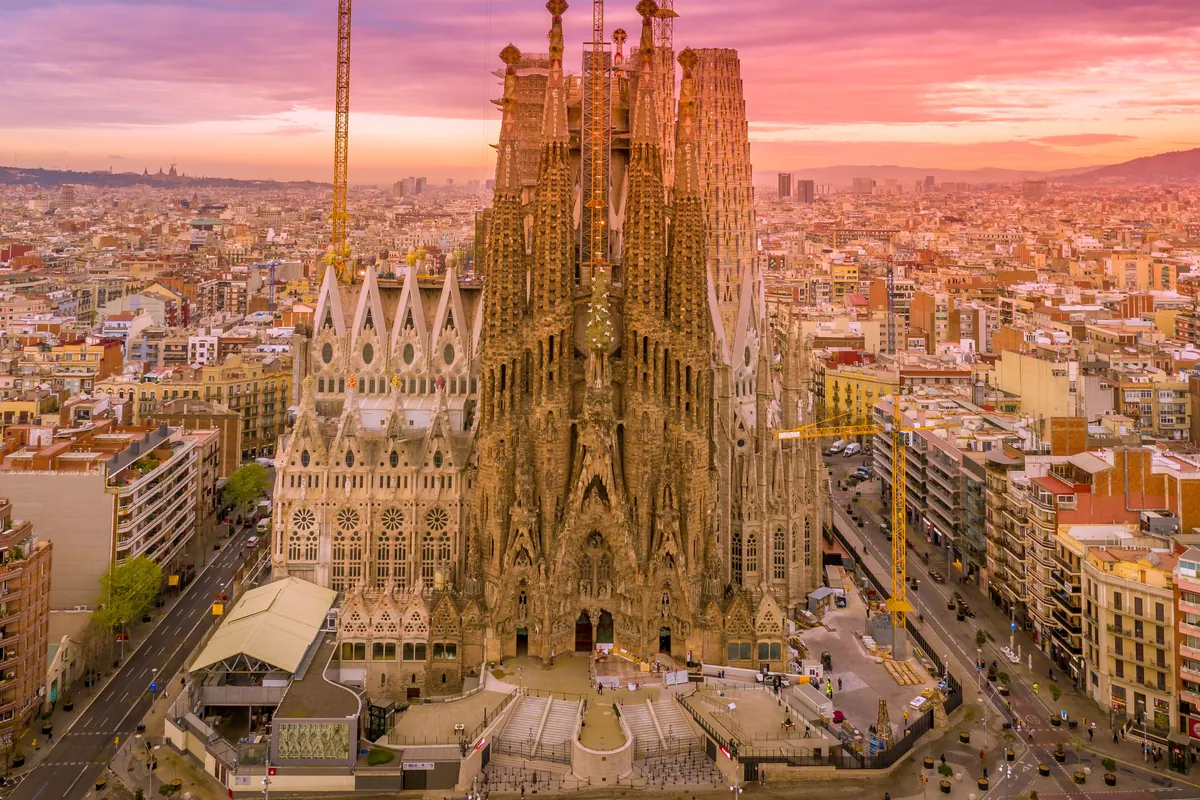
The trail begins at the Sagrada Família, a church in Barcelona's Eixample district still under construction more than 140 years after the bookseller José María Bocabella first proposed an expiatory temple funded entirely by donations. Construction began in 1882 under the architect Francisco de Paula del Villar; when Villar resigned the following year, Antoni Gaudí took over as chief architect and transformed the design into the building recognisable today, work he continued until his death in 1926, by which point the basilica was only 15 to 25 percent complete. Building was further set back when the Spanish Civil War destroyed parts of the unfinished structure along with Gaudí's own models in 1936, and subsequent architects have worked from reconstructed plans ever since. Consecrated as a basilica by Pope Benedict XVI in 2010, the church's original design calls for eighteen spires representing the Twelve Apostles, the four Evangelists, the Virgin Mary and, tallest of all, Jesus Christ; fourteen have been completed as of 2026. Its Nativity Façade, built before construction halted in 1935, carries the most direct trace of Gaudí's own hand, densely carved with naturalistic imagery, while the plainer Passion Façade was completed to his surviving drawings decades after his death.
Park Güell, on the southern slope of the Turó del Carmel hill in the Gràcia district, began not as a public park but as a private residential development, commissioned by the industrialist Eusebi Güell and inspired by the English garden city movement — a debt reflected in its very name. Güell planned sixty triangular plots for luxury homes and moved into the site's existing Larrard House in 1906 to promote the venture, but the location proved too remote from the city centre and only two houses were ever built, neither designed by Gaudí. The failed development was later taken over by the city as a public garden, its curved and undulating benches and mosaic-covered terraces now recognised as an early expression of the naturalist style Gaudí would carry further at the Sagrada Família.
Casa Batlló, on the fashionable Passeig de Gràcia, began in 1877 as an unremarkable classical building before the industrialist Josep Batlló bought it in 1903 and commissioned Gaudí the following year to rebuild it. Gaudí talked Batlló out of demolishing the house entirely and instead reshaped it around an expanded central light well tiled in graded shades of blue, adding new floors and a facade covered in trencadís, a mosaic of broken ceramic tiles that shifts from golden orange into greenish blue. The building is known locally as Casa dels ossos, the House of Bones, for the skeletal quality of its ground-floor stonework, and its roof is shaped to resemble a dragon's arched spine covered in coloured ceramic scales, a design Gaudí completed alongside the contemporaneous construction of the Sagrada Família visible, according to local legend, through a small window in the roof.
A stroll down La Rambla follows what was once a sewage-filled stream separating the walled medieval city from the settlement of El Raval, diverted outside new city walls in 1440 and gradually paved into the tree-lined pedestrian street that runs 1.2 kilometres from Plaça de Catalunya to the Christopher Columbus Monument at the port. Its paving still ripples in a pattern echoing its origin as a watercourse, and the promenade passes the Font de Canaletes fountain, a 1971 pavement mosaic by Joan Miró, and the Gran Teatre del Liceu opera house, opened in 1847. The poet Federico García Lorca once called it the only street in the world he wished would never end.
Across the trail, the walk moves through four expressions of the same Catalan Modernisme movement: an unfinished basilica that has occupied generations of architects, a failed housing development turned public park, a private house rebuilt into a living mosaic, and a historic promenade that predates Gaudí by centuries but still carries the same crowds his buildings now draw. Each stop belongs to the wave of building that reshaped Barcelona at the turn of the twentieth century.
Text adapted from the linked articles under CC BY-SA 4.0; edited for length.
Every dimension the Taro team tags this pack with — filter by any of these on the packs page.
Share your travel month, group size, budget comfort, and must-do experiences. The Taro team will shape the right route before any payment conversation.