Abu Dhabi + Yas Island
5DFrom ₹1,05,000
A 5-day mid-range trip to Rishikesh, India, taking in Laxman Jhula, Triveni Ghat aarti, Beatles Ashram and Rajaji National Park.
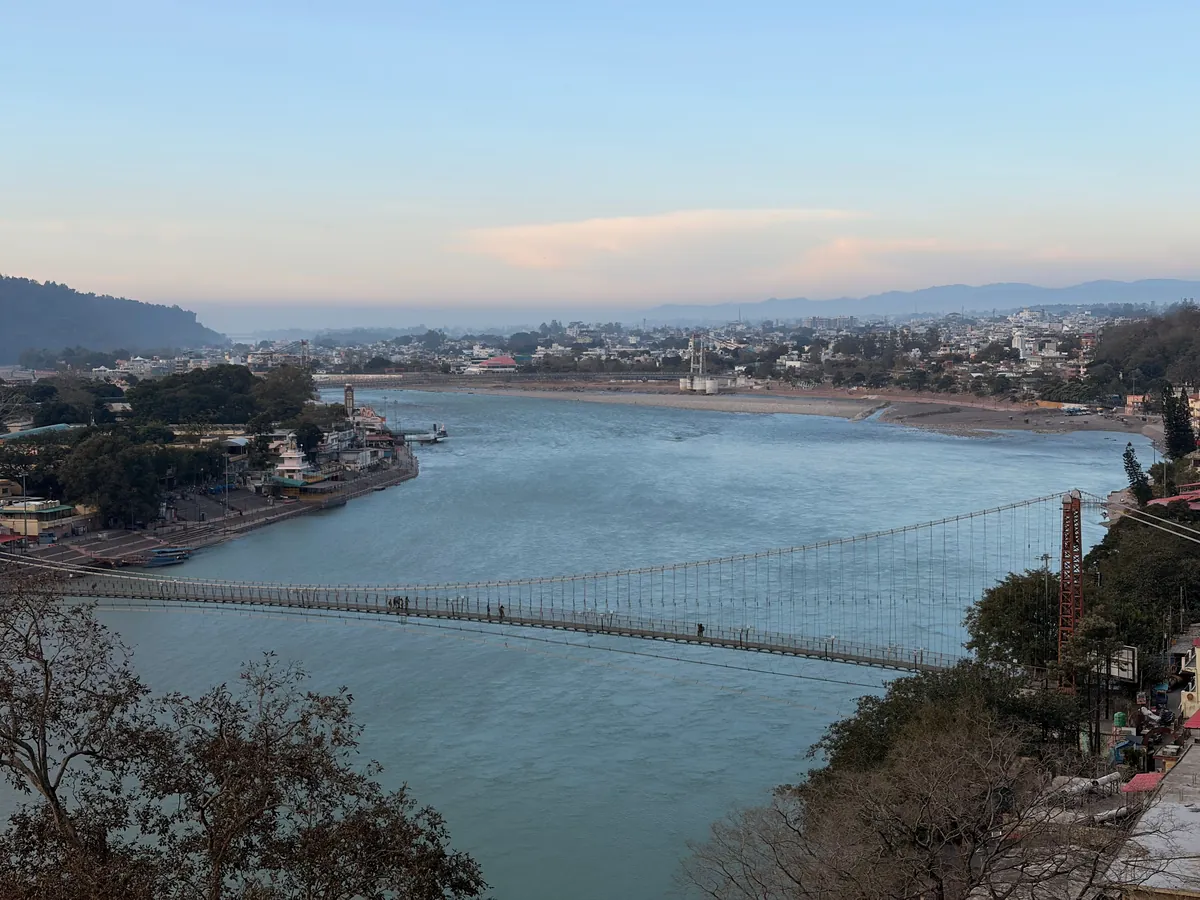
Rishikesh Yoga & Ganges Retreat opens on Lakshman Jhula, a suspension bridge across the Ganges some five kilometres north-east of the city centre, connecting the village of Tapovan on the west bank to Jonk on the east. Completed in 1929, the bridge takes its name from a legend that the Hindu deity Lakshmana once crossed the river here on jute ropes, and for decades it carried pedestrians and even motorbikes across the water until, from November 2020, it was restricted to foot traffic and a replacement span was planned alongside it. A larger crossing, Ram Jhula, sits two kilometres downstream, but Lakshman Jhula remains the more recognisable landmark of the two, its steel cables strung between towers on either bank of the river as it runs out of the Himalayan foothills.
From the bridge the route follows the riverbank to Triveni Ghat, the largest and best known of Rishikesh's bathing ghats. Devotees come here for ritual baths said to cleanse sin, and the ghat is also used for last-rites ceremonies; each evening it draws crowds for the Ganga aarti, a lamp-lit ceremony performed to Vedic chants as the sun sets over the water. The Gita Temple, the Triveni Mata Temple and the Lakshmi-Narayan Temple all stand along its banks, giving the ghat's evening ritual a backdrop of temple spires reflected in the river.
On the eastern bank, opposite the Muni Ki Reti area of the city, stands the ashram now known simply as the Beatles Ashram, formally Chaurasi Kutia. Maharishi Mahesh Yogi leased the site from Uttar Pradesh's forestry department in 1961 and built it in 1963 with funding from the American heiress Doris Duke, running it as the International Academy of Meditation and training centre for his Transcendental Meditation technique. It gained global attention between February and April 1968, when the Beatles travelled here to study meditation together with Donovan, Mia Farrow and Mike Love; George Harrison later recalled crossing the Ganges by 'a big swing suspension bridge' — Lakshman Jhula — to reach it. The stay proved the band's most productive songwriting period, yielding most of the material for their self-titled double album, known as the White Album. The Maharishi's lease expired in 1981 and the land was absorbed into what became Rajaji Tiger Reserve; after years of disrepair and unofficial Beatles-themed graffiti, the site was officially opened to the public in December 2015.
The final stop, Rajaji National Park, spreads across 820 square kilometres of the Sivalik Hills in the Haridwar, Dehradun and Pauri Garhwal districts of Uttarakhand, formed in 1983 by merging three earlier wildlife sanctuaries — Chilla, Motichur and Rajaji — and granted tiger reserve status in 2015. The Ganges itself flows through the park, splitting it into a western section covering the old Rajaji and Motichur sanctuaries and an eastern Chilla sanctuary. Broadleaved deciduous forest, riparian vegetation, grassland and pine stands support Indian elephants, Bengal tigers, Indian leopards, sloth bears and over 315 recorded bird species, along with goral and Himalayan tahr on the park's steeper, pine-covered slopes.
Across five days the pack follows the Ganges through Rishikesh itself — from the suspension bridge and the evening aarti at Triveni Ghat to the cliffside ashram that briefly hosted the Beatles — before finishing in the forested tiger reserve that the river carves through on its way down from the Himalayan foothills.
Text adapted from the linked articles under CC BY-SA 4.0; edited for length.
Every dimension the Taro team tags this pack with — filter by any of these on the packs page.
Share your travel month, group size, budget comfort, and must-do experiences. The Taro team will shape the right route before any payment conversation.