
Arctic Svalbard Polar Bears
8DFrom ₹6,85,000
A 5-day premium trip to Riga, Latvia, taking in Alberta iela facades, House of the Blackheads, Riga Central Market and Sigulda Castle.
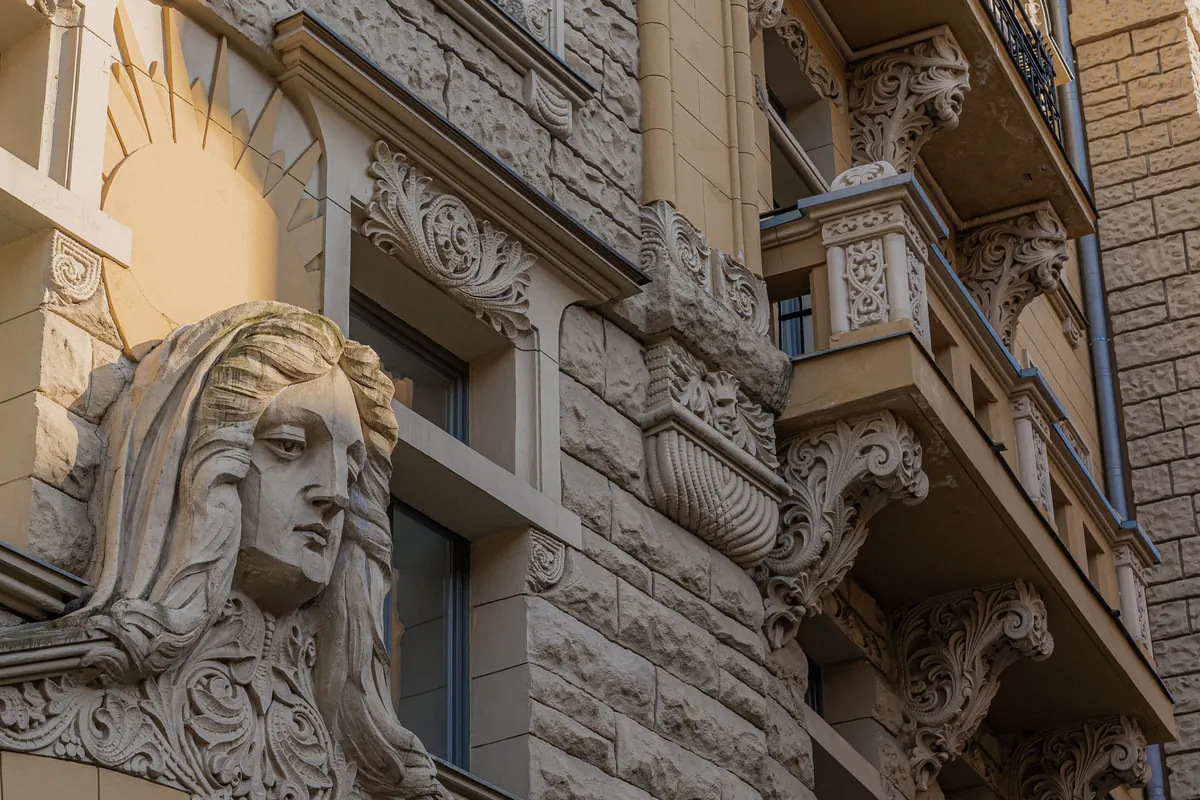
Riga Art Nouveau Trail opens on Albert Street — Alberta iela — in central Riga, a street laid out in 1901 and named for Bishop Albert, who founded the city exactly seven centuries earlier in 1201. The street is celebrated for its concentration of Art Nouveau apartment buildings, many designed by the architect Mikhail Eisenstein, whose decorative, atypical facades along Albert Street drew on the romantic-nationalist strand of Art Nouveau then current across northern Europe. The architect-and-pupil pair of Konstantīns Pēkšēns and Eižens Laube were also prominent in shaping the buildings along the street, which together make Albert Street one of the most complete Art Nouveau ensembles in Europe.
The trail continues into the old town to the House of the Blackheads, first built in 1334 as a warehouse and meeting hall for Riga's merchants, making it the largest public building in the city at the time. From the mid-15th century it also housed the Brotherhood of Blackheads, a guild for the city's unmarried merchants, shipowners and foreign traders, and it was here in 1510 that the first recorded decorated Christmas tree was erected. Major renovation in the early 17th century added most of the building's Mannerist ornamentation, and further sculptural work followed in the 19th century, some of it carried out by the workshop of the sculptor August Volz.
From the guild house the route reaches Riga Central Market, Europe's largest market and bazaar and, together with Old Riga, a UNESCO World Heritage Site since 1998. Planned from 1922 and built between 1924 and 1930, its five main pavilions were formed by reusing metal frameworks salvaged from German Zeppelin hangars at the Vaiņode Air Base, worked into a design combining Neoclassicism and Art Deco. The market covers 72,300 square metres and holds more than 3,000 trade stands, trading on a site where produce has been sold on the banks of the Daugava since 1571 and where formal trade-stand rows were first built in 1863, decades before the market moved to its present hangar-framed pavilions.
The final stop, Sigulda Castle, lies outside Riga in the Vidzeme region, built between 1878 and 1881 in the Neo-Gothic style as a residence for Duchess Olga and Duke Dimitry Kropotkin, using materials salvaged from an earlier 17th-century building on the same site. It stands within a wider manor complex enclosed by chipped-boulder walls, one that also preserves older estate buildings from the Von Borgh and Kropotkin ownership — an earlier Summer Castle, a White Castle, a vagar's house built for the estate's serf supervisor, a laundry house and a barn. Since 1993 the New Castle itself has housed the Sigulda Region Council, giving the building a continuous civic role from manor house to local government seat.
Across five days the route runs from Riga's Art Nouveau streetscape and its Hanseatic-era guild hall, through the vast pavilions of the Central Market, out to the castle ridge at Sigulda — a compact loop through more than seven centuries of Latvian building, from 1334 stonework to 1901 ornament.
Text adapted from the linked articles under CC BY-SA 4.0; edited for length.
Every dimension the Taro team tags this pack with — filter by any of these on the packs page.
Share your travel month, group size, budget comfort, and must-do experiences. The Taro team will shape the right route before any payment conversation.

