Argentina Buenos Aires + Patagonia
11DFrom ₹2,45,000
A 5-day luxury trip to Punta del Este, Uruguay, taking in La Mano sculpture, Casapueblo, Isla de Lobos sea lion colony and Gorriti Island.
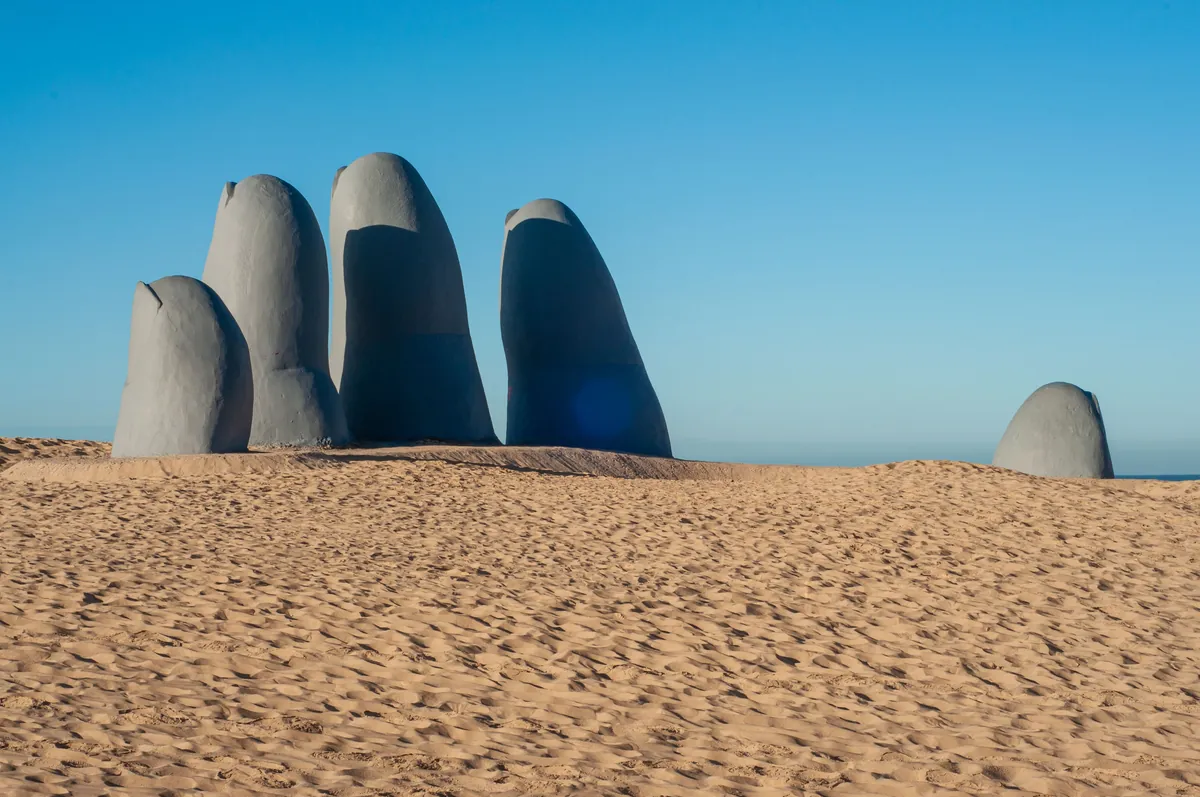
Punta del Este Coastal Glam opens at La Mano, the sculpture of five giant human fingers rising from the sand at Parada 1 on Brava Beach, completed in February 1982 by Chilean artist Mario Irarrázabal and known variously as Los Dedos or Hombre emergiendo a la vida. Irarrázabal built it during the first International Meeting of Modern Sculpture in the Open Air, moving his work to the beach after a dispute over plaza space among the nine participating sculptors, and finished the piece — concrete and plastic fingers reinforced with steel bars and metal mesh — in just six days despite the region's strong southeast winds. Conceived as a warning to swimmers about a hand "drowning" near the rougher surfing waters up the coast at La Barra, it remains the only sculpture from that summer gathering still standing in its original spot, and Irarrázabal later made variations of the design for Madrid, Chile's Atacama Desert and Venice.
The route continues to Casapueblo, the whitewashed cliffside home, workshop and hotel built by Uruguayan artist Carlos Páez Vilaró in Punta Ballena, 13 kilometres from Punta del Este. Begun in 1958 around a small wooden atelier called La Pionera and expanded without formal architectural plans over the following 36 years, the maze-like, thirteen-floor building — designed with a style Páez Vilaró compared to the nests of Uruguay's hornero bird — today holds a museum, art gallery, cafeteria and hotel across terraces built for watching the sunset over the Atlantic. Its rooms include a tribute to the artist's son Carlos Miguel, one of sixteen Uruguayan survivors of the 1972 Andes plane crash, and since 1994 the terraces have hosted a nightly Sun Ceremony in which a recording of the artist's voice bids farewell to the sun moments before it sets.
From the coast the trip reaches Isla de Lobos, a rocky outcrop about 8 kilometres southeast of Punta del Este first documented by Spanish navigator Juan Díaz de Solís in 1516 and visited by explorers including Sebastian Cabot in 1527. Its 1858 lighthouse, rebuilt in 1906 and standing 59 metres above sea level, became Uruguay's first automated lighthouse in 2001, and the surrounding waters, protected since 2024 within the Island and Islet of Lobos National Park, hold the largest colony of South American sea lions and South American fur seals in the Western Hemisphere — an estimated 250,000 sea lions and 1,500 fur seals recorded in 2005 — alongside seasonal visits from southern right whales, southern elephant seals and orcas that hunt tuna in the area.
The trip closes on Gorriti Island, also discovered by Díaz de Solís in 1516 and settled from the 18th century, when its position opposite Portuguese-influenced territory gave it military significance — abandoned cannons still remain on its shores. Declared a National Heritage site alongside Isla de Lobos, the island draws visitors to its beaches each year while its surrounding waters share the same rich marine life as its larger neighbour, closing a five-day route across Punta del Este's best-known sculpture, an artist's handmade cliffside home, and the offshore islands where Uruguay's sea lion and fur seal colonies still breed.
Text adapted from the linked articles under CC BY-SA 4.0; edited for length.
Every dimension the Taro team tags this pack with — filter by any of these on the packs page.
Share your travel month, group size, budget comfort, and must-do experiences. The Taro team will shape the right route before any payment conversation.