Abu Dhabi + Yas Island
5DFrom ₹1,05,000
A 6-day premium route through Punakha, featuring Punakha Dzong, Chimi Lhakhang, Wangdue Phodrang Dzong and Mo Chhu.
The valley route opens at Punakha Dzong, formally Pungthang Dewa Chhenbi Phodrang, "the palace of great happiness," the administrative centre of Punakha District and the second-oldest and second-largest dzong in Bhutan. Built between 1637 and 1638 by Ngawang Namgyal, the first Zhabdrung Rinpoche and unifier of Bhutan, the dzong houses sacred relics of the southern Drukpa Lineage of the Kagyu school, including the Rangjung Kharsapani and the remains of Namgyal himself. It served as the seat of Bhutan's government until the capital moved to Thimphu in 1955, and it has hosted the coronation of every Bhutanese king since 1907, along with the 2011 wedding of King Jigme Khesar Namgyel Wangchuck to Jetsun Pema; it remains on Bhutan's tentative list for UNESCO World Heritage status. Set at 1,200 metres between the Pho Chhu and Mo Chhu rivers, the dzong is where Bhutan's head clergy and monks spend the winter, beneath jacaranda trees that bloom mauve in spring.
A short distance away stands Chimi Lhakhang, a Buddhist monastery founded in 1499 by the Drukpa Kagyu lama Ngawang Chogyal on a round hillock near the village of Lobesa. The site's name refers to a legend in which the lama's cousin, Drukpa Kunley, subdued a demoness that had taken the form of a dog; a chorten near the monastery's entrance still marks the spot. The golden-roofed temple is reached by a twenty-minute walk from the hamlet of Yowakha past fields of mustard and rice lined with prayer flags, and its walls carry paintings found on houses throughout the surrounding village. Inside, a reclining statue of Kunley with his dog Sachi sits at the altar alongside images of the Zhabdrung, Sakyamuni Buddha and Chenresig, and women seeking blessings for children are touched on the head by the resident lama with a small ivory, wood and bone phallus.
Wangdue Phodrang Dzong, the trip's third stop, was likewise founded by Ngawang Namgyal, in 1638, at the confluence of the Puna Tsang and Dang rivers to help consolidate and defend the newly unified country; construction under Penlop Nyama Kukye finished in 1640, and the dzong was later expanded in 1683 and renovated in 1767. Fire destroyed it in 1837 and again more recently, and an 1897 earthquake caused further damage, though each time the dzong was rebuilt on its original hilltop site between the two rivers, at roughly the same 1,200-metre elevation as Punakha Dzong. Built of stone, wood and mud, the fortress-monastery is laid out in three narrow sections that follow the confines of its ridge: two courtyards flanking a central enclosure used for religious purposes, with 14 lhakhangs installed during its most recent reconstruction.
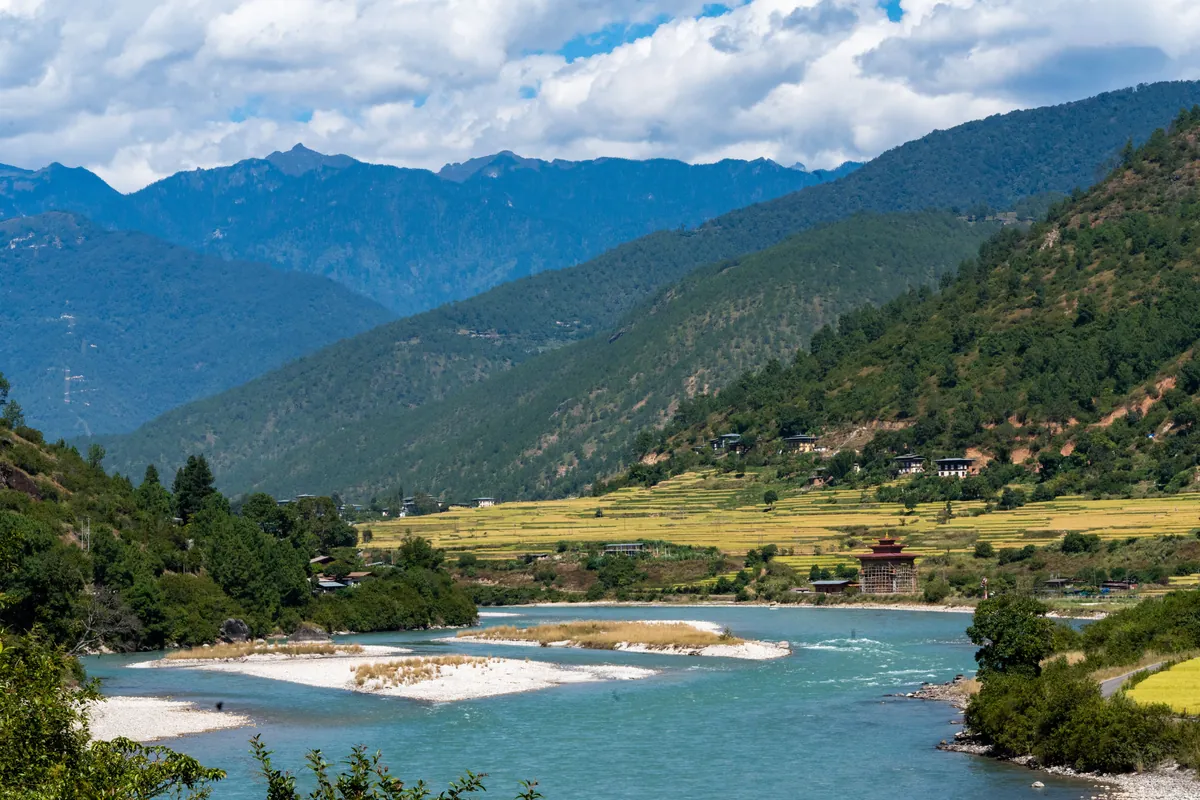
The valley's rivers converge at the Mo Chhu, which rises in Gasa Dzongkhag near the Tibetan border and flows south to Punakha, where it meets the Pho Chhu immediately below Punakha Dzong — the winter seat of Bhutan's Central Monk Body and its Je Khenpo. Below that confluence the combined river takes the name Puna Tsang Chhu, joined further downstream by the Dang Chhu near Wangdue Phodrang before crossing into Assam, India, as the Sankosh River, which eventually reaches the Brahmaputra.
Across six days the trip follows Punakha's two rivers and the fortress-monasteries that rise beside them: from Punakha Dzong at the Pho Chhu–Mo Chhu confluence, to the hillside shrine of Chimi Lhakhang, on to Wangdue Phodrang Dzong where the Puna Tsang Chhu takes shape, and along the Mo Chhu itself back to its source in the country's dzongs. Each stop belongs to the same valley system that Ngawang Namgyal chose, in the 1630s, as the foundation of a newly unified Bhutan.
Text adapted from the linked articles under CC BY-SA 4.0; edited for length.
Every dimension the Taro team tags this pack with — filter by any of these on the packs page.
Share your travel month, group size, budget comfort, and must-do experiences. The Taro team will shape the right route before any payment conversation.