Arctic Svalbard Polar Bears
8DFrom ₹6,85,000
A 5-day premium route through Plitvice, featuring Plitvice Lakes National Park, Rastoke, Zadar and Sea organ.
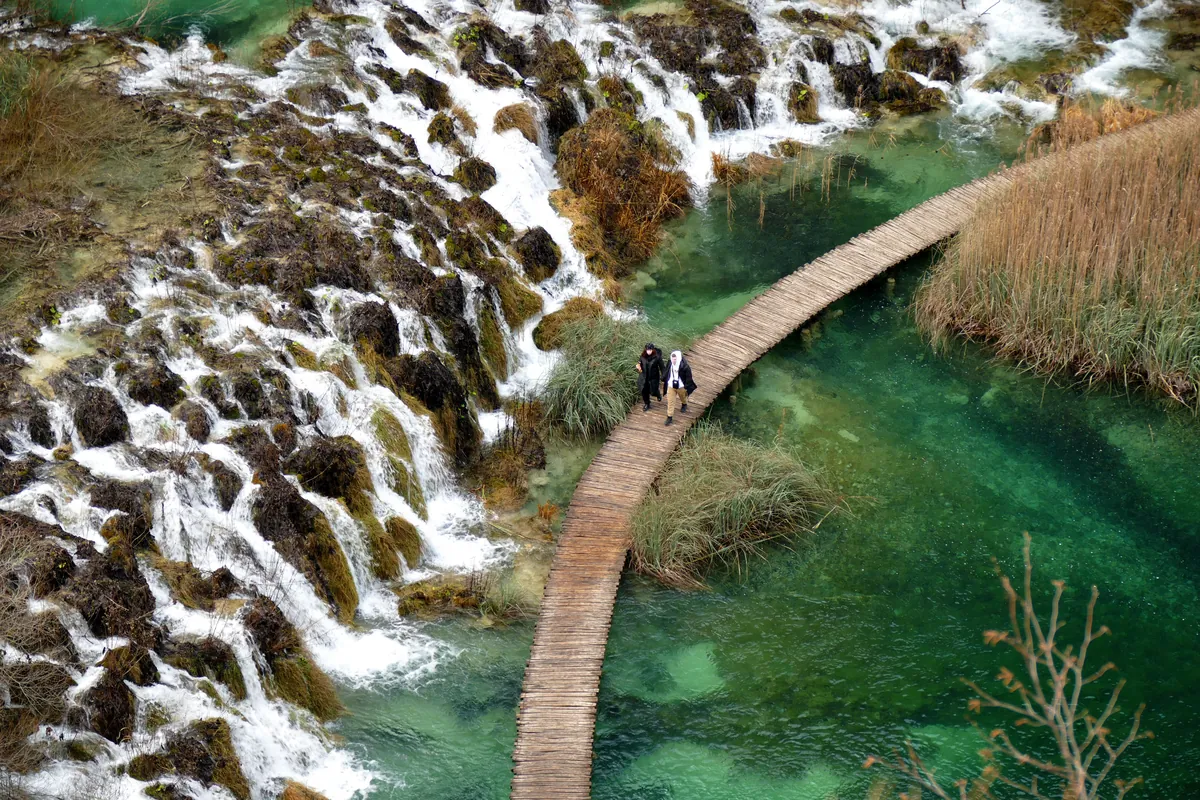
The trail begins in Plitvice Lakes National Park, one of the oldest and largest national parks in Croatia, founded in 1949 in the mountainous karst of the country's interior near the border with Bosnia and Herzegovina. UNESCO inscribed the park on its World Heritage list in 1979 for its cascading tufa lakes, caves and connected waterfalls, spread across 296.85 square kilometres, most of it in Lika-Senj County. Sixteen lakes are visible from the surface, arranged in cascades and shifting in colour between azure, green, grey and blue depending on mineral content, suspended organisms and the angle of sunlight; the two largest, Proscansko and Kozjak, hold about 80 percent of the park's water and reach depths of 37 and 47 metres. The name Plitvice, first recorded in 1777, derives from the Croatian word for "shallow," describing the basins that centuries of flowing water and forming travertine barriers have shaped into today's terraced lake system, with an overall elevation drop of 133 metres from the first lake to the last.
South along the Korana River, the trail reaches Rastoke, a village in the town of Slunj where the Slunjcica River splits into branches that tumble over cascades and small waterfalls before joining the Korana, in a display of the same travertine-forming processes at work in the national park upstream — a resemblance that has earned Rastoke the nickname "the Small Lakes of Plitvice." Watermills built at the point where the rivers branch helped establish Slunj as an economic centre of the surrounding Kordun region; the town's fortifications were first recorded by the writer Johann Weikhard von Valvasor in 1689, and the Rastoke name itself was first documented in an 1860 travel account by the priest and philologist Adolfo Veber Tkalcevic. For centuries the settlement sat in an isolated stretch of borderland between Europe and the Ottoman Empire, guarded by a Frankopan-family fortress destroyed in 1578 and later rebuilt, before Napoleonic-era French rule from 1809 to 1813 briefly made Croatian the province's official language.
The trail's next stop, Zadar, is the oldest continuously inhabited city in Croatia, built on a small stone islet on the Adriatic coast and tied to the mainland by a narrow isthmus that forms a natural harbour. Settled by the Liburnians as Iader in the 9th century BC, the city became the Roman municipium of Iadera in 59 BC and a Roman colony in 48 BC, laid out with the regular street grid and public forum typical of Roman urban planning; today's city covers 25 square kilometres and, per the 2011 census, held a population of 75,082, making it Dalmatia's second-largest city. Long known as great sailors, traders and — in later centuries — pirates, the Liburnians made Zadar a hub of Adriatic commerce with the Phoenicians, Etruscans and Greeks as early as the 7th century BC.
The trail ends at Zadar's Sea Organ, an architectural sound installation built into a set of white marble steps along the city's redesigned waterfront, where waves pushing through underwater tubes and a resonating chamber produce chords that shift with the sea's movement. Architect Nikola Basic designed the instrument as part of a project to rebuild Zadar's coastline after decades of monotonous concrete construction that followed damage sustained in the Second World War, and it opened to the public on 15 April 2005; the following year it won the European Prize for Urban Public Space.
Across five days the trail follows Croatia's karst waterways from their source to the sea: the terraced lakes and waterfalls of Plitvice Lakes National Park, the mill village of Rastoke where the same travertine-forming rivers converge, the ancient Roman-founded city of Zadar on the Adriatic coast, and its wave-powered Sea Organ built into the shoreline. Each stop traces water's path from mountain karst to open water.
Text adapted from the linked articles under CC BY-SA 4.0; edited for length.
Every dimension the Taro team tags this pack with — filter by any of these on the packs page.
Share your travel month, group size, budget comfort, and must-do experiences. The Taro team will shape the right route before any payment conversation.

