
Abu Dhabi + Yas Island
5DFrom ₹1,05,000
A 6-day mid-range route through Cebu with whale-shark snorkelling and a waterfall canyon.
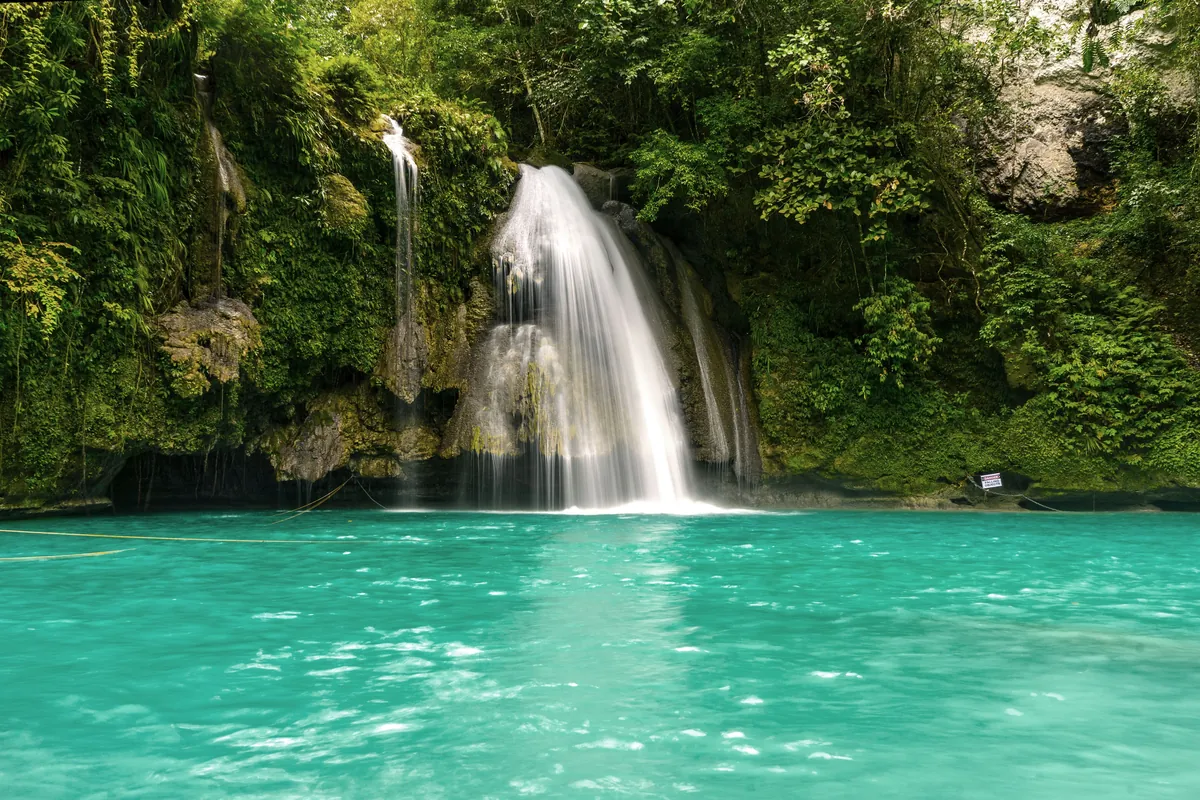
The route opens at Oslob, a coastal municipality 116 kilometres south of Cebu City that has become known for whale shark watching in the barangay of Tan-awan, ten kilometres from the town centre, an activity that has drawn both visitors and criticism over how the encounters are managed for the animals and the surrounding reef. Oslob's Spanish-era history is visible in its Baluarte, a watchtower built in 1788 as part of a coastal defence network of seven towers meant to warn of Moro raiders; the system worked well enough that after repelling an attack in 1815 the townspeople relocated from their fortified inland settlement at Daanglungsod to the present coastal site. The Church of the Immaculate Conception, built of cut coral stone between 1830 and 1848 with a bell tower added in 1858, has twice been damaged by fire — during the Second World War and again in 2008 — but each time was restored, along with the adjoining convento and an unfinished 19th-century cuartel intended as Spanish barracks. Many visitors combine the whale shark encounter with a trip to nearby Tumalog Falls, about three and a half hours from Cebu City. The route continues to Kawasan Falls, a three-stage cascade of clear turquoise water fed by the Kabukalan Spring as it drops through a jungle gorge on the Kawasan River in Badian, Cebu, before continuing to the Matutinao River and the Tañon Strait. The tallest of the three cascades falls about 40 metres, followed by smaller drops and pools used for swimming, rafting and cliff diving. The Cebu provincial government suspended access in 2023 to revoke permits from unlicensed canyoneering operators, reopening the falls that October after three months of rehabilitation and guide certification, and in 2026 allocated further funding toward restoring the site's surrounding environment. From the coast the route reaches Magellan's Cross Pavilion in Cebu City, an octagonal coral-stone kiosk built around 1834 on Plaza Sugbo beside the Basilica del Santo Niño. It houses the cross said to have been planted by Ferdinand Magellan's expedition on arriving in Cebu on 21 April 1521, during the first circumnavigation of the world; the original wooden cross was encased within a second cross of tindalo wood in 1835 to stop people chipping off fragments believed to hold miraculous power. A ceiling mural inside the pavilion depicts the baptism of Rajah Humabon by Fr Pedro Valderrama alongside the planting of the cross. Together with the basilica's church and convent, the pavilion was declared a National Cultural Treasure of the Philippines in 2021, though earthquake damage in 2013 and 2025 has periodically closed it to visitors even as prayer and candle-lighting continue at its entrances. The route's final stop is Moalboal, a peninsula municipality on Cebu's southwestern coast facing the Tañon Strait, with Negros Island visible offshore. Built on a recreational-diving industry developed since the 1970s, Moalboal centres on Panagsama Beach, chosen by Condé Nast Traveler in 2024 as one of the best-known beaches in Southeast Asia and the only Philippine entry on that list, and on Pescador Island, three kilometres offshore, whose underwater cave known as the Cathedral and steep drop-off past 40 metres draw divers alongside sightings of sea turtles, sardine schools, whale sharks and thresher sharks. The town's few surviving pre-war structures were mostly lost when Japanese forces burned it in 1944 in retaliation for a guerrilla ambush, leaving only the belfry and outer walls of the 18th-century San Juan Nepomuceno Parish Church standing from that era. Across six days the route strings together the southeastern coast of Cebu: whale sharks and a fortified church town at Oslob, a jungle waterfall reopened after safety-driven rehabilitation at Kawasan Falls, the 1521 landing site preserved at Magellan's Cross, and the reef-lined peninsula of Moalboal — a single island coastline carrying Spanish-era watchtowers, a circumnavigation's first cross, and some of the country's most consistently visited dive sites.
Text adapted from the linked articles under CC BY-SA 4.0; edited for length.
Every dimension the Taro team tags this pack with — filter by any of these on the packs page.
Share your travel month, group size, budget comfort, and must-do experiences. The Taro team will shape the right route before any payment conversation.