Abu Dhabi + Yas Island
5DFrom ₹1,05,000
A 8-day premium trip to Shillong, India, taking in Kaziranga rhino safari, Living Root Bridges, Tawang Monastery and Umiam Lake.
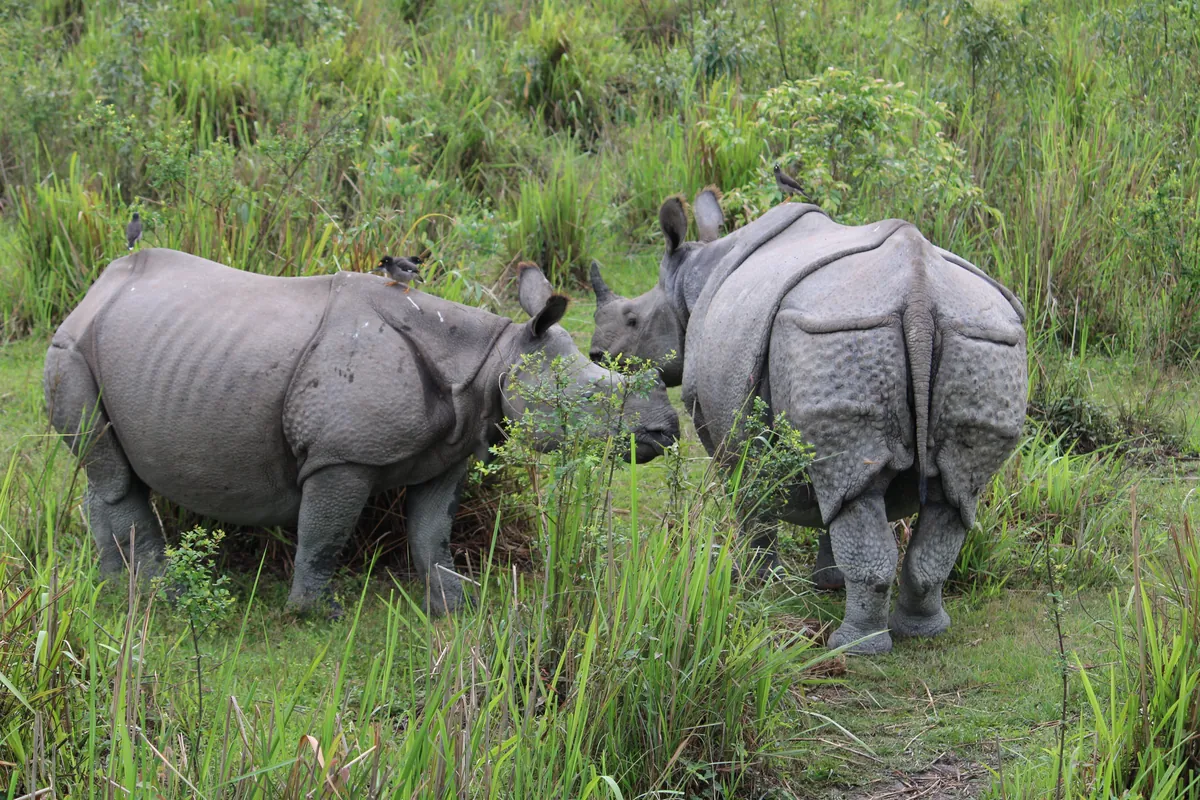
North East India Highlands begins at Kaziranga National Park, a stretch of dense tropical broadleaf forest and tall elephant grass strung along the edge of the Brahmaputra River across the Golaghat, Sonitpur, Biswanath and Nagaon districts of Assam. The park was established as a reserve forest in 1905, after Mary Curzon, Baroness Curzon of Kedleston, visited the area in 1904 and, having failed to see the Indian rhinoceros for which it was already renowned, urged her husband Lord Curzon to protect the dwindling species; it was declared a Tiger Reserve in 2006. Kaziranga is now home to the world's largest population of Indian rhinoceros, with 2,401 counted, alongside 1,666 wild water buffalo — around 57% of the global population of that species — and 1,940 Indian elephants, along with tigers, leopards and swamp deer. The rhino, tiger, elephant, wild water buffalo and swamp deer together are known locally as the park's 'Big Five'. Wildlife viewing is done by guided elephant or jeep safari from observation towers at Sohola, Mihimukh, Kathpara, Foliamari and Harmoti, since hiking within the park is prohibited to avoid human-animal conflict, and the snow-capped peaks of the Lower Himalayas frame the grassland and ponds beyond the trees.
From Kaziranga the route turns to Meghalaya's living root bridges, structures grown rather than built. The Khasi and Jaiñtia peoples of the southern Shillong Plateau train the aerial roots of the rubber fig tree, Ficus elastica, across streams and rivers, sometimes guiding them by hand and sometimes over scaffolds of wood, bamboo or hollowed areca palm trunks, until the roots thicken enough to bear a person's weight — a process that can take up to fifteen years. Because the bridges are living organisms, they keep strengthening as long as the parent tree stays healthy, and some are reckoned to be several hundred years old; the earliest written account of the tradition comes from Henry Yule, who described the bridges of Cherrapunji with astonishment in the 1844 Journal of the Asiatic Society of Bengal. The longest known example, near the town of Pynursla, is thought to run more than 50 metres, and the celebrated 'Double Decker' bridge at Nongriat, with two parallel spans one above the other, is estimated to be around 200 years old.
The trip then climbs toward the Bhutanese border to Tawang Monastery, the largest Buddhist monastery in India, set in the valley of the Tawang Chu close to both the Chinese and Bhutanese frontiers. It was founded in 1680–81 by Merak Lama Lodre Gyatso at the wish of the 5th Dalai Lama, Ngawang Lobsang Gyatso, and belongs to the Gelug school of Vajrayana Buddhism, historically linked to Drepung Monastery in Lhasa. Its Tibetan name, Gaden Namgyal Lhatse, is said to combine words meaning 'divine', 'complete victory' and a heavenly realm, while the place-name Tawang itself is said to mean 'the site chosen by the horse', from a local story about how the monastery's location was found. The complex rises three storeys within a compound wall 925 feet (282 metres) long, enclosing 65 residential buildings and a library that holds old scriptures including the Kangyur and Tengyur, the core canonical texts of Tibetan Buddhism.
The final stop is Umiam Lake, also called Bara Pani, a reservoir in the hills some 15 kilometres north of Shillong in Meghalaya. It was formed in the early 1960s by damming the Umiam River, and its catchment area spreads across 225 square kilometres, fed in turn by the Wah Umkhrah and Wah Umshyrpi rivers. Ringed by forested hills, the reservoir is used today for boating and water sports as well as for hydroelectric power, and its still surface reflecting the surrounding slopes makes it one of Meghalaya's most photographed viewpoints on the road out of Shillong.
Across these four stops the eight-day route moves from the Brahmaputra floodplain of Assam, past the root-grown crossings of the Khasi hills, up to the Buddhist highlands on the Bhutan and China frontier, and back down to the reservoir above Shillong — a single loop through landscapes and traditions that otherwise sit hundreds of kilometres apart across India's north-eastern states.
Text adapted from the linked articles under CC BY-SA 4.0; edited for length.
Every dimension the Taro team tags this pack with — filter by any of these on the packs page.
Share your travel month, group size, budget comfort, and must-do experiences. The Taro team will shape the right route before any payment conversation.