Argentina Buenos Aires + Patagonia
11DFrom ₹2,45,000
A 6-day premium city break in Medellín with its cable-car barrios and flower festival heritage.
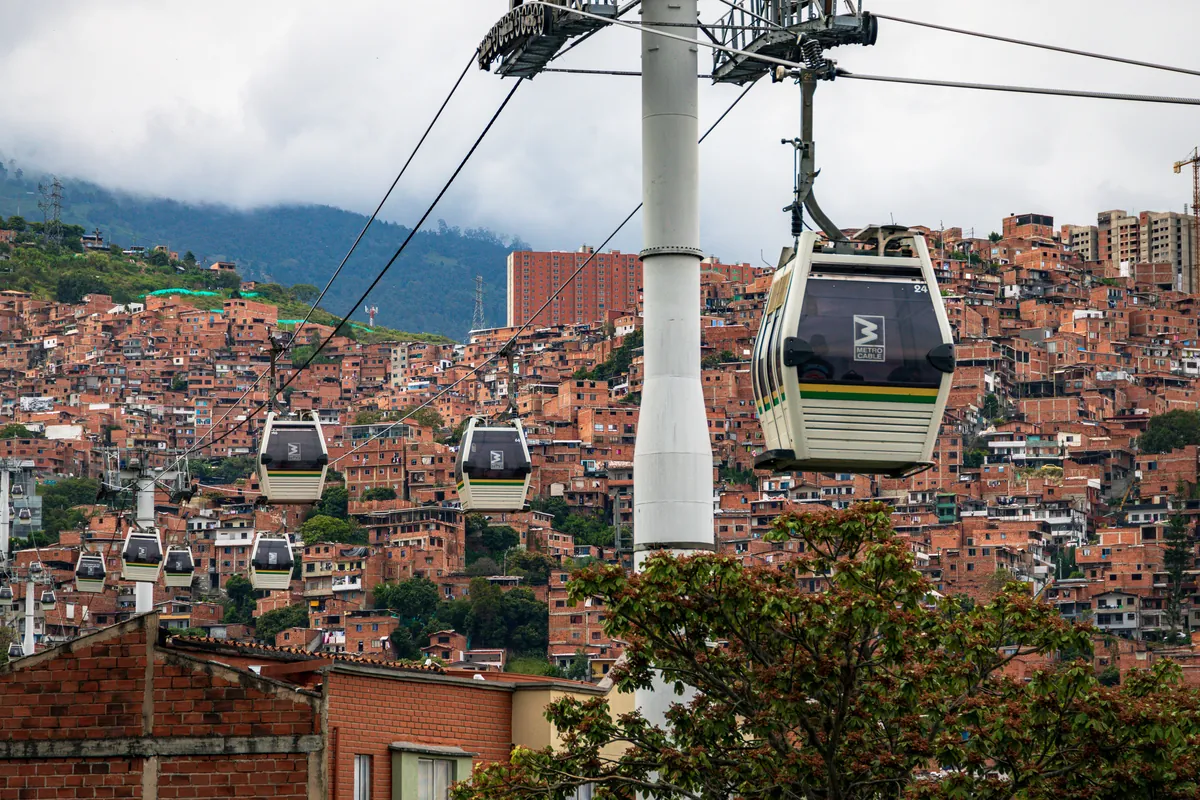
Medellín City of Eternal Spring opens on the Metrocable, a gondola-lift system introduced by the city in 2004 to complement the Medellín Metro and reach informal settlements built into the steep hills ringing the Aburrá Valley — largely considered the first cable-propelled urban transit system in South America. Its first route, Line K, runs 2.07 kilometres between four stations and cut a commute that had taken residents of the Santo Domingo Savio neighbourhood up to two and a half hours each way; five further lines have since opened, including Line L, a tourist route connecting to Arví Park, and the system — built using detachable-grip gondola technology from the French company Poma — now carries thousands of passengers an hour across a city whose topography once made a conventional bus network impractical in its hillside barrios.
The route continues into Comuna 13, or San Javier, a hillside district of roughly 160,000 people originally settled by farmers displaced from rural Colombia and known today for street art, graffiti tours and an atmosphere its own residents describe as one of resilience. Investment under the "social urbanism" philosophy championed by Mayor Sergio Fajardo brought libraries, parks, schools and — most visibly — a set of outdoor escalators and two Metrocable lines that connected the once-isolated hillside to the city centre and its subway network, easing years of social exclusion. Community-led initiatives such as Casa Kolacho, a hip-hop-based centre that also runs graffiti tours addressing the neighbourhood's history and politics, have helped turn the comuna into one of the most visited parts of Medellín, drawing as many as 6,000 visitors on a single weekend day.
From the hillside barrios the route descends to Botero Plaza, a 7,000-square-metre open-air park in Medellín's Old Quarter surrounded by the Museum of Antioquia and the Rafael Uribe Uribe Palace of Culture. The plaza displays 23 bronze sculptures donated by Colombian artist Fernando Botero as part of a broader 2004 gift to the museum's renovation — simply titled works such as "The Hand," "Eve" and "Man on Horseback," several of them previously exhibited in museums in Paris, New York and Madrid — with four more Botero sculptures found elsewhere in the city at Berrío Park and San Antonio Plaza, and a local tradition holding that rubbing the statues brings luck.
The final stop, Guatapé, is a town of around 6,500 people some 79 kilometres from Medellín in the Department of Antioquia, named for an indigenous cacique and settled from 1811 by the Spaniard Francisco Giraldo y Jiménez. Its buildings are covered in colourful zócalos, painted relief tiles depicting the trades or beliefs of each household, and its centrepiece is El Peñón de Guatapé, a granite monolith formed some 70 million years ago along the Antioquia batholith, its exposed face rising more than 200 metres above the reservoir at its foot and reachable by a staircase of more than 700 steps to a viewing platform at the summit — the hydroelectric reservoir itself built by Medellín's public utility company in the 1970s, a project that also flooded the neighbouring town of El Peñol and reshaped Guatapé's economy from farming toward the tourism this six-day route now closes on.
Text adapted from the linked articles under CC BY-SA 4.0; edited for length.
Every dimension the Taro team tags this pack with — filter by any of these on the packs page.
Share your travel month, group size, budget comfort, and must-do experiences. The Taro team will shape the right route before any payment conversation.