Arctic Svalbard Polar Bears
8DFrom ₹6,85,000
A 5-day premium island-hop from Malta to Gozo and the Blue Lagoon at Comino.
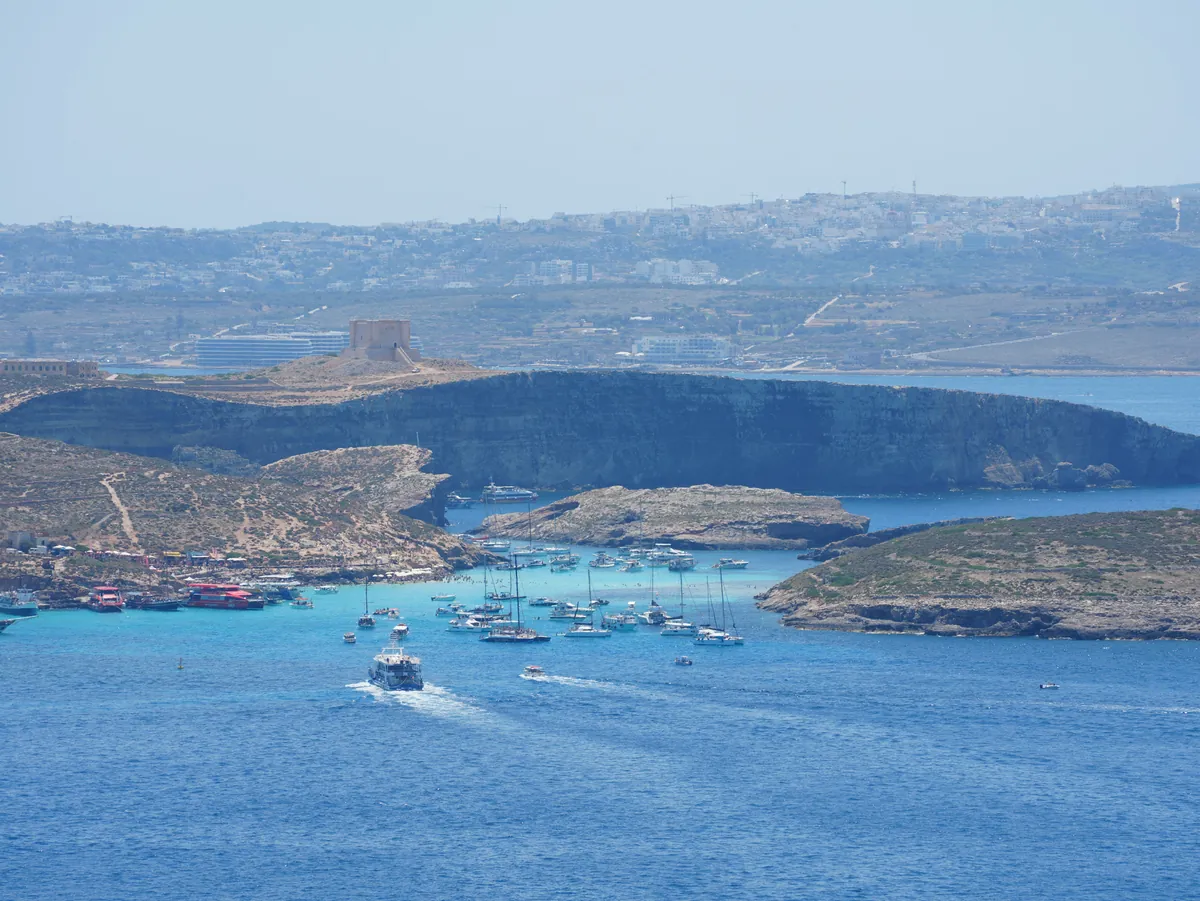
The route begins at the Cittadella, the walled citadel that crowns the hilltop above Victoria, Gozo's capital. The naturally defensible promontory has been inhabited since the Bronze Age and is believed to have been the acropolis of the Punic-Roman settlement of Gaulos. In the medieval period the acropolis became a castle where, by the 13th century, roughly a third of Gozo's population lived, and residents were required to spend the night inside its walls against raiders. A large Ottoman force under admiral Sinan Pasha besieged and sacked the Cittadella in July 1551, taking most of the 6,000 Gozitans sheltering there as slaves; the fortress was rebuilt and, between 1599 and 1622, its southern walls were reconstructed as a bastioned gunpowder fortress, while the northern walls kept their medieval form. The citadel was decommissioned by the British in 1868. Inside its walls stands the Cathedral of the Assumption, a Baroque building of 1697–1711 by the Maltese architect Lorenzo Gafà, built on a site tradition holds was once a Roman temple to Juno; its ceiling carries a trompe-l'œil dome painted by the Sicilian artist Antonio Manuele. A restoration completed in 2016 reopened the piazza and streets, and converted a 19th-century water reservoir into a visitors' centre. From Victoria the route crosses to Comino, a 3.5-square-kilometre island in the channel between Malta and Gozo. Known in antiquity as Ephaestia, Comino was farmed by the Romans, then largely uninhabited or privately held for long stretches of its history; its cliffs and caves sheltered pirates raiding boats crossing between the two larger islands. The Knights of Malta used Comino as hunting ground and, in the 16th and 17th centuries, as a place of exile for knights convicted of minor offences, some of them sentenced to garrison duty at St Mary's Tower. Built in 1618 under Grand Master Wignacourt, the tower is a square structure with four corner turrets standing about 80 metres above the sea, its walls roughly six metres thick, part of a chain of coastal watchtowers linking Malta and Gozo. Farming families sustained a small community on the island into the 20th century, cultivating terraced fields of onions, potatoes, figs and barley without electricity until the 1950s; Comino's permanent population today numbers only two residents. Between Comino and the islet of Cominotto lies the Blue Lagoon, a bay of pale sand and clear, shallow water that draws swimmers, snorkellers and divers by day. The route continues to Dwejra Bay on Gozo's western coast, site of the Azure Window until its collapse. The natural arch formed over an estimated five centuries as sea erosion widened a notch in the Lower Coralline Limestone cliff into a cave and then a 28-metre-tall span; it does not appear in 17th- and 18th-century accounts of the area, and the earliest confirmed image of a completed arch dates to around 1830. Decades of rockfalls through the 1980s and 2000s widened and weakened it, and on 8 March 2017, after a period of heavy storms, the pillar gave way and the arch collapsed into the sea, leaving nothing visible above the waterline. The Maltese government ruled out rebuilding it, and the site today is visited for the rest of Dwejra's geology: the Inland Sea, a circular sinkhole linked to the open water by a short tunnel, and Fungus Rock, an islet left standing after an earlier arch's own collapse. The route's final stop is Ġgantija, a megalithic temple complex on the edge of the Xagħra plateau, its two temples dated to around 3600–2500 BC. Built more than 5,500 years ago, they are the earliest of the Megalithic Temples of Malta, predate the pyramids of Egypt, and rank as the world's second-oldest known free-standing manmade religious structures after Göbekli Tepe in Turkey. The larger, older southern temple rises to six metres and holds five broad apses; a stone block with a hollowed recess at its entrance is thought to have served as a station for ritual purification before worshippers entered. Local folklore credits their construction to a giantess, Sansuna, who is said to have carried an infant on her shoulder while building the temples on a diet of fava beans and honey. Cleared of debris in 1827 and listed as a UNESCO World Heritage Site in 1980, the complex was later joined by five further Maltese temple sites under the same listing, renamed the Megalithic Temples of Malta, and a heritage park with protective walkways opened around it in 2013. Across five days the itinerary threads together Gozo's layered past: a Bronze Age acropolis turned fortress at the Cittadella, a once-sparsely-peopled island of watchtowers and pirate coves at Comino, the eroded limestone of Dwejra Bay where the Azure Window stood until 2017, and, older than all of them, the Neolithic temples of Ġgantija on the Xagħra plateau — a single thread from prehistoric ritual through medieval siege to a coastline still being reshaped by the sea.
Text adapted from the linked articles under CC BY-SA 4.0; edited for length.
Every dimension the Taro team tags this pack with — filter by any of these on the packs page.
Share your travel month, group size, budget comfort, and must-do experiences. The Taro team will shape the right route before any payment conversation.

