Abu Dhabi + Yas Island
5DFrom ₹1,05,000
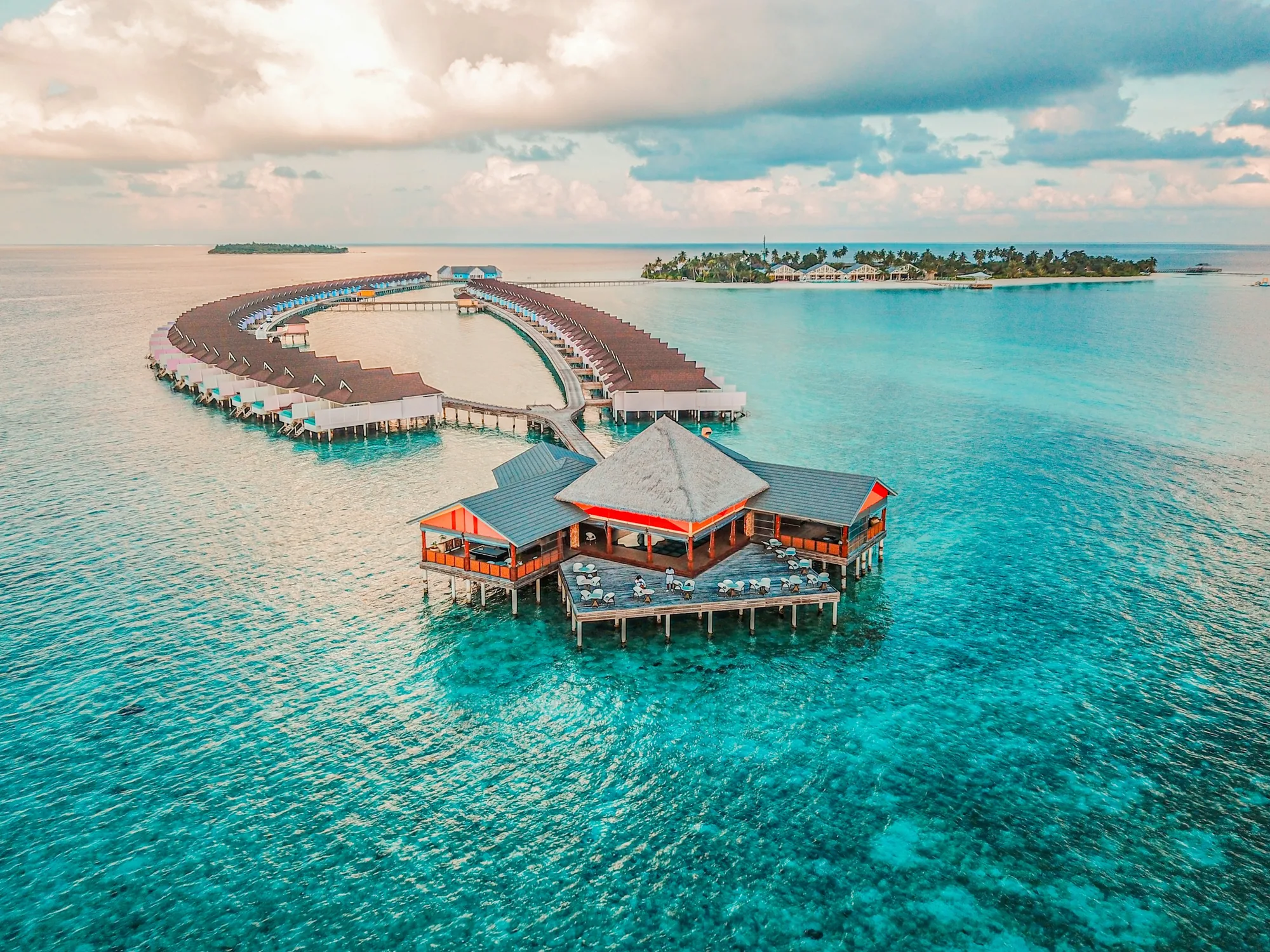
Overwater villa, private dining, snorkelling with mantas.
This honeymoon is spent entirely within the Maldives, an archipelagic country in South Asia in the Indian Ocean, roughly 750 kilometres southwest of the Asian mainland. Its chain of 26 atolls stretches across the equator from Ihavandhippolhu Atoll in the north to Addu Atoll in the south, and while the country's land area totals only 298 square kilometres, that land is spread across some 90,000 square kilometres of sea, making it one of the world's most spatially dispersed sovereign states. With a population of 515,132 at the 2022 census, the Maldives is the second least populous country in Asia and one of the most densely populated, and with an average ground-level elevation of about 1.5 metres and a highest natural point of just 2.4 metres, it is also the world's lowest-lying country.
The name Maldives itself carries this geography: one theory traces it to the Sanskrit mālā, "garland," and dvīpa, "island," giving a meaning close to "garland of islands," echoed in the Sinhala Maala Divaina and the Sri Lankan chronicle Mahavamsa's reference to an island it called Mahiladiva. Historical evidence points to more than 2,500 years of settlement, with the Mahāvaṃsa recording emigration from Sri Lanka as early as 300 BCE, and historians have suggested people may have lived in the Maldives as far back as the Indus Valley Civilisation, given that its characteristic cowrie shells are believed to have originated there; artefacts from before the Islamic period also show evidence of Hinduism in the country.
The stay itself is spent in North Malé Atoll, part of the administrative division of Kaafu Atoll, which is officially and traditionally known as Malé Atoll and made up of the natural atolls of North Malé, South Malé, Gaafaru, and Kaashidhoo Island, separated from each other by channels such as the Vaadhoo Kandu between the two Malé atolls. Most of the country's resort islands sit within these administrative divisions, classified as uninhabited islands that have been converted for tourism, distinct from Malé itself and the neighbouring islands of Hulhulé and Hulhumalé, which fall under the separate Malé City administrative division even though they are geographically part of North Malé Atoll.
Snorkelling excursions from the resort put the Maldives' manta rays within reach — rays of the genus Mobula, of which the largest species reaches 7 metres across, with triangular pectoral fins, horn-shaped cephalic fins, and forward-facing mouths adapted for filter feeding on zooplankton. Mantas have one of the highest brain-to-body ratios of any fish, show advanced cognition, and are thought to be capable of understanding mirror contingencies; they visit cleaning stations to have parasites removed and, like whales, are known to breach clear of the water for reasons still not fully understood. The Portuguese and Spanish name manta, meaning "cloak" or "blanket," also gave rise to the older name "devilfish," a reference to the horn-like shape of their cephalic fins.
The lagoon views from the villa are a direct product of that geography: the Maldives is made up of 1,192 coral islands across its 26 atolls, composed of live coral reefs and sand bars sitting atop a submarine ridge some 960 kilometres long that rises abruptly from the floor of the Indian Ocean. More than 80 percent of the country's land rises less than one metre above sea level, which is why the Intergovernmental Panel on Climate Change has warned that continued sea-level rise could make the Maldives uninhabitable by 2100 — a fact that sits quietly behind the overwater views and shallow house reefs the resort's private dining and sunset outings are built around.
Text adapted from the linked articles under CC BY-SA 4.0; edited for length.
On documentation, this trip is in the e-visa band, generally sorted online before travel — treat that as a planning signal only, and verify exact, current requirements with the relevant embassy or consulate before booking. It runs 5 days, from ₹2,45,000 per person.
Every dimension the Taro team tags this pack with — filter by any of these on the packs page.
5 days across Maldives, starting from ₹2,45,000 per person.
Suited to Couples, Friends, Luxury Travellers, and Honeymooners, with best suited to adults travelling without children and a moderate activity level.
This trip typically involves an online e-visa arranged ahead of travel. Always confirm exact, current requirements with the relevant embassy or consulate before booking — this is a planning signal, not a legal statement.
Yes — Maldives Overwater Honeymoon suits engagements and anniversaries well.
Share your travel month, group size, budget comfort, and must-do experiences. The Taro team will shape the right route before any payment conversation.