Abu Dhabi + Yas Island
5DFrom ₹1,05,000
KL skyline, Sepilok orangutans, Borneo rainforest river.
This trip opens in Kuala Lumpur, Malaysia's capital and most populous city, a federal territory covering 243 square kilometres with a population of 2,111,536, part of a wider Greater Kuala Lumpur urban agglomeration of 8.81 million people. The city grew from a tin-mining settlement founded around 1857 at the confluence of the Gombak and Klang rivers — its name means "muddy confluence" in Malay — and it served as the capital of Selangor from 1880 to 1978 before becoming the founding capital of the Federation of Malaya and, later, Malaysia.
The trip's first stop in the city is the Petronas Towers, an interlinked pair of 88-storey supertall skyscrapers standing 451.9 metres tall, the tallest buildings in the world from 1998 until Taipei 101 surpassed them in 2004, and still the tallest twin skyscrapers anywhere. Designed by the Argentine-American architect César Pelli using a tube-in-tube structural system, the towers' steel-and-glass facade echoes motifs from Islamic art, and their cross-section is based on the geometric shape of a Rub el Hizb, adapted with circular sectors to meet office-space needs. Construction ran for seven years from 1993 on the site of the former Selangor Turf Club, and the towers remained Malaysia's tallest buildings until The Exchange 106 surpassed them in 2019.
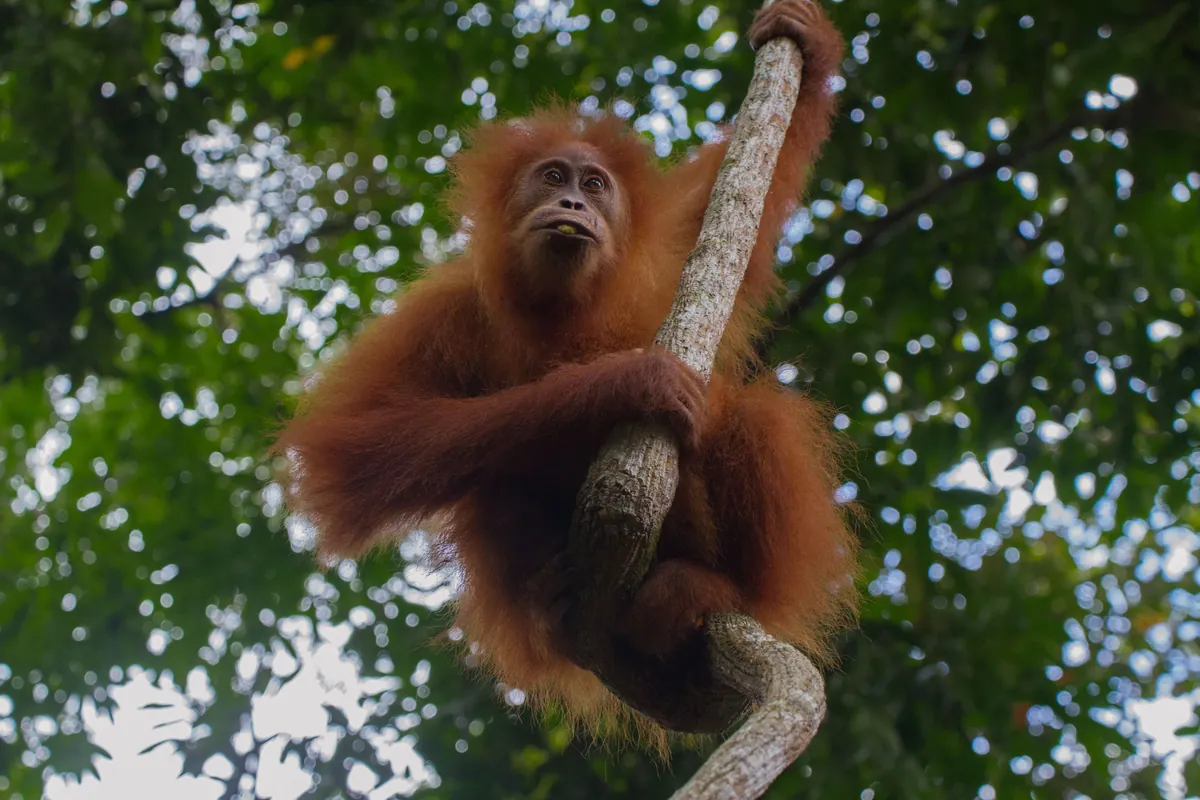
From the capital, the trip flies to Sabah for the Sepilok Orangutan Rehabilitation Centre, about 25 kilometres west of Sandakan. Opened in 1964 as the first official orangutan rehabilitation project of its kind, it takes in orphaned baby orangutans rescued from logging sites, plantations, illegal hunting, or life as pets, trains them to survive in the wild, and releases them once ready; the sanctuary sits inside the 4,294-hectare Kabili-Sepilok Forest Reserve, much of it virgin rainforest and designated an Important Bird Area by BirdLife International, where an estimated 60 to 80 orangutans now live free.
A river safari follows on the Kinabatangan River, Malaysia's second-longest at 560 kilometres from its headwaters in southwest Sabah to its outlet in the Sulu Sea east of Sandakan. Its name comes from Kina Batañgan, an indigenous Dusun reference to Chinese traders who settled the river mouth as early as the seventh century to deal in edible-nest swiftlet, beeswax, rattan, and ivory. Despite heavy logging in its upper reaches, the lowland forest and mangrove swamps nearer the coast survive largely intact, sheltering saltwater crocodiles alongside some of Borneo's highest concentrations of wildlife, including Bornean orangutans, proboscis monkeys, Borneo elephants, Sunda clouded leopards, and hornbill species such as the rhinoceros and wrinkled hornbill.
The trip closes at the base of Mount Kinabalu, the highest mountain in Malaysia and in Maritime Southeast Asia, rising 4,095 metres in Sabah's Ranau district and protected within Kinabalu Park, a World Heritage Site. It is the third-highest peak of any island on Earth and supports extraordinary biodiversity, with 5,000 to 6,000 plant species, 326 bird species, and more than 100 mammal species recorded, including the Rafflesia plant and the orangutan. Geologically young by mountain standards, its granodiorite core hardened only about 10 million years ago and is still rising roughly 5 millimetres a year; glaciers that covered it around 100,000 years ago carved the 1,800-metre-deep Low's Gully on its northern side, a feature that helped the mountain's granite earn a place among the International Union of Geological Sciences' 100 geological heritage sites in 2022.
Text adapted from the linked articles under CC BY-SA 4.0; edited for length.
On documentation, this trip sits in the e-visa complexity band — usually arranged online ahead of travel — treat that as a planning signal only, and verify exact, current requirements with the relevant embassy or consulate before booking. It runs 9 days, from ₹95,000 per person.
Every dimension the Taro team tags this pack with — filter by any of these on the packs page.
9 days across Malaysia, starting from ₹95,000 per person.
Suited to Couples and Friends, with a suitable option for families and a moderate activity level.
This trip sits in the e-visa complexity band — usually arranged online ahead of travel. Always confirm exact, current requirements with the relevant embassy or consulate before booking — this is a planning signal, not a legal statement.
Share your travel month, group size, budget comfort, and must-do experiences. The Taro team will shape the right route before any payment conversation.