Abu Dhabi + Yas Island
5DFrom ₹1,05,000
A 6-day luxury trip to Kuwait City, Kuwait, taking in Souq Al-Mubarakiya, Sadu House, Kuwait Towers and Failaka Island ruins.
Kuwait Desert & Heritage Trail opens at Souq Al-Mubarakiya, one of the oldest souqs in Kuwait City and a centre of trade dating back at least 200 years, well before the discovery of oil transformed the country's economy. Vendors here sell Persian silk carpets, antiques, musk and oud perfumes, gold and silver jewellery, dates, honey and spices alongside fresh produce and traditional costumes, and the market's courtyard near the Sea Mosque holds traditional cafés that still brew tea over coals; two small museums inside the souq, the Sheikh Mubarak Kiosk and Kuwait's first pharmacy building, are open to visitors free of charge. Damaged during the Iraqi invasion of 1990 and again by a fire in March 2022 that destroyed a section of shops, the souq has since been under a phased reconstruction overseen by a joint committee of Kuwaiti heritage and municipal bodies.
From the souq the route reaches Sadu House, a museum in Kuwait City established in 1980 by the Al Sadu Society to preserve Sadu weaving, the geometric hand-woven embroidery traditionally practised by Bedouin communities. Built on the site of an early 20th-century mud house destroyed in the 1936 Kuwaiti floods, Sadu House had registered 300 Bedouin women by 1984, producing around seventy woven items a week, and its rooms — decorated with pottery motifs of traditional houses and mosques — remain a showcase for Bedouin craft traditions in the heart of the modern city.
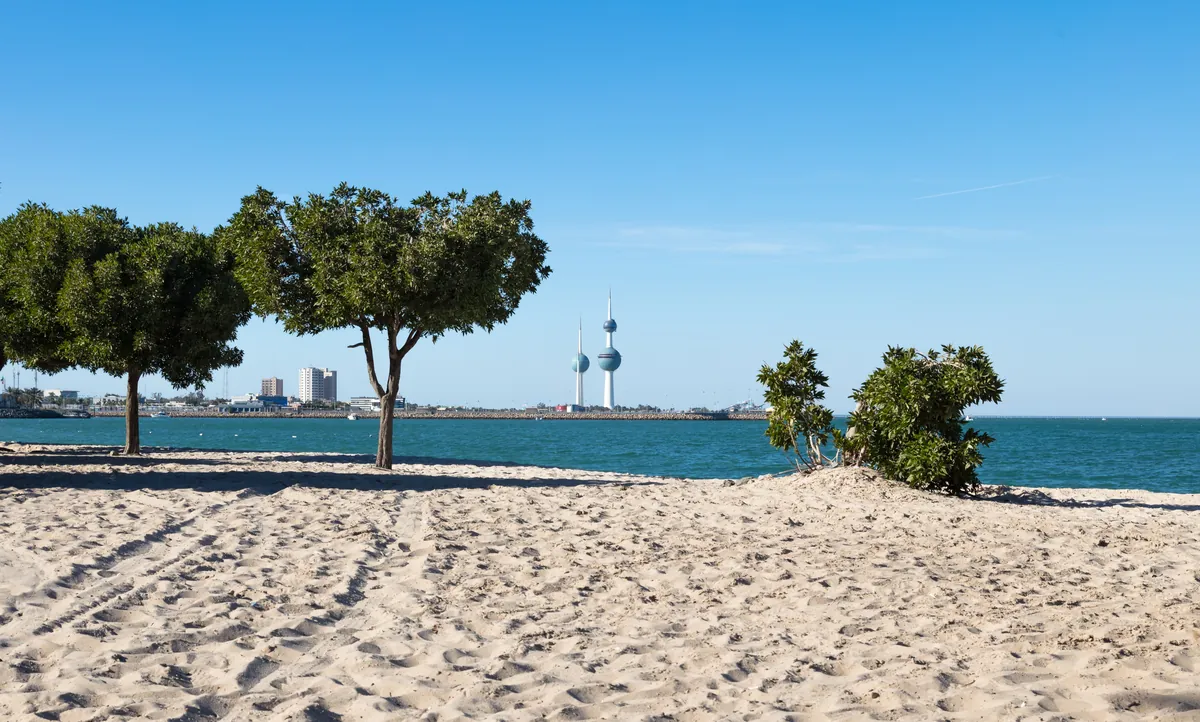
The trip continues to Kuwait Towers, a cluster of three towers on a promontory into the Persian Gulf that were inaugurated in March 1979 as the final and most distinctive group in Kuwait's wider water-tower system. Designed by Danish architect Malene Bjørn, the 187-metre main tower carries two spheres clad in roughly 41,000 enamelled steel discs in shades of blue, green and grey, its lower sphere holding both a water tank and a revolving restaurant, its upper sphere completing a full rotation every 30 minutes; heavily damaged during the Iraqi occupation of 1990–91, the towers were restored and remain a recognised symbol of modern Kuwait, having received the Aga Khan Award for Architecture as part of the wider Kuwait Water Towers system in 1980.
The route closes on Failaka Island, 20 kilometres off Kuwait City and one of the most continuously inhabited places in the wider Persian Gulf, settled as early as 2000 BC by traders from the Sumerian city of Ur and later known during the Dilmun era as "Agarum." Alexander the Great's forces renamed the island Ikaros around 324 BC for its resemblance to the Aegean island of the same name, and a Hellenistic fort and two Greek temples excavated on the island since the 1950s attest to centuries of settlement that continued through Nestorian Christian communities in the 5th to 9th centuries AD and into the modern era, when the island supported over two thousand residents before the 1990 Iraqi invasion forced their evacuation; today Failaka's excavated tells, its Hellenistic fortress ruins and its quieter, less-developed shoreline close out a six-day route through Kuwait's markets, modern landmarks and one of the Gulf's oldest continuously occupied islands.
Text adapted from the linked articles under CC BY-SA 4.0; edited for length.
Every dimension the Taro team tags this pack with — filter by any of these on the packs page.
Share your travel month, group size, budget comfort, and must-do experiences. The Taro team will shape the right route before any payment conversation.