Abu Dhabi + Yas Island
5DFrom ₹1,05,000
Petra by Night, Wadi Rum Bedouin camp, Dead Sea float.
Jordan Petra + Wadi Rum is based in Amman, Jordan's capital, largest city and economic, political and cultural centre, home to five million people as of 2024 and the largest city in the Levant. The name derives from the ancient Ammonites, whose capital the city had been since the 13th century BC under the name Rabat ʿAmmān, meaning "Capital" or "King's Quarters," and the Neolithic site of ʿAin Ghazal on Amman's outskirts once covered 15 hectares and housed around 3,000 people at its height around 7000 BC — four to five times the population of Jericho at the same period. Over 8 days the pack moves from that ancient capital to a rock-cut tomb, a desert valley, a salt lake, and a second Roman-era city.
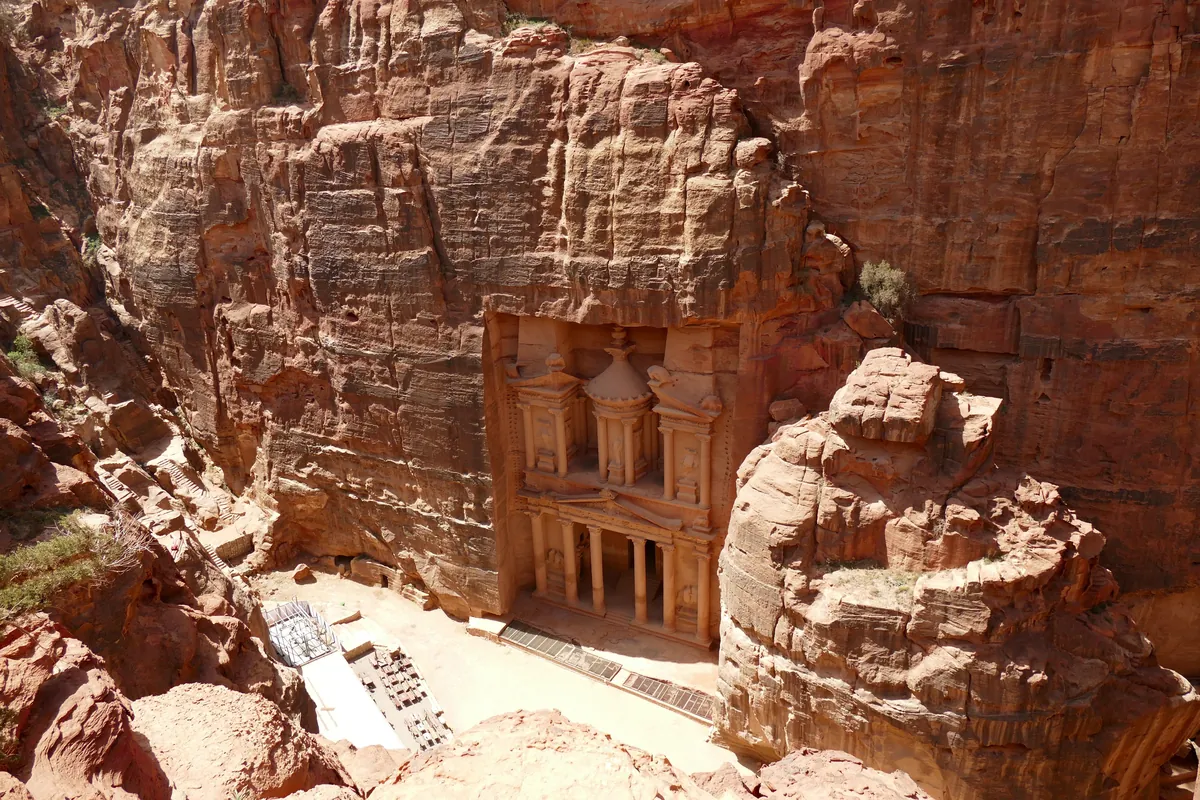
Al-Khazneh, Petra's Treasury and the pack's first stop, is one of the most elaborate rock-cut tombs in the Nabataean city, carved directly into the cliff like most of Petra's other monuments, including the Monastery. Its name, meaning "The Treasury" in Arabic, comes from local Bedouin legend about a decorative stone urn on its upper level, believed to hide treasure though it is in fact solid sandstone, and much of the carved detail on its facade — thought to depict mythological figures associated with the afterlife — has eroded over the two millennia since it was cut.
Wadi Rum, also called the Valley of the Moon, is a valley cut into sandstone and granite in southern Jordan near the Saudi border, about 60 kilometres east of Aqaba. Its name is thought to come from the lost city of Iram of the Pillars, mentioned in the Quran, and the highest point in Jordan, Jabal Umm ad Dami at 1,840 metres, rises about 30 kilometres south of Wadi Rum village, first located by the Zalabia Bedouin guide Difallah Ateeg.
The Dead Sea, where the pack floats, is a landlocked salt lake bordered by Jordan to the east and the West Bank and Israel to the west, sitting in the endorheic Jordan Rift Valley and fed mainly by the Jordan River. Its English name is a calque of the Arabic name, itself translated from still older Greek and Latin names, all referring to the near-total absence of aquatic life the lake's extreme salinity causes — a description that has also produced historical English names such as the Salt Sea and the Lake of Sodom.
The trip closes at Jerash, a city in northern Jordan about 30 miles north of Amman and the administrative centre of Jerash Governorate, recorded with a population of 50,745 in 2015. Archaeologists have traced settlement here back to the Neolithic period — in August 2015 a University of Jordan excavation team even uncovered two human skulls dated to between 7500 and 5500 BC — with further evidence of Bronze Age settlement in the surrounding region, long before the Hellenistic-era ruins of Gerasa the pack actually walks through today; ancient Greek inscriptions credit the city's founding to Alexander the Great and his general Perdiccas, and after the Roman conquest of the region in 63 BC, Pompey folded Gerasa into the Decapolis, a league of Hellenistic cities that kept considerable autonomy under Roman protection.
Text adapted from the linked articles under CC BY-SA 4.0; edited for length.
On documentation, this trip falls into the on-arrival complexity band — treat that as a planning signal only, and verify exact, current requirements with the relevant embassy or consulate before booking. It runs 8 days, from ₹1,45,000 per person.
Every dimension the Taro team tags this pack with — filter by any of these on the packs page.
8 days across Jordan, starting from ₹1,45,000 per person.
Suited to Couples and Friends, with a suitable option for families and a moderate activity level.
This trip sits in the on-arrival visa-complexity band. Always confirm exact, current requirements with the relevant embassy or consulate before booking — this is a planning signal, not a legal statement.
Share your travel month, group size, budget comfort, and must-do experiences. The Taro team will shape the right route before any payment conversation.