Arctic Svalbard Polar Bears
8DFrom ₹6,85,000
A 5-day premium city break in Florence around its Renaissance art and architecture.
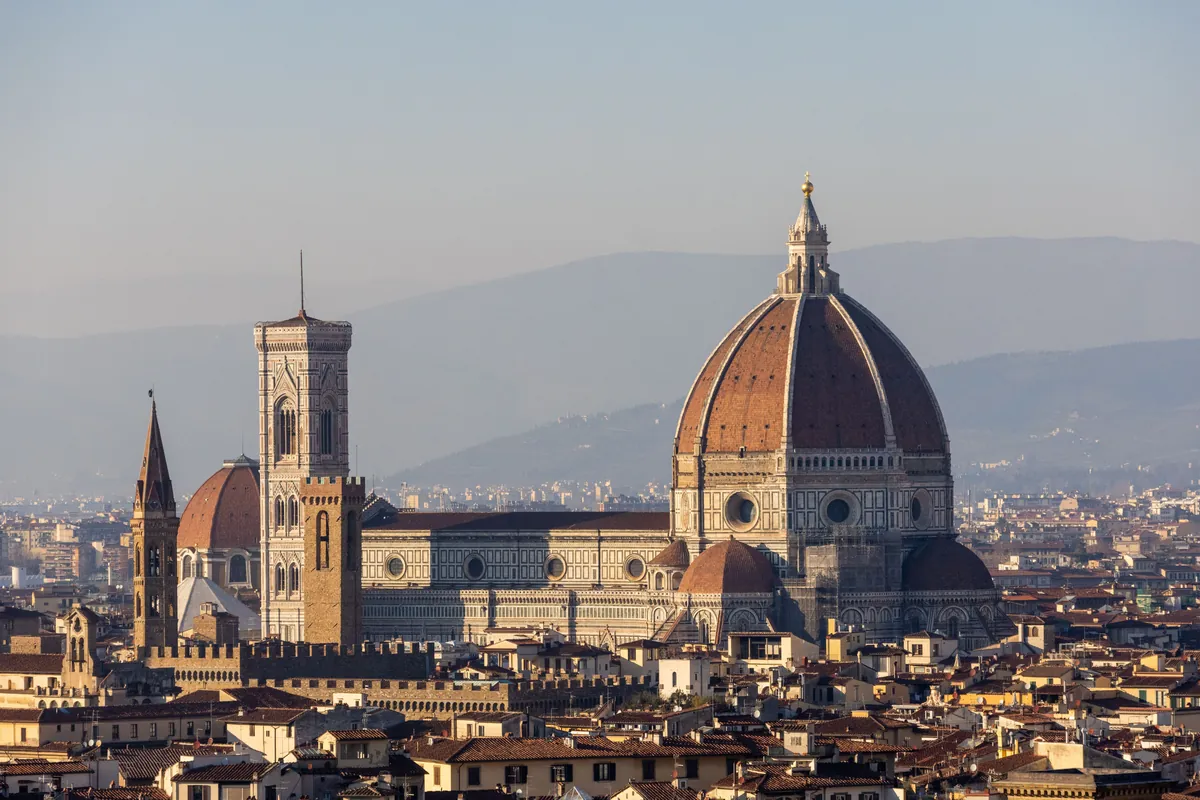
The walk starts at the Duomo, formally the Cathedral of Saint Mary of the Flower, begun in 1296 to a design by Arnolfo di Cambio and built on the site of Florence's earlier cathedral of Santa Reparata. Its exterior of polychrome marble panels and its 19th-century Gothic Revival facade frame a building that took more than a century to complete because it was missing the one feature its own original design demanded: a dome wider and higher than any built before, with no external buttresses to hold it up. That challenge was finally solved by Filippo Brunelleschi, whose engineering delivered the dome by 1436; he is buried in a simple tomb in the cathedral's crypt, close to the entrance, a modest resting place for the man who solved the era's hardest architectural problem. In 1475 the astronomer Paolo dal Pozzo Toscanelli, who had also tutored Brunelleschi in mathematics, pierced a hole high in the dome to create a meridian line still used to mark the summer solstice.
A short walk away, the Uffizi occupies a building begun in 1560 by the architect and painter Giorgio Vasari for Cosimo I de' Medici, originally built to consolidate Florence's various government offices in one place — hence its name, meaning simply 'offices'. Its top floor became a gallery for the Medici family's own collection of Roman sculpture and Renaissance art, which passed to the city of Florence after the Medici line died out, under a family pact negotiated by Anna Maria Luisa, the last Medici heiress. The museum survived a severe flood in 1966 that damaged works across the city, and a 1993 car bomb attack that destroyed several pieces and damaged others; today it is among the most visited museums in Italy, its collection ranging from ancient sculptures such as the Venus de' Medici to the core of the world's Italian Renaissance painting.
The Ponte Vecchio, the only bridge in Florence to survive the Second World War, spans the Arno at its narrowest point, a crossing used since Roman times; the present stone bridge was rebuilt in 1345 after its predecessor was swept away by flooding in 1333. Its shops, first occupied by butchers and tanners, were restricted by ducal decree in 1565 to goldsmiths and jewellers alone, a rule still in force today, after Cosimo I de' Medici had the elevated Vasari Corridor built above the bridge to connect the Palazzo Vecchio with the Palazzo Pitti. When German forces retreated from the advancing Allied army in August 1944 and mined every other bridge in the city, the Ponte Vecchio alone was left standing, reportedly on Hitler's own order.
The route ends at Piazzale Michelangelo's viewpoint, a square laid out by the architect Giuseppe Poggi in 1869 on a hill south of the historic centre, during the urban renewal that accompanied Florence's brief period as the capital of a newly unified Italy. The square was part of a wider remaking of the Oltrarno district, when the city's medieval walls on the opposite bank were cleared to make way for tree-lined boulevards, and it remains the classic panoramic vantage point over the city's rooftops and river.
Across the day, the walk moves through the layered centuries of Florentine building: a cathedral whose dome took a century to solve, a Medici office building turned into one of the world's great art collections, a medieval bridge that outlasted a world war, and a nineteenth-century square built to show the whole city off at once. Each stop belongs to a different age of Florence, from the Gothic thirteenth century to the newly unified Italy of 1869.
Text adapted from the linked articles under CC BY-SA 4.0; edited for length.
Every dimension the Taro team tags this pack with — filter by any of these on the packs page.
Share your travel month, group size, budget comfort, and must-do experiences. The Taro team will shape the right route before any payment conversation.