Abu Dhabi + Yas Island
5DFrom ₹1,05,000
Holy Land triple-country pilgrimage with biblical archaeology.
Israel Jordan Egypt Holy Land is based in Tel Aviv, officially Tel Aviv-Yafo, the most populous city in Israel's Gush Dan metropolitan area and the country's economic and technological centre, with a population of 494,900 on the Israeli Mediterranean coast. The modern city takes its Hebrew name from Theodor Herzl's 1902 novel Altneuland, "Old New Land," as translated by Nahum Sokolow, who borrowed the phrase from a Mesopotamian site near Babylon mentioned in the Book of Ezekiel; within the modern city, the walled port of Jaffa is Tel Aviv-Yafo's only urban centre to have existed in early modern times, with archaeological evidence of settlement there stretching back roughly 7,500 years. The modern city itself grew out of the Ahuzat Bayit society, formed in 1906 by a group including Jaffa residents under Akiva Aryeh Weiss during the Second Aliyah, and passed to British control in late 1917 when imperial forces captured Jaffa during the First World War's Sinai and Palestine Campaign, remaining part of Mandatory Palestine until 1948. Over 13 days the trip crosses three countries to reach a walled old city, a rock-cut city, a pyramid complex, and a desert mountain.
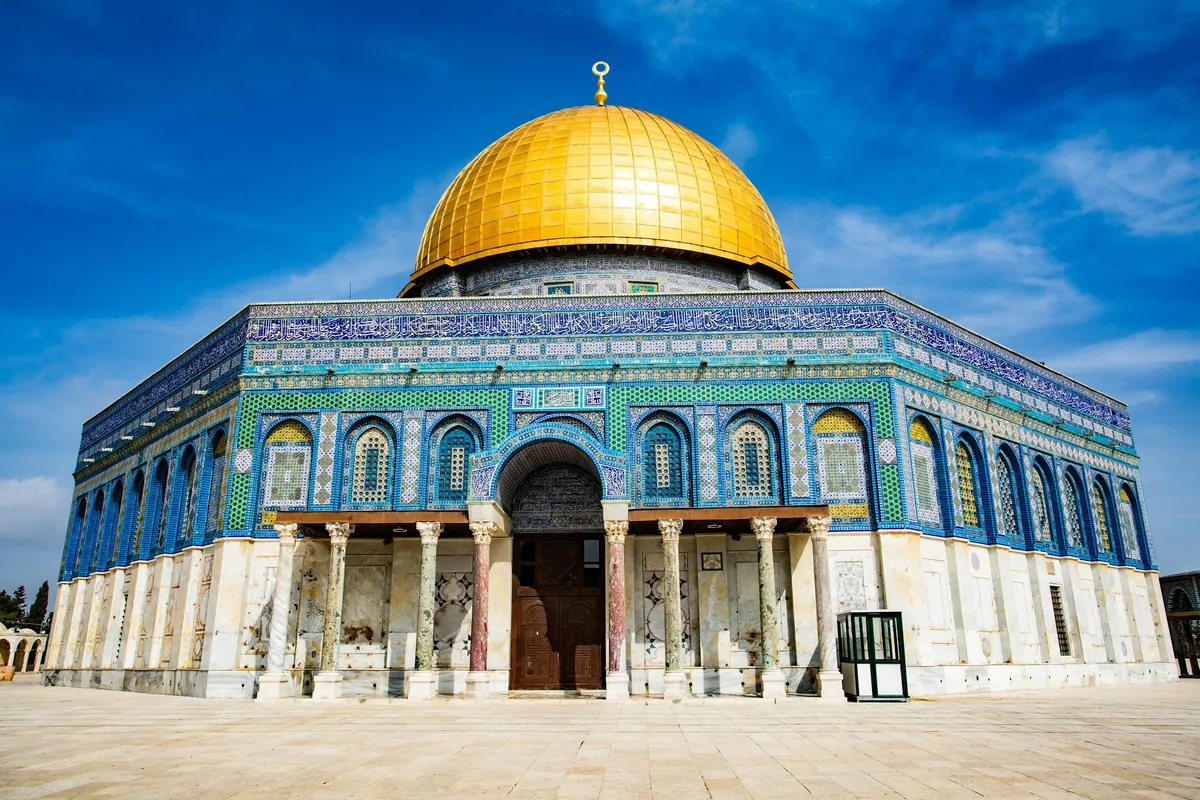
The Old City of Jerusalem, home to the pack's holy sites, is a 0.9-square-kilometre walled area in East Jerusalem whose population, recorded at 36,965 in 2007, is concentrated mostly in the Muslim Quarter. Its political status has shifted repeatedly in the modern era: Jordan captured the Old City and evicted its Jewish residents during the 1948 Arab-Israeli War, and Israeli forces took it, along with the rest of East Jerusalem, during hand-to-hand fighting on the Temple Mount in the 1967 Six-Day War.
Petra, known to its own inhabitants as Raqmu, is an ancient rock-cut city in southern Jordan famous for its architecture and water-conduit systems, sometimes called the "Rose City" for the colour of the sandstone it is carved from. Its history reaches back to at least 7000 BC, when some of the earliest recorded farmers settled at Beidha, just north of the site, and Petra itself appears in Egyptian campaign accounts and the Amarna letters under names including Pel, Sela and Seir.
The Giza pyramid complex, home to the Great Pyramid, the Pyramid of Khafre and the Pyramid of Menkaure alongside the Great Sphinx, was built during the Fourth Dynasty of Egypt's Old Kingdom, between roughly 2600 and 2500 BC. The Great Pyramid, built around 2580 to 2560 BC, stands with the somewhat smaller Pyramid of Khafre a few hundred metres to its south-west, on a plateau that was already settled even earlier — jars from the Maadi culture found at the foot of the Great Pyramid point to a disturbed, older settlement on the same ground.
The trip closes at Mount Sinai, also known as Jabal Musa, one of several peaks on Egypt's Sinai Peninsula claimed as the biblical mountain where, according to the scriptures of the three Abrahamic faiths, Moses received the Ten Commandments. Its rock formed during the late stages of the Arabian-Nubian Shield's geological evolution, and just north of the summit stands the sixth-century Saint Catherine's Monastery, with a Greek Orthodox chapel built in 1934 on the ruins of an earlier 16th-century church enclosing the rock traditionally considered central to the mountain's biblical story.
Text adapted from the linked articles under CC BY-SA 4.0; edited for length.
On documentation, this trip typically involves an online e-visa arranged ahead of travel — treat that as a planning signal only, and verify exact, current requirements with the relevant embassy or consulate before booking. It runs 13 days, from ₹2,45,000 per person.
Every dimension the Taro team tags this pack with — filter by any of these on the packs page.
13 days across Israel, Jordan, and Egypt, starting from ₹2,45,000 per person.
Suited to Couples, Friends, and Luxury Travellers, with a suitable option for families and a moderate activity level.
This trip is in the e-visa band, generally sorted online before travel. Always confirm exact, current requirements with the relevant embassy or consulate before booking — this is a planning signal, not a legal statement.
Share your travel month, group size, budget comfort, and must-do experiences. The Taro team will shape the right route before any payment conversation.