Abu Dhabi + Yas Island
5DFrom ₹1,05,000
A 6-day premium route through Guilin, featuring Li River, Yangshuo County, Reed Flute Cave and Longsheng Rice Terraces.
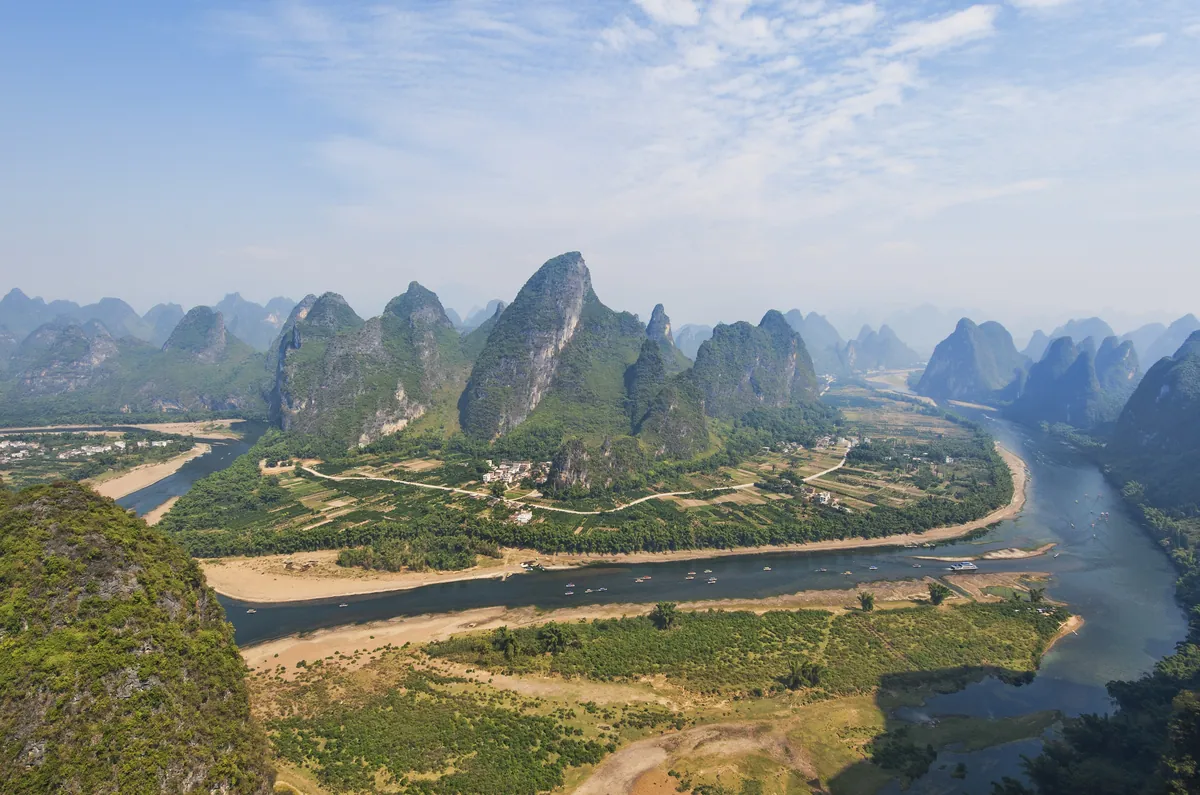
The route opens on the Li River, the name given to the upper 164 kilometres of the Gui River as it flows from Xing'an County through Guilin and Yangshuo to Pingle in northeastern Guangxi, part of the Xijiang system within the wider Pearl River basin. Rising in the Mao'er Mountains, the river descends from 141 metres at Guilin to 103 metres at Yangshuo, its course flanked for 439 kilometres by green hills shaped by roughly 2,600 metres of Devonian and Carboniferous limestone that has weathered over 10 to 20 million years into fengcong and fenglin karst — clustered peaks divided by deep depressions, riddled with hundreds of caves. Cormorant fishing has long been practised on these waters, and river cruises past the karst scenery draw millions of visitors each year; the river's imagery appears on the fifth series of China's 20-yuan banknote.
Downstream, Yangshuo County sits amid the same karst peaks along the Li River, a settlement inhabited for roughly 3,000 years and formally incorporated as a county in 590 CE under Emperor Wen of Sui, when its main street — five metres wide and 200 metres long — became the origin of today's West Street. Japanese troops occupied and looted the county briefly in 1944; by the 1970s domestic tourism had become commonplace, and government efforts to welcome foreign visitors turned Yangshuo into a favourite stop for backpackers, with West Street growing into a hub that drew over 21.1 million tourists in 2023 and today supports a substantial English-language teaching trade of its own.
The trip continues into Reed Flute Cave, known as the "Palace of Natural Arts," a limestone cave in Guilin named for the reeds growing outside it that can be fashioned into flutes. More than 70 inscriptions of poems and travelogues line its interior in ink, the oldest dated to 792 CE under the Tang dynasty; the cave was rediscovered in the 1940s by refugees fleeing Japanese forces and today is lit with coloured lighting that illuminates stalactite and stalagmite formations named for their shapes, among them the Crystal Palace, Fish Tail Peak and Dragon Pagoda.
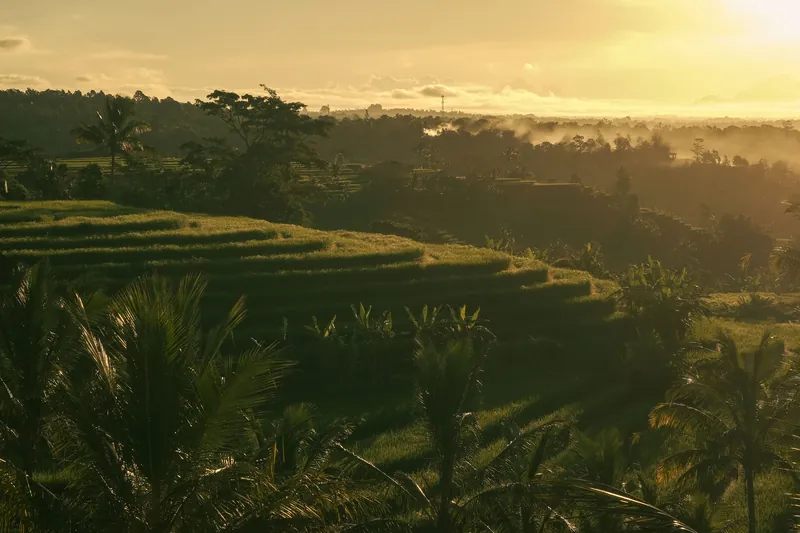
The journey closes at the Longsheng, or Longji, Rice Terraces, about 100 kilometres from Guilin in Longsheng Various Nationalities Autonomous County, where fields climb the mountainside between 600 and 800 metres above sea level along coiling terrace lines built roughly 650 years ago. The terraces shift in character through the seasons — sheets of water in spring, green shoots in summer, ripened rice in autumn, frost in winter — tracing the same slope from riverside to summit.
Over six days the route follows the Li River basin from its karst-lined course through Guilin and Yangshuo to the cave systems and mountain terraces that flank it: the cormorant-fished waters of the Li River, the backpacker town of Yangshuo, the inscribed limestone chambers of Reed Flute Cave, and the centuries-old terraced fields of Longsheng. Each stop sits within the same limestone landscape that has shaped this part of Guangxi for millions of years.
Text adapted from the linked articles under CC BY-SA 4.0; edited for length.
Every dimension the Taro team tags this pack with — filter by any of these on the packs page.
Share your travel month, group size, budget comfort, and must-do experiences. The Taro team will shape the right route before any payment conversation.