Abu Dhabi + Yas Island
5DFrom ₹1,05,000
A 5-day mid-range trip to Gobustan, Azerbaijan, taking in Gobustan Rock Art, Gobustan mud volcanoes, Absheron Peninsula and Yanar Dag.
Gobustan Rock Art & Mud Volcanoes opens at the Gobustan State Historical and Cultural Reserve, about 70 kilometres south-west of Baku, established to protect the region's prehistoric rock carvings, mud volcanoes and natural musical stones. Within the reserve, the Gobustan Rock Art Cultural Landscape spans 537 hectares and holds more than 6,000 petroglyphs dating back 5,000 to 20,000 years, depicting people, animals, battles, ritual dances, bullfights, reed boats crewed by armed oarsmen, camel caravans and celestial symbols. The Norwegian anthropologist Thor Heyerdahl visited repeatedly between 1981 and his death in 2002 to study the site as part of his 'Search for Odin', and in 1948 the archaeologist Ishag Jafarzadeh discovered a Latin inscription near Boyuk-Dash mountain dedicated to Emperor Domitian by a centurion of the Twelfth Legion — the easternmost Latin inscription known anywhere.
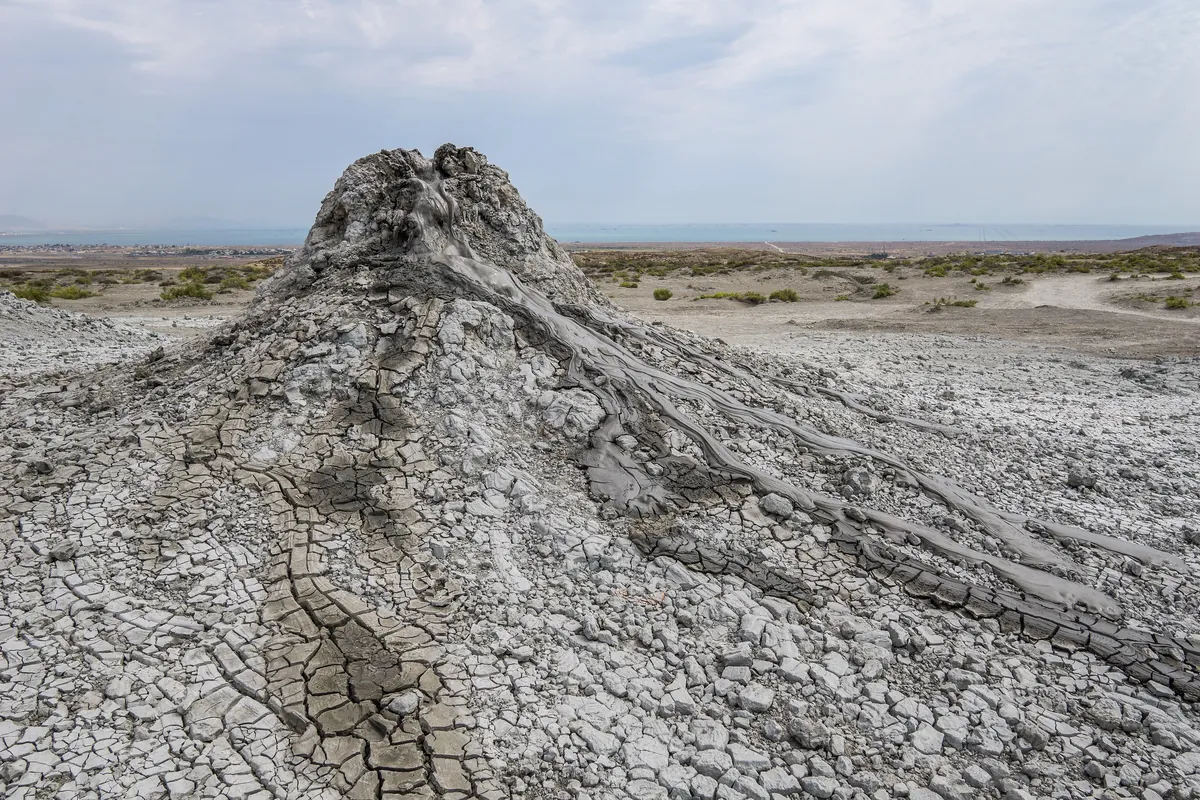
From the rock art the route reaches Gobustan's mud volcanoes, part of a phenomenon for which Azerbaijan holds the world's highest concentration, with roughly half of the planet's 700 known mud volcanoes found across the country and its stretch of the Caspian Sea. Formed by pressurised gas, water and mud forced up from deep within the Earth's crust, the volcanoes have produced around 200 recorded eruptions at fifty sites since 1810, some accompanied by underground rumbling and flames as escaping gas ignites; more than 140 further mud volcanoes lie on the floor of the Caspian itself, and eight islands of the Baku Archipelago are themselves of mud-volcanic origin.
The trip continues to the Absheron Peninsula, home to Baku and often described as the beak of the eagle-shaped landmass of Azerbaijan, extending 60 kilometres into the Caspian Sea. Technically the easternmost extension of the Caucasus Mountains despite its gently undulating, only mildly hilly terrain, the peninsula takes its name from the Persian for 'salty waters' and saw large-scale migration of Iranian labourers during the petroleum boom of the late 19th century, when its oil resources first drew industrial-scale exploitation.
The route ends at Yanar Dagh, a natural gas fire that has burned continuously on an Absheron hillside near Baku since at least the first millennium BCE, when it served Zoroastrian fire-worship as a link between people and the divine. Fed by a steady seep of gas from beneath the surface, its flames rise up to three metres from a porous scarp of sandstone, and unlike the region's mud volcanoes, Yanar Dagh produces no accompanying mud or liquid discharge; the marketplace traveller Marco Polo is among the historical figures said to have documented similar natural fires in the area, and a state reserve established by presidential decree in 2007 now protects the site, alongside a museum built after renovations completed in 2019.
Over five days the pack moves from the petroglyphs and singing stones of Gobustan, past its bubbling mud volcanoes, out along the oil-rich Absheron Peninsula, and to the perpetual flame of Yanar Dagh — a route across the geology that has given Azerbaijan its reputation as the Land of Fire.
Text adapted from the linked articles under CC BY-SA 4.0; edited for length.
Every dimension the Taro team tags this pack with — filter by any of these on the packs page.
Share your travel month, group size, budget comfort, and must-do experiences. The Taro team will shape the right route before any payment conversation.