Arctic Svalbard Polar Bears
8DFrom ₹6,85,000
A 6-day premium loop through Bavaria's castle road from Füssen.
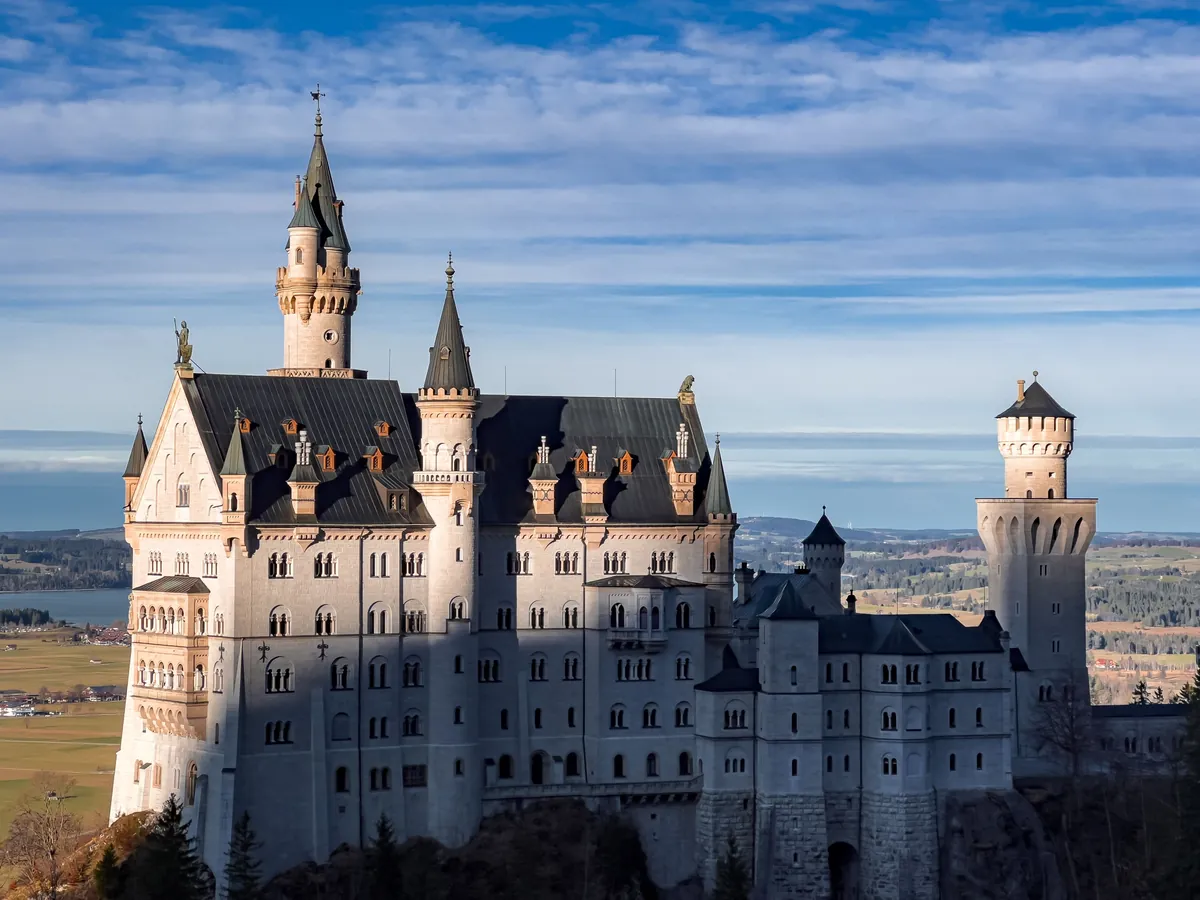
Bavaria Castle Road Loop opens at Neuschwanstein Castle, a 19th-century palace on a rugged hill above the village of Hohenschwangau near Füssen, commissioned by King Ludwig II of Bavaria as a retreat from the constraints of Munich and a tribute to the composer Richard Wagner. Built from 1869 after Ludwig had the ruins of two medieval castles on the site demolished, the palace was erected as brick construction faced in white limestone quarried nearby, with marble from Untersberg near Salzburg for its windows and columns; at 65 metres it is recognised by Guinness World Records as the tallest castle in the world, and since 2025 it has formed part of a UNESCO World Heritage Site alongside three of Ludwig's other palaces. The king moved in before construction was finished in 1884 and died in 1886 with much of the interior still incomplete — only 14 rooms were ever finished — and the palace, considered strategically unimportant, survived the Second World War undamaged, serving briefly as a wartime storage depot for looted art before its restitution.
Just below it stands Hohenschwangau Castle, built by King Maximilian II of Bavaria on the site of a fortress first mentioned in the 12th century and finished in 1837 as his family's summer residence; his son Ludwig spent much of his childhood here, sketching the ruined castles on the hill above that he would later rebuild as Neuschwanstein. The Wittelsbachs acquired the underlying fief between 1440 and 1521, and after changing hands again in the 16th century the lower castle was reconstructed by the Italian architect Lucio di Spazzi for the Augsburg merchant Johann Paumgartner, who kept its original exterior walls and towers while rebuilding the interior to a floor plan that survives today.
The loop continues to Nördlingen, a walled town of around 20,000 people built inside the Nördlinger Ries, a 15-million-year-old, 25-kilometre-wide impact crater left by a meteorite that struck at an estimated 70,000 kilometres an hour and scattered an estimated 72,000 tons of micro-diamonds across the area. First recorded in 898 and granted city rights by Emperor Frederick II in 1215, Nördlingen retains one of Germany's few completely intact circuits of medieval city walls, alongside Saint George's Church and its 90-metre steeple, built from suevite impact breccia quarried from the crater itself, and a Ries crater museum housed in the town's well-preserved former tanners' quarter.
The route closes at the Wieskirche, an oval Rococo pilgrimage church designed by the brothers Johann Baptist and Dominikus Zimmermann and completed in 1754 in the foothills of the Ammergau Alps near Steingaden. Its construction followed reports in 1738 that tears had been seen on a wooden figure of the Scourged Saviour, drawing pilgrims in numbers that quickly outgrew the small chapel first built to house it, and its interior frescoes and stuccowork, in the tradition of the Wessobrunner School, were designed, in the words later used to describe the result, to make the supernatural visible; inscribed as a UNESCO World Heritage Site in 1983 for its Rococo architecture, it remains an active pilgrimage church as well as one of Bavaria's most visited, closing a six-day loop from a 19th-century royal fantasy castle to an 18th-century meadow chapel.
Text adapted from the linked articles under CC BY-SA 4.0; edited for length.
Every dimension the Taro team tags this pack with — filter by any of these on the packs page.
Share your travel month, group size, budget comfort, and must-do experiences. The Taro team will shape the right route before any payment conversation.

