Abu Dhabi + Yas Island
5DFrom ₹1,05,000
A 8-day premium trip to Panjakent, Tajikistan, taking in Iskanderkul lake, Seven Lakes, Kulikalon Lakes and Chimtarga Peak.
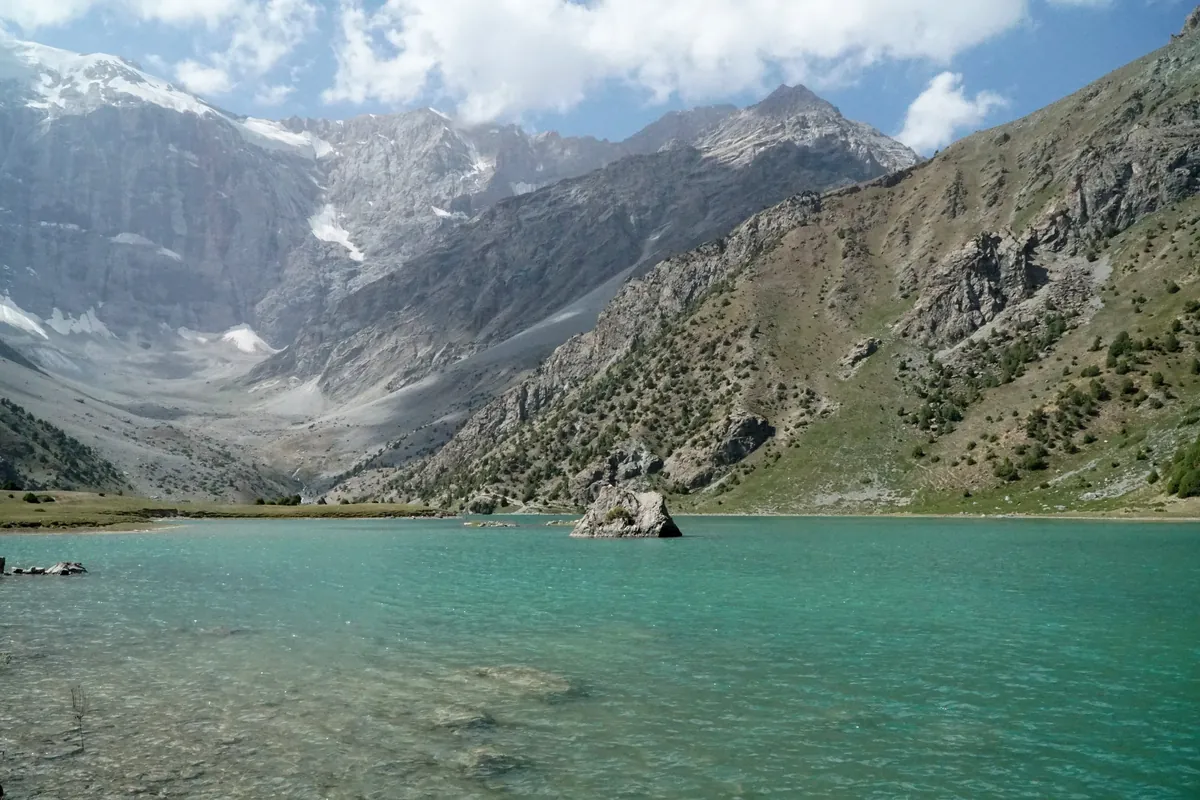
Fann Mountains Alpine Lakes Trek opens at Iskanderkul, a triangular glacial lake at 2,195 metres on the northern slopes of the Gissar Range, formed where a landslide dammed the Saratogh river and covering 3.4 square kilometres to a depth of up to 72 metres. Its outflow, the Iskander Darya, joins the Yaghnob River to form the Fan Darya, a major tributary of the Zarafshan River, and the lake takes its name from Iskander, the Persian rendering of Alexander the Great, whose forces are said locally to have either flooded a resistant settlement here in anger or lost Alexander's horse Bucephalus beneath its waters — legends rather than documented history. A 300-square-kilometre nature reserve protects the lake and surrounding rivers, forests and sub-alpine meadows, with 177 square kilometres recognised by BirdLife International as an Important Bird Area for species including Himalayan snowcocks, saker falcons and cinereous vultures.
The trek continues to the Seven Lakes, also called the Marguzor Lakes or the Seven Beauties of Shing, a chain of naturally dammed lakes in the Panjakent District running from Mižgon at 1,598 metres up to Hazorchashma — "a thousand springs" — at 2,400 metres. Each carries its own character and name along the Shing River valley: turquoise and purple-hued Mižgon, shadowed Soja, Ҳушёр named for the venomous snakes once reported nearby, reddish-tinted Nofin, the small Churdak near the village of Padrut, the light-blue Marguzor — the largest and most visited of the seven — and finally Hazorchashma, fed by numerous springs and two rivers and set somewhat apart from the rest of the chain.
From the Seven Lakes the route reaches the Kulikalon Lakes, three glacial tarns in the Zeravshan Mountains some 55 kilometres southeast of Panjakent, set within the Kulikalon cirque among remnants of juniper forest at around 2,800 metres, ringed by peaks rising to 3,000–3,500 metres. Fed by meltwater from the Chimtarga glacier and drained by the Artuch River, the cirque holds the largest surviving blocks of juniper forest in the western Zeravshan Range and, like Iskanderkul, has been designated an Important Bird Area for species such as Himalayan snowcocks and Himalayan vultures, with the surrounding slopes still used as summer pasture.
The trek closes beneath Chimtarga Peak, the highest point of the Zarafshan Range at 5,489 metres, rising near the range's centre where the Zarafshan and Gissar ranges meet to form the Fann Mountains — the highest section of both. Alexander the Great's forces are recorded reaching the wider Zarafshan Valley during his Central Asian campaign in 330 BC, and the range later passed through Hephthalite, Umayyad, Samanid, Mongol and Bukharan control before Russian troops occupied the Zarafshan and Yaghnob valleys by 1870, the same decade that saw the Zarafshan Glacier — one of Central Asia's longest, at nearly 25 kilometres — discovered and surveyed by Russian scientists. Today the Fann Mountains remain the range's most visited section for mountaineers and hikers, closing an eight-day trek across the glacial lakes and peaks that give this corner of Tajikistan its name.
Text adapted from the linked articles under CC BY-SA 4.0; edited for length.
Every dimension the Taro team tags this pack with — filter by any of these on the packs page.
Share your travel month, group size, budget comfort, and must-do experiences. The Taro team will shape the right route before any payment conversation.