Abu Dhabi + Yas Island
5DFrom ₹1,05,000
A 5-day mid-range trip to Dushanbe, Tajikistan, taking in Rudaki Park, Hissar Fortress, National Museum of Tajikistan and Dushanbe Flagpole.
Dushanbe City & Hissar Fortress opens in Rudaki Park, one of the oldest of Dushanbe's fifteen public parks, laid out in the mid-1930s alongside a bronze statue of Lenin and renovated in 2007. The park sits within a capital that has grown from a Monday market village — Dushanbe means "Monday" in Persian, named for the bazaar once held there weekly — into a city of over 1.2 million people set in the Hisar Valley at an elevation of 750 to 930 metres, bounded by the Hisar Range to the north and east and by the Babatag, Aktau, Rangontau and Karatau mountains to the south. First recorded by name in 1676, in a letter from the Balkh khan to the Tsar of Russia, the market town grew around a caravanserai on trade routes running east–west through Karategin to the Alay Valley and north–south toward Afghanistan, and by the turn of the 19th century held 14 mosques, two madrassas and 14 teahouses inside a citadel on the Varzob River's left bank. Proclaimed capital of the Tajik Autonomous Soviet Socialist Republic in 1924, the city was renamed Stalinabad from 1929 until de-Stalinization restored the name Dushanbe in 1961.
The route continues to Hissar Fortress, the fort of Hisor said to date back to Cyrus the Great and captured on 21 separate occasions over its long history, standing in the city of Hisor about 15 kilometres west of Dushanbe at an elevation of 799 to 824 metres. The fort served as the residence of the Bukharan governor through periods of Uzbek, Tajik and Bukharan rule; after Muhammad Shaybani's conquest in 1504 and a brief occupation by Babur in 1511, Hisar spent the 17th century under growing Tajik influence before asserting outright independence following the 1711 assassination of Bukharan khan Ubaydullah Khan. Russian military support helped Bukhara reabsorb Hisar after an 1868 treaty, and the wider region later became the historical core of what would form the Tajik Autonomous Soviet Socialist Republic, before Hisar itself was formally made a city in 1993.
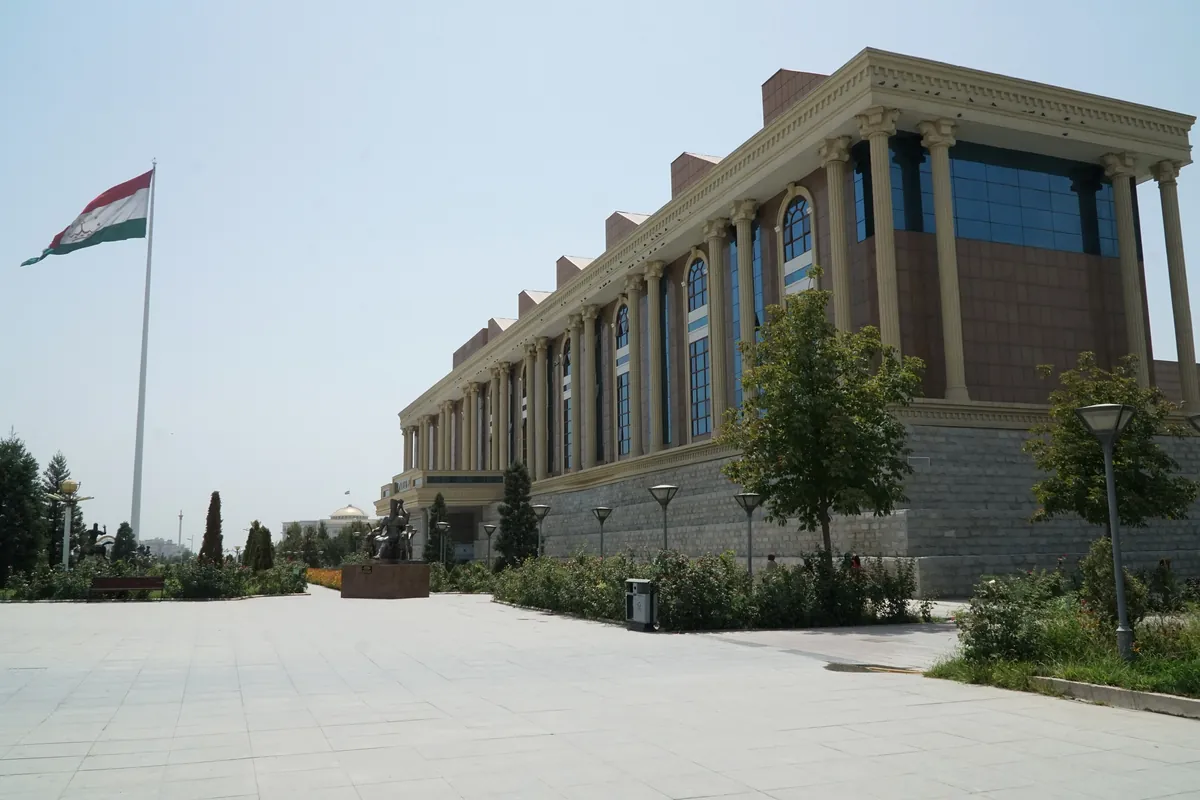
From Hisar the trip returns to Dushanbe for the National Museum of Tajikistan, a 24,000-square-metre institution of which more than 15,000 square metres serve as exhibition space across four departments — natural history, ancient and medieval history, modern and contemporary history, and fine and applied arts — gathering the country's archaeological and artistic record under one roof in the capital.
The route closes at the Dushanbe Flagpole, a free-standing steel tower erected in front of the Palace of Nation and assembled from 12-metre tube sections shipped from Dubai, where fabrication finished in October 2010; construction in Dushanbe began that November on Tajikistan's National Flag Day, with the flag's first test flight on 24 May 2011. At 165 metres it was briefly the tallest flagpole in the world until Jeddah's 171-metre pole overtook it in 2014, and it still ranks fifth tallest worldwide, flying a 30-by-60-metre Tajik flag weighing 700 kilograms — a soaring finish to a five-day route linking Dushanbe's parks and museums to the Silk Road-era fortress at Hisar.
Text adapted from the linked articles under CC BY-SA 4.0; edited for length.
Every dimension the Taro team tags this pack with — filter by any of these on the packs page.
Share your travel month, group size, budget comfort, and must-do experiences. The Taro team will shape the right route before any payment conversation.