Arctic Svalbard Polar Bears
8DFrom ₹6,85,000
A 4-day premium short break centred on the UNESCO castle town of Český Krumlov.
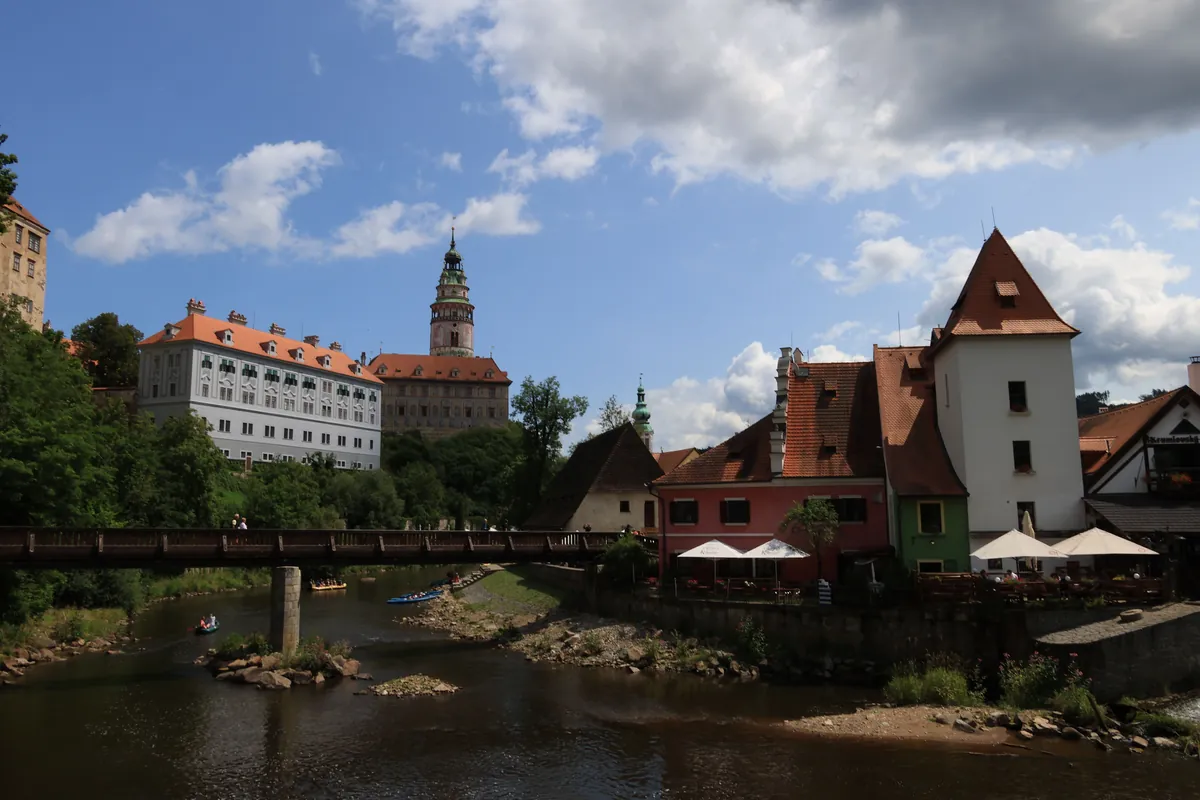
Český Krumlov Castle Town opens at Český Krumlov Castle, first documented in 1253 as a seat of the Vítkovci family, the main branch of the powerful Rosenberg dynasty, who took control after 1302 and carried out a major Renaissance renovation under William of Rosenberg. Passed in the 17th century to the Eggenberg family and then, after 1717, to the Schwarzenbergs, the castle grew into the second-largest castle and chateau complex in the Czech Republic after Prague Castle, and was declared a national monument in 1989 before its UNESCO World Heritage inscription in 1992. Its Baroque theatre of 1767, reached across a five-storey Cloak Bridge spanning a deep moat, is considered one of the best-preserved Baroque theatres anywhere in its original form, comparable only to Sweden's Drottningholm Palace Theatre and the Margravial Opera House.
Below the castle walls flows the Vltava, the longest river in the Czech Republic and, at 431 kilometres including its Teplá Vltava headwater, often called the country's national river; it rises on the slope of the Černá hora mountain in the Bohemian Forest before running north through Český Krumlov, České Budějovice and Prague to join the Elbe at Mělník, dropping just over 1,000 metres from source to mouth. The stretch around Český Krumlov, from Vyšší Brod to Boršov nad Vltavou, is a popular destination for river tourism, and downstream nine hydroelectric dams built since the 1930s — among them the Lipno and Orlík reservoirs — regulate a flow that has nonetheless flooded the valley repeatedly, most severely in August 2002, when floodwaters seriously weakened Prague's Charles Bridge; the river has also inspired Bedřich Smetana's symphonic poem Vltava, a musical portrait of its course through Bohemia.
A short walk through the old town leads to the Egon Schiele Art Centrum, a museum and gallery in Krumau devoted to the Austrian painter Egon Schiele, established in 1992 through the joint effort of a group of Czechs, Austrians and Americans. It has held a permanent exhibition of Schiele's own work since 1993, alongside annual rotating displays of other 20th-century artists that have included Picasso, Dalí and Klimt.
The route closes in the Bohemian Forest, known in Czech as Šumava, a low mountain range up to 50 kilometres wide that forms a natural border between the Czech Republic, Austria and Germany and gives rise to the Vltava, Otava and Úhlava rivers. One of the oldest ranges in Europe, its rounded, sparsely populated peaks reach 1,378 metres at Plechý on the Czech side, and its position along the Iron Curtain through much of the 20th century left large areas free of settlement, helping preserve forest ecosystems now protected within Šumava National Park and a UNESCO Biosphere Reserve; more than 500 kilometres of marked hiking trails and numerous glacial lakes make it, alongside the castle town below, one of South Bohemia's principal outdoor destinations, closing a four-day route that has run from a 13th-century fortress to the wooded frontier hills behind it.
Text adapted from the linked articles under CC BY-SA 4.0; edited for length.
Every dimension the Taro team tags this pack with — filter by any of these on the packs page.
Share your travel month, group size, budget comfort, and must-do experiences. The Taro team will shape the right route before any payment conversation.