Arctic Svalbard Polar Bears
8DFrom ₹6,85,000
A 7-day premium trip to Paphos, Cyprus, taking in Troodos Mountains, Kykkos Monastery, Omodos village and Painted Churches of the Troodos.
Cyprus Troodos Mountains & Villages opens across the Troodos range, the largest mountain range in Cyprus, covering roughly a third of the island and rising to 1,952 metres at its highest peak, Mount Olympus. Known since antiquity for copper mines that once supplied the entire Mediterranean, the range became a centre of Byzantine art from the Byzantine period onward, as monasteries and churches were built away from the island's exposed coastline; geologically, Troodos preserves an undisturbed ophiolite sequence, exposed rock from an ancient magma chamber whose study by geologist Ian Graham Gass and colleagues contributed evidence toward the modern theory of seafloor spreading. Nine Byzantine churches and one monastery scattered across the range together form a UNESCO World Heritage Site first inscribed in 1985, and the mountains' forests, dominated at altitude by Anatolian black pine and the endemic Cyprus cedar, shelter the endangered Cyprus mouflon alongside Bonelli's eagle and the Eurasian griffon vulture.
From the high range the route reaches Kykkos Monastery, one of the wealthiest monasteries in Cyprus, set at 1,318 metres on the range's northwest face some 20 kilometres west of Pedoulas. Tradition holds it was founded at the end of the 11th century by the Byzantine emperor Alexios I Komnenos, after the Byzantine governor of Cyprus, having mistreated a hermit named Esaias living on the mountain, fell gravely ill and was cured only once he had the icon of the Virgin — said to have been painted by the Apostle Luke — brought from Constantinople to Cyprus; the icon has been kept at Kykkos ever since, its top half permanently veiled, and the current church dates to 1745 after earlier buildings burned down three times. The monastery was also where Archbishop Makarios III, the first president of Cyprus, began his ecclesiastical career as a young monk in 1926, and his grave lies today at Throni, three kilometres to the west.
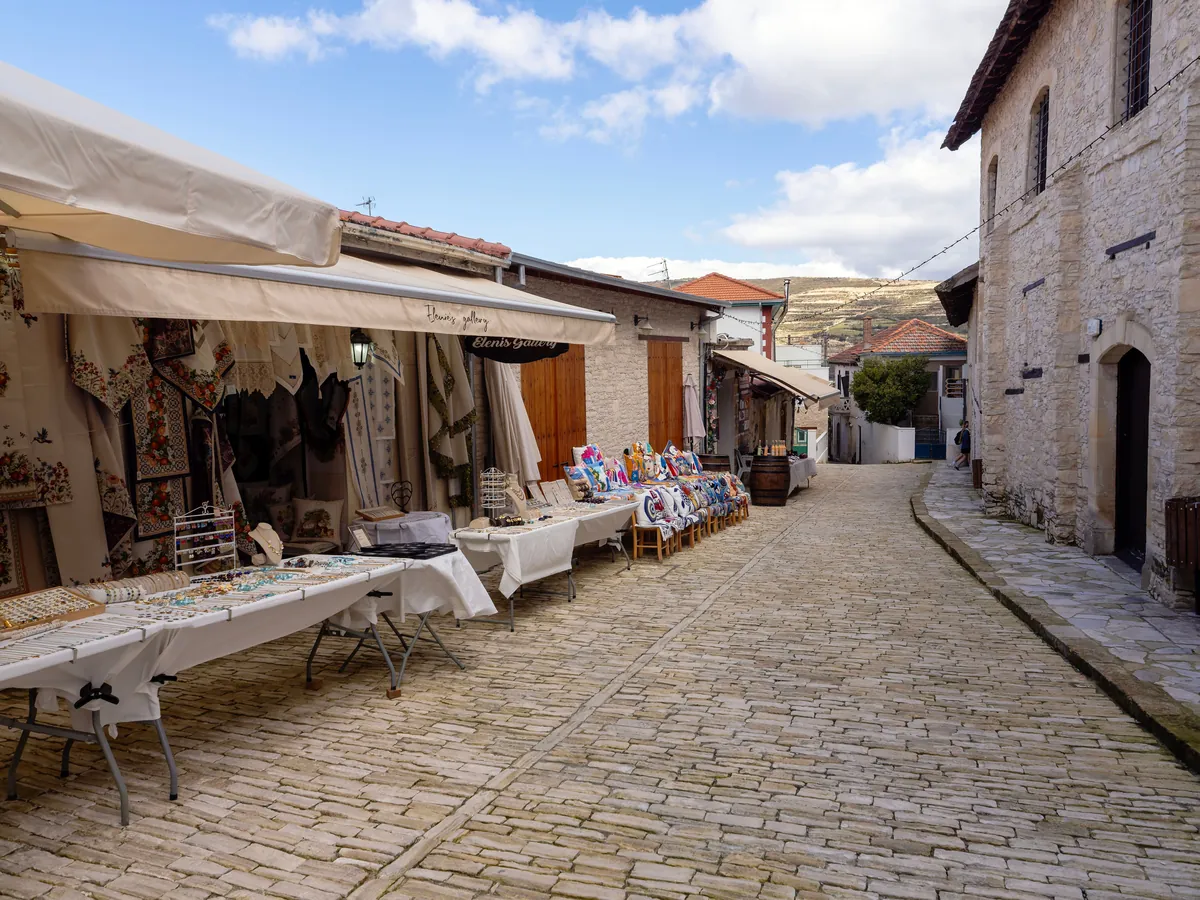
The trip continues to Omodos, a village in the Troodos Mountains of the Limassol District, some 80 kilometres from Nicosia, its stone lanes and vineyard-covered hillsides typical of the wine-producing villages scattered across the range's southern slopes.
The route closes among the Painted Churches in the Troodos Region, a UNESCO World Heritage Site comprising ten Byzantine and post-Byzantine churches and monasteries scattered across the mountains, richly decorated with murals spanning five centuries from the annexation of Cyprus by the Byzantine Empire in 965 AD onward. Among them, the Church of Agios Nikolaos tis Stegis at Kakopetria holds the oldest surviving katholikon in Cyprus, dating to the 11th century, while the 13th-century Church of Panagia tou Arakou at Lagoudhera and the 12th-century Church of Panagia Phorviotissa at Asinou preserve some of the finest surviving Byzantine wall paintings on the island; nine of the ten churches were inscribed by UNESCO in 1985, with the church at Palaichori added in 2001. Distinguished across the region by their steep-pitched, tiled wooden roofs — a local adaptation found nowhere else in the former Byzantine world — the painted churches close a seven-day route through the mountains, monasteries and wine villages of central Cyprus.
Text adapted from the linked articles under CC BY-SA 4.0; edited for length.
Every dimension the Taro team tags this pack with — filter by any of these on the packs page.
Share your travel month, group size, budget comfort, and must-do experiences. The Taro team will shape the right route before any payment conversation.

