Abu Dhabi + Yas Island
5DFrom ₹1,05,000
Angkor Wat sunrise + Sihanoukville beaches.
Cambodia Temples + Beach is based in Siem Reap, Cambodia's second-largest city and the capital of Siem Reap province in the country's northwest. During the Angkor period the site is thought to have been the town of Dvijendrapura, its former location probably marked by the old temple of Prah Einkosei, and its modern name is generally taken to mean "defeat of Siam," a reference — probably apocryphal — to the centuries-old conflict between the Siamese and Khmer kingdoms. Over 7 days the pack moves through three temples of the wider Angkor complex before finishing on the coast.
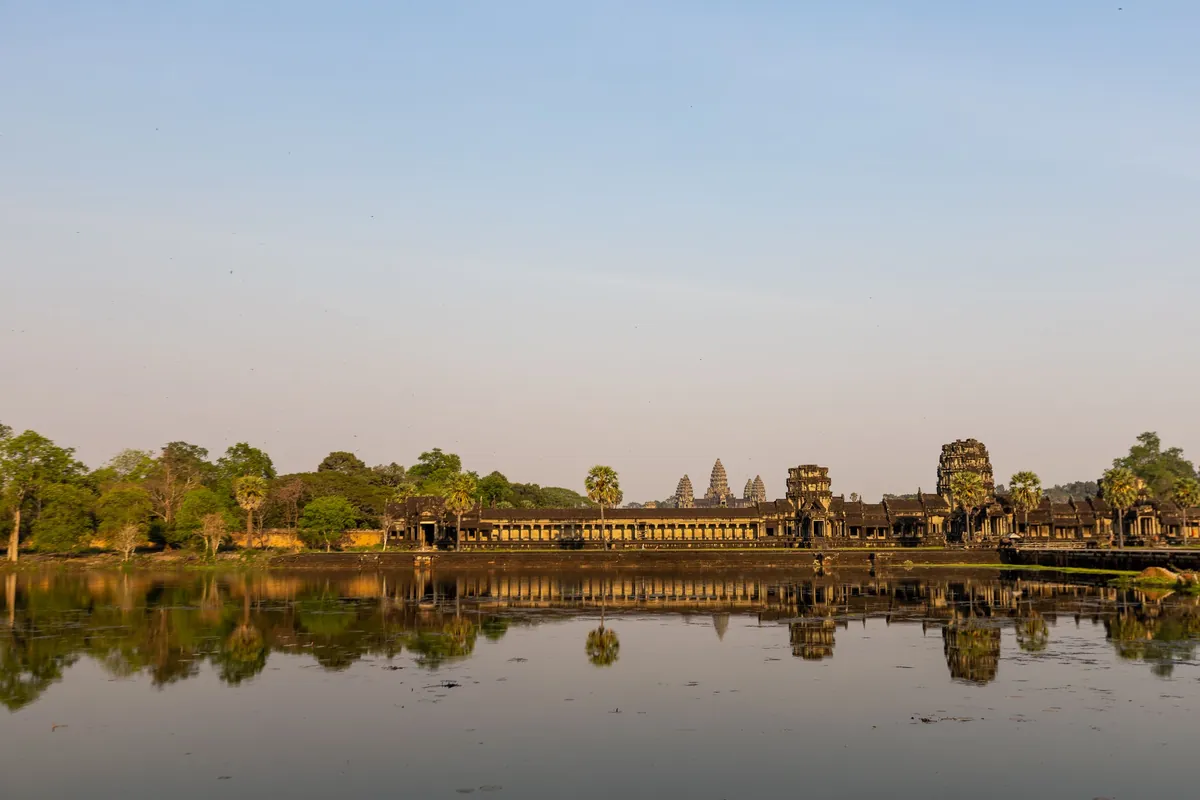
Angkor Wat, the pack's sunrise temple, is a Vaishnava Hindu and Theravada Buddhist temple complex covering 162.6 hectares within the ancient Khmer capital, and the largest religious complex in the world. It was commissioned by the Khmer king Suryavarman II in the early 12th century at Yaśodharapura, present-day Angkor, with construction running from 1122 to 1150 CE. Its name means "Temple City" or "City of Temples" in Khmer — "Angkor" a vernacular form of the Sanskrit and Pali word for "city," and "Wat" the Khmer word for temple.
The Bayon, home to the pack's carved temple faces, is a richly decorated Theravada Buddhist temple built in the late 12th or early 13th century as the state temple of King Jayavarman VII, standing at the centre of his capital, Angkor Thom. Its original name, Jayagiri, means "Victory Mountain" or "Mountain of Brahma," and it was the last state temple built at Angkor and the only one built primarily to worship Buddhist deities, though it also encompassed a great many minor and local deities representing the different districts and cities of Jayavarman's realm.
Ta Prohm, the pack's tree-temple, sits about a kilometre east of Angkor Thom on the southern edge of the East Baray, built largely in the late 12th and early 13th centuries and originally named Rajavihara, "monastery of the king." It was founded in 1186 as part of a massive construction programme launched by Jayavarman VII, and after the fall of the Khmer Empire in the 15th century it stood abandoned and neglected for centuries until the École française d'Extrême-Orient took charge of its restoration in the early 20th century as conservation work began across the wider Angkor complex.
The pack closes at Otres Beach, part of Sihanoukville, a coastal port city on a peninsula at the southern tip of the Gulf of Thailand and the capital of Preah Sihanouk Province. Its Khmer name translates to "City of the Holy Sihanouk," honouring King Norodom Sihanouk, who reigned from 1941 to 1955 and again from 1993 to 2004 and is revered as the father of modern Cambodia. The port here has a long, contested history of its own — a Siamese fleet burned the port of Kompong Som in 1717 during the Nguyen–Siamese War before being defeated by Vietnamese forces nearby, and under French rule from 1863 the coastal region was administered from Kampot as part of a single French Indochina spanning Vietnam, Laos and Cambodia — a very different register of history from the temple stops that came before it.
Text adapted from the linked articles under CC BY-SA 4.0; edited for length.
On documentation, this trip sits in the on-arrival visa-complexity band — treat that as a planning signal only, and verify exact, current requirements with the relevant embassy or consulate before booking. It runs 7 days, from ₹58,000 per person.
Every dimension the Taro team tags this pack with — filter by any of these on the packs page.
7 days across Cambodia, starting from ₹58,000 per person.
Suited to Couples and Friends, with a suitable option for families and a moderate activity level.
This trip is typically handled on arrival, going by this trip’s visa-complexity band. Always confirm exact, current requirements with the relevant embassy or consulate before booking — this is a planning signal, not a legal statement.
Share your travel month, group size, budget comfort, and must-do experiences. The Taro team will shape the right route before any payment conversation.