Abu Dhabi + Yas Island
5DFrom ₹1,05,000
Tiger's Nest hike, Punakha dzong, traditional hot stone bath.
Bhutan Happiness Trail is based in Paro, the seat of Paro District in the Paro Valley and home to Paro International Airport, Bhutan's only international airport and an airfield sometimes described as one of the world's most demanding for commercial pilots, its single runway threading between Himalayan peaks as high as 5,500 metres. The town itself is dotted with sacred sites and historical buildings — the 15th-century Dungtse Lhakhang temple and the Ugyen Perli Palace, where the royal family lodges when in Paro, both stand near the town's new bridge, close to the old bridge and the Rinpung Dzong. Across 7 days the trail moves from that historic base up to a cliffside monastery, into a river-valley fortress, through a traditional wellness custom, and out to the edge of the country's oldest national park.
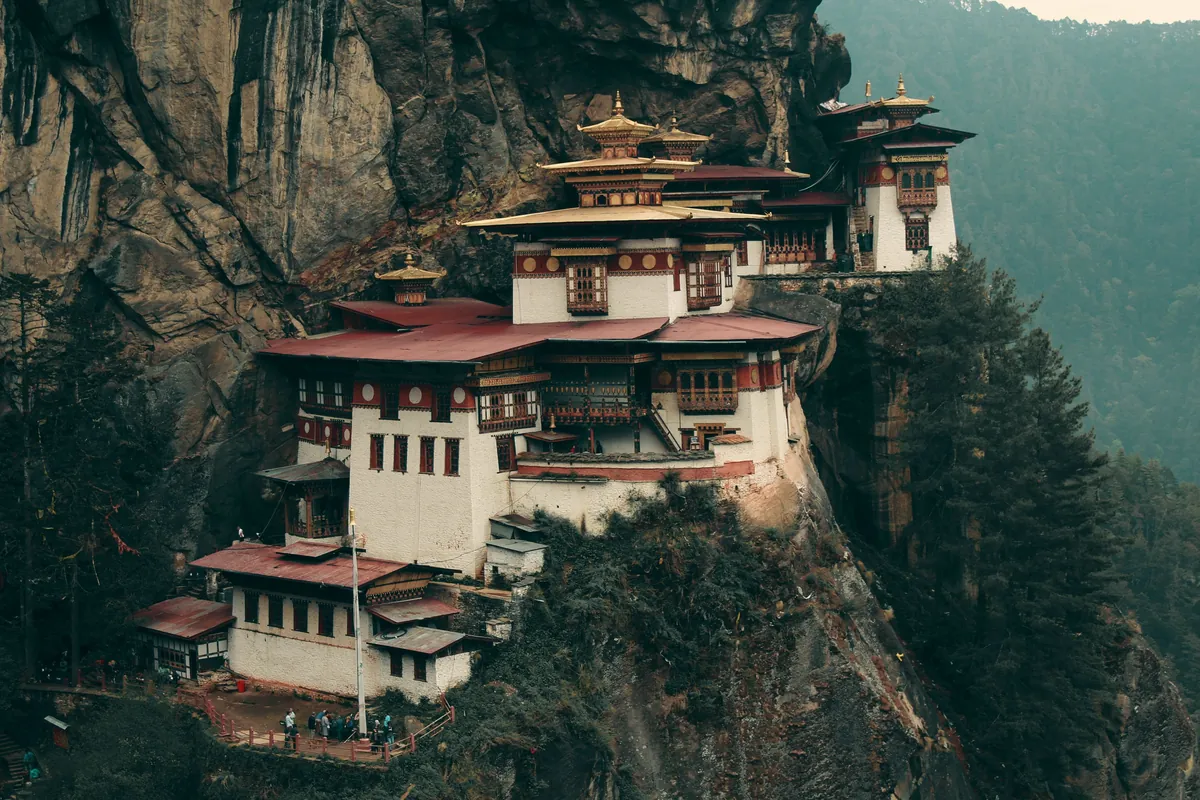
Paro Taktsang, the pack's Tiger's Nest monastery, is a sacred Vajrayana Himalayan Buddhist site built into the cliffside of the upper Paro valley, about 10 kilometres north of Paro town and clinging to a rock face at 3,120 metres, roughly 900 metres above the valley floor — one of thirteen "Tiger's Nest" caves across historical Tibet where the tantric master Padmasambhava is said to have practised and taught. According to the site's own namthar, or hagiography, Padmasambhava — also known as Guru Rinpoche — flew to the location from Singye Dzong on the back of a tigress, took on the wrathful form of Dorje Drolo, and meditated in the cliffside cave to subdue the malicious spirits believed to inhabit the area. A fire in the main building in 1998 destroyed part of the historic complex, since restored, though the cliffside cave where Padmasambhava is said to have first arrived remains one of the site's most sacred points.
From Paro the trail continues to Punakha Dzong, also known as Pungthang Dewa Chhenbi Phodrang, the administrative centre of Punakha District, built between 1637 and 1638 by Ngawang Namgyal, the first leader of a unified Bhutan, to designs by the architect Zowe Palep. It is the second-oldest and second-largest dzong in Bhutan and one of its most striking structures, standing at an elevation of 1,200 metres between the Pho Chhu, or "male," and Mo Chhu, or "female," rivers — the Mo Chhu fed from the northern hills of Lingshi and Laya and from Tibet, the Pho Chhu fed by glaciers in the Lunana region. In more recent history, it was the venue for the wedding of Bhutan's Druk Gyalpo, Jigme Khesar Namgyel Wangchuck, to Jetsun Pema, on 13 October 2011.
The trail also builds in time for a traditional Bhutanese hot stone bath, a wellness custom that sits alongside the dzongs and monasteries as part of the country's everyday cultural life rather than as a separate historical site in its own right.
The trip's final stretch reaches the edge of Royal Manas National Park, Bhutan's oldest national park, which the Royal Government describes as the "conservation showpiece of the Kingdom" and a "genetic depository" for valuable plant species. Covering 1,057 square kilometres across eastern Sarpang District and beyond, it was one of the earliest priorities of the Bhutan Trust Fund in the early 1990s, receiving infrastructure investment and baseline biological and socio-economic surveys, and Bhutan's first park management plan was written for Royal Manas before being used as the model for managing the country's other parks.
Text adapted from the linked articles under CC BY-SA 4.0; edited for length.
On documentation, this trip sits in the most involved, embassy visa-complexity band — treat that as a planning signal only, and verify exact, current requirements with the relevant embassy or consulate before booking. It runs 7 days, from ₹1,45,000 per person.
Every dimension the Taro team tags this pack with — filter by any of these on the packs page.
7 days across Bhutan, starting from ₹1,45,000 per person.
Suited to Couples and Friends, with a suitable option for families and a moderate activity level.
This trip typically needs an embassy-arranged visa ahead of travel. Always confirm exact, current requirements with the relevant embassy or consulate before booking — this is a planning signal, not a legal statement.
Share your travel month, group size, budget comfort, and must-do experiences. The Taro team will shape the right route before any payment conversation.