Argentina Buenos Aires + Patagonia
11DFrom ₹2,45,000
A 5-day premium city break in Buenos Aires around its tango halls and historic barrios.
The nights in Buenos Aires begin at Teatro Colón, an opera house that National Geographic has ranked among the world's ten leading venues for opera, and whose acoustics a survey of international opera and orchestra directors by the acoustics expert Leo Beranek rated the finest for opera and second-finest for concert performance anywhere. The present building, on Plaza Lavalle, replaced an original 1857 theatre that had operated for thirty years on the Plaza de Mayo; construction of the new house began in 1889 under the architect Francesco Tamburini and took nearly twenty years to complete, finally opening on 25 May 1908 with a production of Verdi's Aida. Its horseshoe-shaped auditorium seats 2,487, slightly more than London's Royal Opera House, beneath a chandelier of 700 light bulbs, and across the twentieth century its stage hosted figures from Arturo Toscanini and Enrico Caruso to Anna Pavlova and Maya Plisetskaya. A three-year, $100 million renovation completed in the 2000s restored the house after a long period of decline tied to Argentina's economic difficulties.
The old barrio of San Telmo, the oldest neighbourhood in Buenos Aires, grew up in the seventeenth century as San Pedro Heights, home to the city's dockworkers and brickmakers and the site of its first windmill and brick kilns; the wool, hides and leather that were colonial Argentina's chief exports were prepared and stored here. It was formally incorporated into the city in 1708, and by the mid-twentieth century had become a bohemian quarter of painters' studios and jazz clubs — one of the neighbourhoods credited with tango's early development — a character that survives today in its cobblestone streets, antique shops and the long-running Feria de Antigüedades antiques fair in Plaza Dorrego.
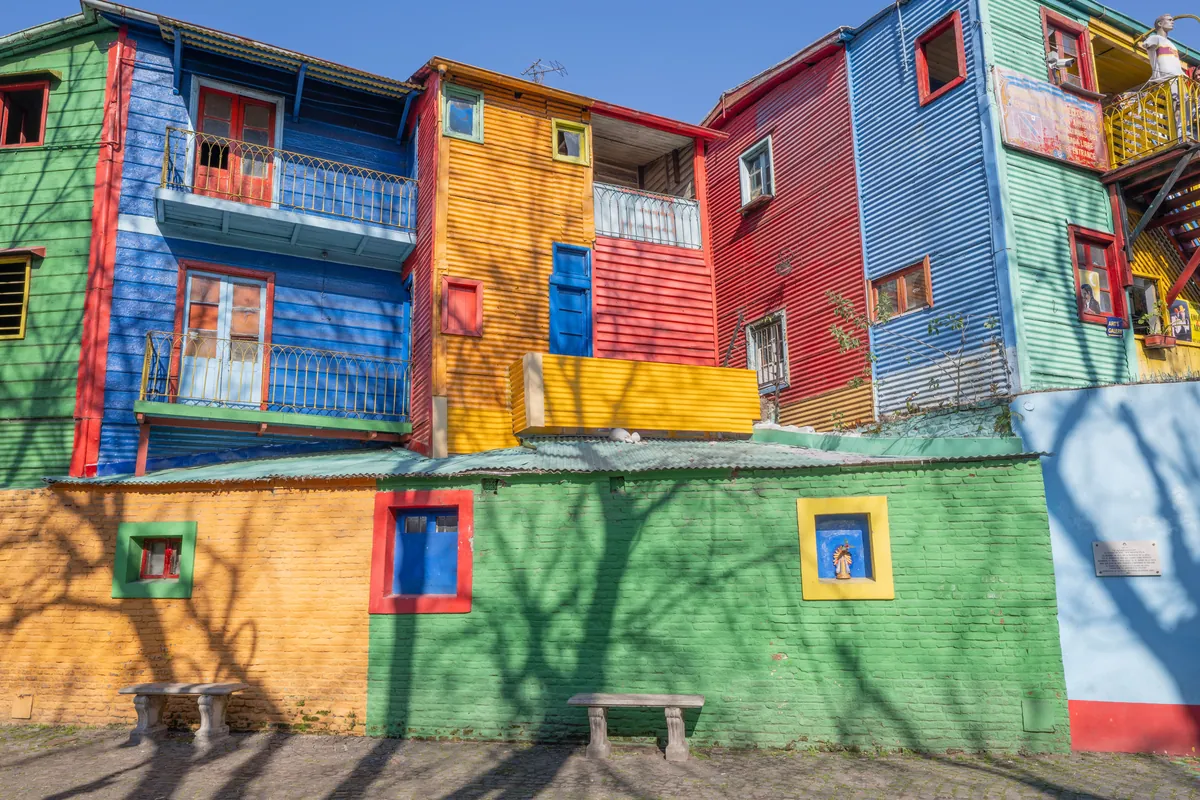
The colourful La Boca quarter, in the city's southeast near the old port, took shape as a melting pot for the European and Asian immigrants who arrived in Argentina through the twentieth century, many of them from the Italian region of Liguria; that mix of arrivals made La Boca a cornerstone of porteño culture and another site central to tango's early history. In 1882, after a prolonged general strike, the neighbourhood briefly seceded from Argentina and raised the flag of Genoa, before it was personally torn down by then-president Julio Argentino Roca. La Boca is known today above all as home to the Boca Juniors football club, whose stadium, La Bombonera, anchors the neighbourhood's identity.
La Recoleta Cemetery, in the Recoleta neighbourhood, grew out of the garden of a Recollect Franciscan convent founded in the area in the early eighteenth century; when the religious order was disbanded in 1822, the garden became Buenos Aires' first public cemetery, opened that November as the Cementerio del Norte. Set on 5.5 hectares, it now holds 4,691 above-ground vaults, 94 of them declared national historical monuments, including the graves of Eva Perón, several Argentine presidents and the founder of the Argentine Navy, in a dense arrangement of marble mausoleums built between 1880 and 1930 in styles from Art Nouveau to Neo-Gothic, much of the material imported from Paris and Milan. The BBC named it one of the world's outstanding cemeteries in 2011.
Across the nights, the route traces tango's own geography through the city: the grand opera stage of Teatro Colón, the working port-side barrios of San Telmo and La Boca where the dance took shape among dockworkers and immigrant communities, and the marble avenues of La Recoleta where many of the same era's leading figures are now buried. Each stop belongs to the same wave of nineteenth- and twentieth-century growth that built modern Buenos Aires.
Text adapted from the linked articles under CC BY-SA 4.0; edited for length.
Every dimension the Taro team tags this pack with — filter by any of these on the packs page.
Share your travel month, group size, budget comfort, and must-do experiences. The Taro team will shape the right route before any payment conversation.