Abu Dhabi + Yas Island
5DFrom ₹1,05,000
A 4-day premium trip to Al Zubarah, Qatar, taking in Al Zubarah Fort, Al Zubarah archaeological site, Al Khor Island mangroves and Al Thakira mangroves.
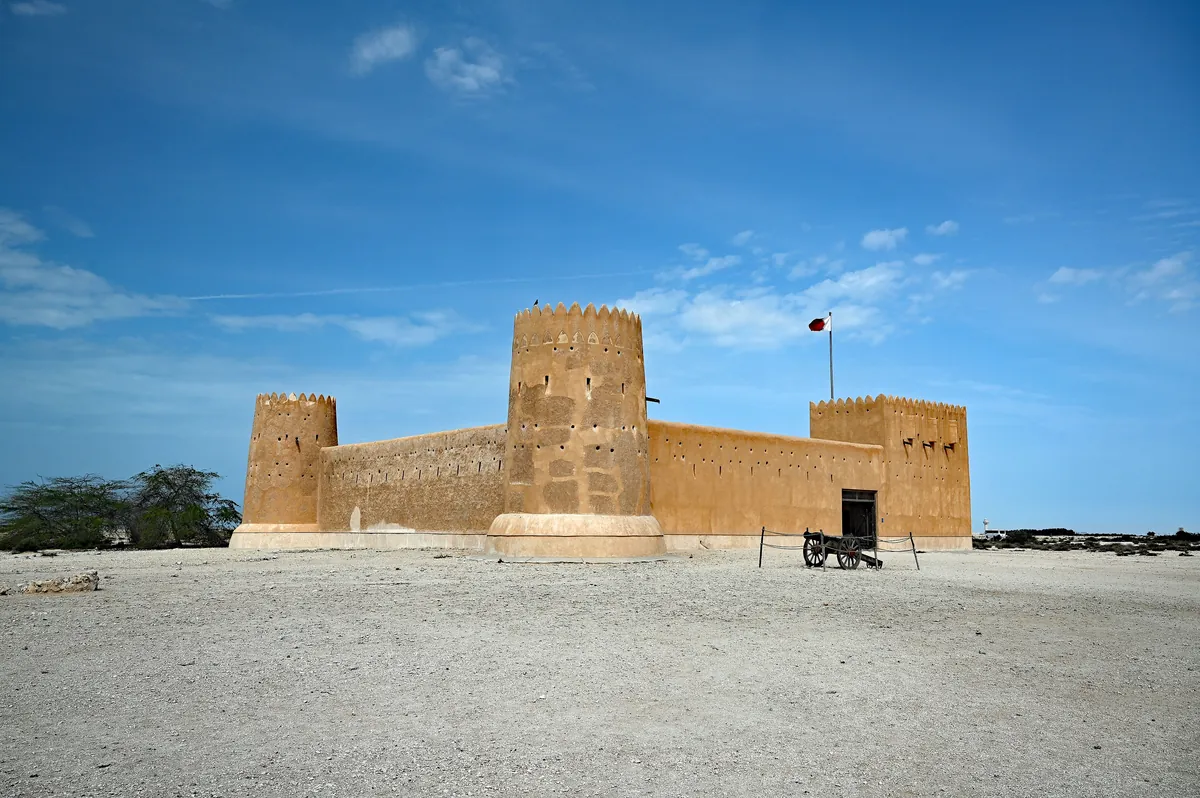
Al Zubarah Heritage & Desert opens at Al Zubara Fort, a square-plan coastal fortress built in 1938 under Sheikh Abdullah bin Jassim Al Thani in the aftermath of the 1937 Qatari–Bahraini conflict, using materials salvaged in part from the earlier ruined Qal'at Murair. Its metre-thick walls, stacked from coral rock and limestone bound with mud and coated in gypsum plaster, rise to three round corner towers with Qatari-style battlements and a fourth, rectangular tower fitted with machicolations, enclosing a courtyard with a 15-metre well; eight ground-floor rooms that once housed soldiers now hold museum exhibits. Restored in 1987 and again from 2011 under the Qatar Museums Authority, the fort served originally to guard Qatar's northwest coast and later as a coast guard station into the 1980s, before becoming, after Zubarah's UNESCO listing in 2013, the archaeological site's visitor centre.
Surrounding the fort lies the Al Zubarah archaeological site itself, a 400-hectare ruined town founded by the Bani Utbah tribal confederation after their mid-18th-century migration from Kuwait and inscribed as a UNESCO World Heritage Site in 2013 for its unusually intact 18th- and 19th-century urban layout. At its peak the town held an estimated 6,000 to 9,000 residents inside a fortified perimeter defended by a 2.5-kilometre wall studded with 22 semi-circular towers, its streets and courtyard houses built from local stone and coated in gypsum plaster, centred on a souq and a 110-by-110-metre palatial compound of nine interconnected courtyard complexes. Positioned midway along Gulf trade routes and close to rich pearl beds, Zubarah grew into one of the region's principal pearling and trading emporiums, drawing merchants and ceramics from as far as East Asia, Persia and Europe, before wars, sieges and a failing water supply led to its decline and eventual abandonment over the 19th and 20th centuries; excavations since the 1950s, intensified under the Qatar Islamic Archaeology and Heritage Project from 2009, have uncovered date presses, pearling tools and the largest date-pressing complex yet found in the region.
North along the coast, Al Khor Island — also called Jazirat bin Ghanim, or Purple Island — sits about 50 kilometres north of Doha in a sheltered bay overlooked by the city of Al Khor, reached across a tapered dirt causeway that crosses several tidal streams. The island holds Qatar's only archaeological site attributable to the second millennium BC, including evidence of a Kassite-run purple dye industry active from roughly 1400 to 1100 BC, where some three million crushed murex snail shells were recovered alongside Kassite pottery — among the earliest known production sites for the shellfish dye later called Tyrian purple. Later occupation layers span the Sasanian period and the late Islamic era up to 1900, while today the island's mangrove forest along its southeast and east coasts, together with its limestone outcrops and beachrock formations, make it one of the country's most visited natural sites.
The route closes among the mangroves of Al Thakhira, a coastal town roughly 60 kilometres from Doha founded by the Al Muhannadi tribal confederation in the mid-18th century, whose early residents lived by pearling and fishing much as J.G. Lorimer's 1908 Gazetteer described — some 300 houses, fifteen pearl boats and divers who worked productive beds for two or three days at a time before moving on. Together with neighbouring Al Khor, roughly 1,392 hectares of mangrove line this stretch of coast, the densest such habitat in Qatar, protected in part within the Al Thakhira Nature Reserve established in 2006 around the small mangrove-covered island of Umm Al Far. The reserve's waters and the nearby ten-kilometre Al Thakhira Beach draw kayakers, fishers and bird watchers who come for herons, terns and egrets, and nesting sea turtles in late spring and early summer — a four-day route running from a restored pearling-era fort through a UNESCO-listed ruined city to the mangrove channels of Qatar's northeast coast.
Text adapted from the linked articles under CC BY-SA 4.0; edited for length.
Every dimension the Taro team tags this pack with — filter by any of these on the packs page.
Share your travel month, group size, budget comfort, and must-do experiences. The Taro team will shape the right route before any payment conversation.